Why the Right Should Celebrate the UT-Austin Football Photo
For decades, conservative and libertarian legal activists worked to ban race preferences in admissions. They won.
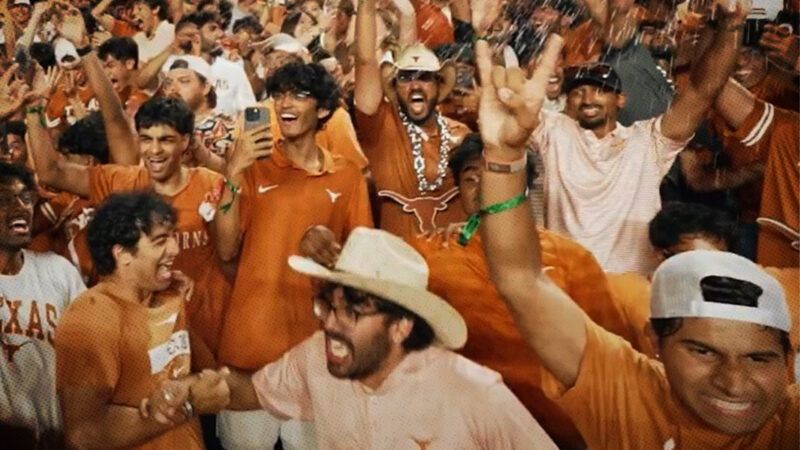
A photo of University of Texas at Austin students celebrating the Longhorns' come-from-behind victory over Ohio State University last weekend went viral on X—and for all the wrong reasons. Bo French, a Republican candidate for Texas railroad commissioner, chose to ignore those positive vibes (Texas was down 20 points in the final quarter, and won anyway), and instead commented on the racial makeup of the Longhorns' cheering section.
I heard UT graduation this year looked like this. I didn't believe it. The problem is now obviously far worse than anyone imagined. pic.twitter.com/Ys1bql0y4U
— Bo French (@bofrench) September 13, 2026
"The problem" to which French referred is apparently that there are too many non-white Texas students, particularly students of Indian heritage. In case there was any confusion about what he meant, French followed up with this observation:
"I cheered the win for the team," he wrote. "It was a great game. But I weep for the families in Texas who can't get into UT because they prioritize foreigners over Texans. Shame on you for ignoring that fact."
You are reading Free Media from Robby Soave and Reason. Get more of Robby's on-the-media, disinformation, and free speech coverage.
French's observations drew widespread condemnation from many on the right. Radio host Eric Erickson used it as a launching point to scrutinize the white nationalist infiltration of the Republican Party. Karl Rove said he would vote for a Democrat, French's opponent, for only the second time in his life. Ben Shapiro made the entirely valid point that if self-described Republicans have such a problem with Indian over-representation, they're in for a rude awakening when they learn that Vice President JD Vance—the presumed successor to President Donald Trump and a man who is perceived to be ideologically sympathetic to some of their goals—has an Indian wife and half-Indian children.
Other conservatives pointed out the incoherence of being mad that some immigrants don't assimilate rapidly enough—a standard conservative complaint—and then choosing to fume over a photo that shows them proudly participating in one of the most quintessential American traditions: college football, and Texas football at that. Moreover, the students depicted are probably mostly Texans: By state law, UT-Austin is required to maintain a campus population that is overwhelmingly Texan. Just 10 percent of the student body comes from out of state, and even fewer come from outside the country. These students may be of Indian descent, but they are indeed Americans.
Unfortunately, that's not good enough for certain elements of the right. The truth is that French's comments also received plenty of support from conservatives involved with the groups that Erickson called out in his terrific article—the Claremont Institute, American Moment, and others—and also from right-wing commentators like Benny Johnson, Auron MacIntyre, Joel Webbon, etc. In effect, some of the loudest conservative voices on social media obviously agree with French that a photo of non-white kids at the UT-Austin is a symptom of some deeper failure or moral betrayal of white America, one the Republican Party and the conservative movement have failed to prevent. Elite institutions are overrun with people who do not look like white Europeans and who do not practice Christianity, and that's bad, according to these folks.
What's ironic about this whole discussion is that forcing universities to practice race-blind admissions has been a major achievement of the conservative (and libertarian) legal movement. Identitarian right-wingers who now say they lament that the relevant authority figures can't simply prioritize one race (white people) over another (Indians) are the ones betraying their own ideological heritage: The right won the war over affirmative action, and now these people are mad about what that means.
Race Conscious
There's an additional irony here, in that UT-Austin was an important battle along the way to banning race-based admissions. In 2008, Abigail Fisher was denied admission to the school and sued over its race-based admissions policies. At that time, the university automatically accepted the top-performing students from every high school in Texas. Other students could gain admission based on numerous criteria, including grades, leadership qualities, and their race—applicants in this category gained extra points toward admission if they were racial minorities.
The case went to the Supreme Court in 2013, and again in 2016. Fisher lost both times, as the Court maintained that it was OK for universities to consider race if it was just one of many factors. This had long been the Court's opinion; the majority decision in Grutter v. Bollinger (2003) decreed that a racially diverse campus was beneficial to the education experiences of all students, and thus race could be considered for admissions purposes if narrowly tailored.
Most conservatives and libertarians disagreed with these decisions, instead viewing race-conscious admissions as a form of racial discrimination, mainly against white and Asian applicants whose admissions rates fall when administrators were allowed to prioritize underperforming minority groups. And by 2023, the composition of the Supreme Court had changed significantly enough for a majority to agree: In Students for Fair Admissions v. Harvard University, the Court reversed both previous decisions and made race-based admissions effectively illegal. Institutions of higher education can no longer cherry-pick their students in order to achieve their desired racial makeup.
This was a huge achievement, given elite admissions officials' penchant for using crude racial stereotyping to deny admission to very qualified students—usually Asian students—in favor of applicants whose test scores were objectively worse. The race obsessives lost, the individual merit enthusiasts won.
Even before the 2023 decision, Texas Republicans were doing everything in their power to stop the state's schools from practicing race conscious admissions. Current Republican Senate candidate Ken Paxton, Sen. Ted Cruz, and outgoing Sen. John Cornyn all called on the Court to end race-based admissions. Gov. Greg Abbott issued a ban on diversity, equity, and inclusion in education. Republican officials acted swiftly and decisively to make racial considerations a thing of the past.
So, what happens when a university can no longer use crude racial essentialism to pick its student population? Well, only the most academically gifted students get in. Unfortunately for French and other right-wing identitarians, this does not mean you necessarily end up with more white students. High-performing immigrant groups, like Asians and Indians, will scoop up a disproportionate share of the admissions slots on the strength of their test scores and grades. When French and his fellow travelers object to this, they are making mirror-image arguments of progressive educators who long desired to use skin color as a factor toward admission.
It is wrong to make admissions decisions on the basis of race, and enshrining that principle into law was a major achievement of the conservative and libertarian legal movement. It is a good thing that when we look at a photo of university students celebrating their football team beating Ohio State (hooray for them, says this Michigan kid), we know they all got there on their own individual merit: They are neither being punished nor unduly rewarded for some immutable characteristic.
If you object to that, and you also object to the kind of race-based sorting that the progressives were doing, well then, your political project really is just white nationalism—and you don't get to complain when other people on the right try to disassociate from you.
For a longer read on these same themes, you should order this brand new book by Reason's Stephanie Slade: Fusionism, Liberty, Virtue, and the Future of the American Right.
This Week on Free Media
I've been ill this week, and so I've managed to film very little. We'll have Freed Up tomorrow, however, and more Free Media next week. In the meantime, head to the YouTube page and subscribe!
Worth Watching
I just wrapped up my 80,000 rewatch of the television series Lost, which I still say mostly holds up, including the ending. If you haven't revisited the show since then, I'd recommend giving it another try. Contrary to popular belief that the show fails to deliver answers to most of its questions, I would struggle to point to any specific aspect of Lost that is not sufficiently explained by the end. The ability to binge-watch episodes really helps mitigate the feeling that the show is just an endless procession of unaddressed cliff-hangers. Also, in an era when everything on TV is way too dark (and I don't mean in terms of tone), my eyes were very grateful that I could always see what was happening on screen.