

Critics of AR-15 Bans Urge SCOTUS To Reject the 7th Circuit's Distinction Between Civilian and Military Arms
Given the Second Amendment's history, several briefs argue, a gun's suitability for militia service suggests Americans have a right to possess it.
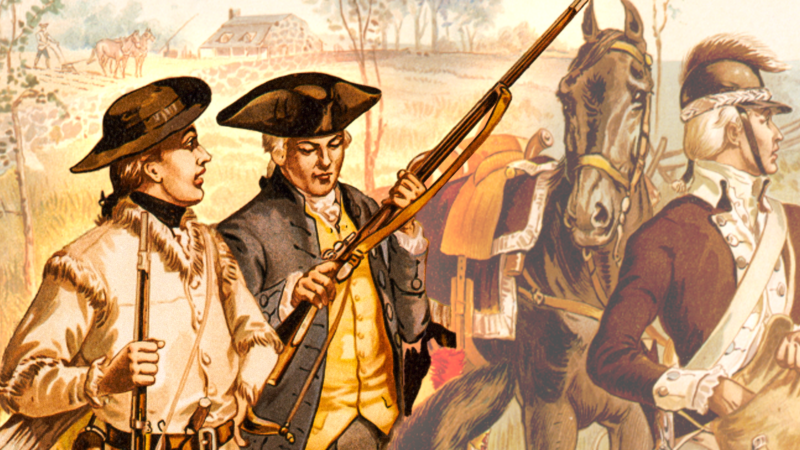
The Second Amendment does not cover "military-grade weapons," the U.S. Court of Appeals for the 7th Circuit averred last year, when it upheld an AR-15 ban enacted by Cook County, Illinois. The ruling reaffirmed the reasoning of a 2023 decision in which the 7th Circuit distinguished between civilian and military arms, saying the "assault weapons" that Illinois had banned "lie on the military side of that line."
That distinction is misguided and ahistorical, Solicitor General D. John Sauer argues in a brief urging the Supreme Court to reject Cook County's rifle restrictions. "The founders would have been astonished at the claim that legislatures may ban arms in common use if those arms can also be used for military purposes," he writes.
Several briefs in that case, Viramontes v. Cook County, elaborate on Sauer's point, highlighting the Second Amendment's connection to "a well regulated militia," which implies that a weapon's usefulness in that context counts in favor of concluding that Americans have a constitutional right to possess it. Relatedly, the briefs note that the Second Amendment's purposes include common defense against invaders, insurrectionists, and tyrants as well as individual self-defense against criminal predators.
The Supreme Court is considering Viramontes along with Grant v. Higgins, which involves a similar Connecticut law. Both laws target "assault weapons," which they define to include AR-15s and similar semi-automatic rifles. Those rifles, the petitioners argue, are plainly covered by the Second Amendment because they are "in common use" for "lawful purposes like self-defense"—the test that the Supreme Court applied when it overturned the District of Columbia's handgun ban in 2008.
The Court's decision in District of Columbia v. Heller focused on the use of handguns "in defense of hearth and home." But as Sauer notes, Heller acknowledged that the Second Amendment also "protects the right to possess arms so that they are available for the common defense—i.e., for 'repelling invasions,' 'suppressing insurrections,' and 'resist[ing] tyranny.'"
The Second Amendment's prefatory clause, which describes "a well regulated militia" as "necessary to the security of a free state," indicates that "the founders codified the right precisely because it would promote 'the security of a free State' by enabling armed common defense," Sauer writes. "The founding generation understood that the individual right to keep and bear arms 'helped to secure the ideal of a citizen militia, which might be necessary to oppose an oppressive military force if the constitutional order broke down.'"
The Cato Institute's brief in Viramontes emphasizes that theme. "Although Heller's holding [regarding] guns in 'common use' for self-defense resolves this case," Cato attorneys Matthew Cavedon, Clark Neily, and Dan Greenberg say, "the Second Amendment protects AR-15s for a further reason: they are suited to the reserve militia"—i.e., "the entire population of 'citizens capable of bearing arms.'"
At the Founding, the "well regulated militia," which was viewed as a safeguard against the dangers posed by a standing army and a potentially oppressive national government, included all able-bodied men, who "were expected to appear bearing arms supplied by themselves and of the kind in common use," as the Supreme Court explained in the 1939 case United States v. Miller. Although Miller upheld the federal ban on short-barreled shotguns, its rationale was that the petitioner had failed to show that such weapons were "part of the ordinary military equipment or that [their] use could contribute to the common defense."
The implication was that arms are covered by the Second Amendment if they meet that test. Cavedon et al. argue that the AR-15 does, as the 7th Circuit implicitly conceded. The features of the AR-15 "align with those of the small arms historically used by the reserve militia," they say, and that counts as "an independent reason for constitutional protection."
In declaring the militia "necessary to the security of a free state," the Framers were not talking merely about repelling invasions or maintaining law and order. "A 'free state' meant a republic or constitutional monarchy, not despotic rule," Cavedon et al. note. "The Amendment checked military power and would deter tyranny."
The Second Amendment "was enacted so 'the people could resist oppression' as well as private violence," Cavedon et al. say, citing a 2014 Indiana Law Journal article by Robert Leider, now a professor at George Mason University's Antonin Scalia Law School. "William Blackstone wrote that the right to keep arms was a way to combat 'the violence of oppression.' Blackstone was alluding to the people's remedy against tyranny: armed resistance."
The Founders were "suspicious of standing armies," Cavedon et al. note. "The reserve militia would reduce 'civil-military tensions' and deter the prospect of devolution into tyranny that was thought to be inherent in democracy. This cultural outlook was a pillar of civic republicanism, and it was meant to ensure that the people 'could readily resist' any government oppression."
Historically, that background guided courts in deciding which arms are covered by the Second Amendment and state analogs. "Even for courts with a relatively narrow understanding of the right to keep and bear arms," Cavedon et al. say, "the suitability of arms for militia use weighed in favor of their protection. Courts consistently protected 'rifles, muskets, and army pistols.'"
The upshot: "Arms suited for militia service are not outside the Second Amendment's protection. Historically, they are at its core. Although the features triggering the bans
at issue here focus more on comfort than on martial effectiveness, the usefulness of such arms for militia service should weigh in favor of Second Amendment protection."
The Cato brief addresses concerns about the potentially "absurd" implications of that principle, such as the possibility that Second Amendment could be construed to protect "the private ownership of nuclear weaponry, warplanes, or ballistic rocketry." Since Heller restricts the Second Amendment to "bearable arms," that scenario seems implausible.
As understood in Heller, the Second Amendment was "not meant to equalize the strength of the reserve militia compared with that of the nation's military," Cavedon et al. write. "Rather, Heller protects Americans by preserving access to 'the sorts of lawful weapons that they possessed at home' for use in militia duty." Although "it may be true that no amount of small arms could be useful against modern-day bombers and tanks," the Supreme Court said in that case, "the fact that modern developments have limited the degree of fit between the prefatory clause and the protected right cannot change our interpretation of the right."
Cavedon et al. add that "semiautomatic rifles using the AR-15 platform," which fire just one round per trigger pull, are "easily distinguishable" from machine guns, which fire continuously. "A restriction on fully automatic firing 'narrowly regulates' a potential use without banning 'an entire class of weapons,'" the brief says. "To recognize constitutional protection for AR-15s is hardly to authorize private armies."
The National Association for Gun Rights (NAGR) likewise argues that the right to arms "secures defense against public violence as well as private violence." And "because deterring tyranny is a purpose of the codified right," the NAGR says, "suitability for militia service places an arm at the Amendment's core."
The Second Amendment Institute (SAI) joins Sauer, Cato, and the NAGR in disputing the distinction drawn by the 7th Circuit. The appeals court mistakenly read Heller as saying "the sole purpose of the Second Amendment was to protect armed self-defense," the SAI's attorney, George L. Lyon Jr., says in the organization's brief. "And it drew a distinction between 'civilian' weapons on one side and weapons 'reserved for military use' on the other."
That analysis turns Miller "upside down," Lyon writes. While Miller "asked whether
the weapon has militia utility as a reason for coverage," he says, the 7th Circuit "treated military utility as a reason for exclusion."
All this talk about the militia as a safeguard against tyranny "may seem quaint," Cavedon et al. concede. "Nonetheless, it is historically true that a people can expect to be disarmed 'when a country is overborne by force.'"
The Cato brief quotes the North Carolina Supreme Court's 1921 decision in State v. Kerner. "The constitutional provision which forbids any prohibition upon the people to bear arms and use them effectively by being accustomed to their use should be strictly and stoutly maintained," the court said, "for we know not when the occasion may again require the assertion of that doctrine which was once familiar throughout this country that 'resistance to tyranny is obedience to God.'"
AR-15s "are the sort of small arms that the Founders expected the American reserve militia to have in the event of such an evil," Cavedon et al. conclude. "In the interim, they have proven an extremely popular choice for other lawful purposes. They are protected by the Second Amendment."




