Do You Have the Right To Possess an AR-15? The Supreme Court Will Soon Decide.
The Supreme Court has agreed to hear a pair of cases involving rifle restrictions imposed by Connecticut and Cook County, Illinois.
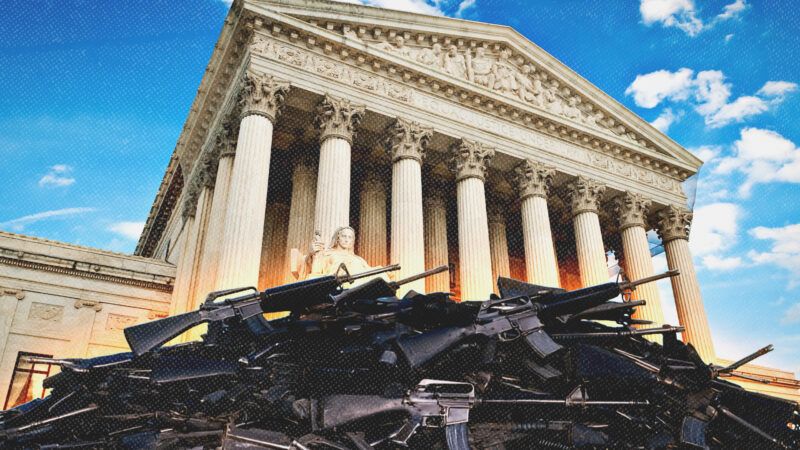
During its next term, the Supreme Court will address the long-simmering question of whether "assault weapon" bans are consistent with the Second Amendment. The answer could have broad implications for other state limits on the arms that residents are allowed to purchase and possess.
A dozen states have enacted bans on firearms that legislators tendentiously describe as "assault weapons," which supposedly are good for nothing but mass murder. These laws typically ban a long list of gun models, along with firearms that meet specified criteria, including semi-automatic rifles that accept detachable magazines and have arbitrarily disfavored features such as folding stocks, pistol grips, and barrel shrouds. The bans encompass some of the most popular guns sold in the United States, including AR-15-style rifles.
The Supreme Court has agreed to hear a pair of cases involving rifle restrictions imposed by Connecticut and Cook County, Illinois. The question presented is whether the Second Amendment guarantees "the right to possess" AR-15s and "similar semiautomatic rifles."
As the plaintiffs see it, the answer is clear. In the landmark 2008 case District of Columbia v. Heller, the Supreme Court said the Second Amendment applies to "bearable arms" that are "in common use" for "lawful purposes like self-defense." The rifles targeted by Connecticut and Cook County plainly fall into that category, since Americans own more than 30 million of them, which they commonly report using for lawful purposes such as self-defense, hunting, and target shooting.
Under the constitutional test established by the Supreme Court's 2022 ruling in New York State Rifle & Pistol Association v. Bruen, Connecticut and Cook County have the burden of showing their laws are "consistent with this Nation's historical tradition of firearm regulation." To pass that test, they will need to cite historical analogs that are "relevantly similar" in motivation and scope.
That will be hard to do. Cook County, for example, invokes "strict historical regulations on gunpowder"—fire-prevention measures that have nothing to do with banning rifle features such as adjustable stocks and muzzle compensators, both of which Cook County has deemed intolerable. And while Heller recognized a "historical tradition" of prohibiting "dangerous and unusual weapons," the Cook County plaintiffs say, "history demonstrates that only arms that are both dangerous and unusual may be banned."
Four justices have indicated they are inclined to view "assault weapon" bans as unconstitutional, while two others are at least willing to question political judgments about the sort of danger that justifies gun restrictions. When you combine those clues with the seemingly straightforward implications of Heller and Bruen, it looks like Connecticut and Cook County will be fighting an uphill battle at the Supreme Court.
This article originally appeared in print under the headline "SCOTUS Takes Up 'Assault Weapon' Bans."