A 90-Day Waiver on Beef Tariffs Won't Rescue America's Cattle Industry
It will take more than three months to fix the problems plaguing the American beef industry.
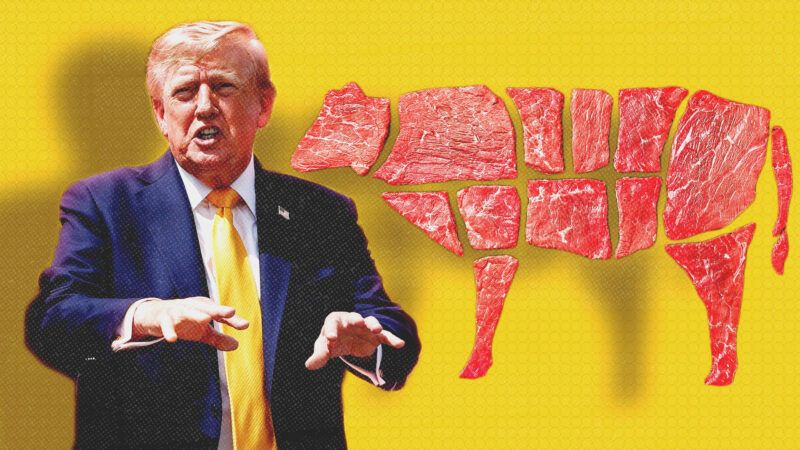
American ranchers have beef with the Trump administration.
Last week, President Donald Trump announced that he would allow imports of "up to 300,000 metric tons of product for ground beef" above the volume limit of the U.S. beef tariff-rate quota system without any tariffs for 90 days. The proposal has drawn the ire of cattlemen, farmers, and lawmakers alike.
In a protectionist bid to preserve her state's share of the American beef industry, Sen. Deb Fischer (R–Neb.) said she was "extremely disappointed" with the plan. Similarly, Sen. John Barrasso (R–Wyo.) said Americans "want U.S. beef on the table—not foreign imports," while Sen. Tim Sheehy (R–Mont.) admitted that while the president's "heart is in the right place," his plan will "make it more difficult for American ranchers to rebuild our herd and bring prices down for the American people."
Under his plan, the president says the imported beef will be "sold at 25 percent below current market prices," though no details have been released. However, CNBC reports the president will "formally sign an executive order on the tariff waiver" in the next two weeks. Altin Kalo, head economist at Steiner Consulting Group, told the outlet that imported beef is already "trading at a steep discount." If that's true, that's good news for consumers who have seen the price of beef increase by 24 percent since the start of Trump's second term. (This has happened even as the U.S. has increased its beef imports from last year by 12 percent.)
However, it's likely bad news for American beef producers. In a statement, Colin Woodall, CEO of the National Cattlemen's Beef Association (NCBA), said the organization was "disappointed by the President's statement."
"While America's cattle producers share the goal of keeping groceries affordable for consumers," he added, "flooding the market with government-subsidized, below-market beef is not the way to rebuild the American cattle herd." Woodall said the plan and "other market interventions" by the Trump administration "throw cold water on the prospect of herd expansion and sacrifices long-term stability for short term messaging." Beef producers in Ohio, Missouri, Texas, and Minnesota issued similar statements denouncing the move as bad for the industry's current prospects and any opportunities for future growth.
Woodall is right that a 90-day easement on tariffs is a short-term solution to the president's political problems that ignores the real culprit behind high beef prices: a supply shortage. The number of U.S. beef cows, calves, and beef cattle in feedlots is down from the previous year, and the U.S. herd is at its lowest point since the 1950s, according to the Department of Agriculture.
With over 79 percent of the beef cattle across America's 26 largest cattle-producing states facing persistent drought and poor weather conditions, rebuilding the U.S. herd would take time and the kind of long-term policy-thinking absent in the Trump administration. This is, after all, the same administration that sent farmers a $12 billion bailout last December "in response to temporary trade market disruptions and increased production costs" caused by the president's trade wars.
Still, the domestic beef industry is not without fault: It cannot meet market demand, yet in a self-serving move, it is determined to keep out competition that would serve its consumers because it no longer has the advantage of tariffs.
Rebuilding America's cattle herds is possible, but it'd require government and beef producers to eschew the easy trappings of subsidies and protectionism. While it recognizes that Trump's latest move is bad for its long-term health, the industry has historically been willing to accept government meddling when it suits its bottom line.
By cutting tariffs to lower the price of beef, the Trump administration is ultimately conceding that tariffs do, in fact, raise prices.
However, the president's approach is shortsighted; if he were serious about lowering prices, he'd ask Congress to lift all tariffs and quotas on beef imports in perpetuity, not just for 90 days. Instead, it seems like a maneuver to boost his party's prospects in the midterms.