This Federal Case Against Minnesota Protesters Is Worth Watching if You Care About Your Civil Liberties
The tentacles of the Trump administration’s domestic spying apparatus are being revealed—and their reach is alarming.
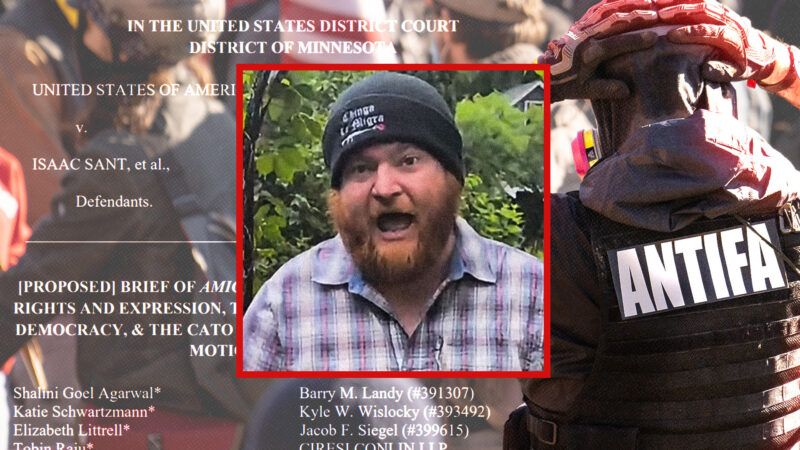
Later today, a federal judge in Minneapolis will hear a motion for discovery in the Minnesota 15 antifa case. If granted, it could eventually reveal just how far the tentacles of the Trump administration's vast surveillance, harassment, and intimidation campaign against its critics in Minnesota reached—and how much of it continues today.
In mid-June, the federal government unsealed an eight-count indictment against 15 activists for allegedly interfering, sometimes violently, with the federal immigration crackdown that roiled the Twin Cities last winter, during which federal agents shot and killed Renée Good and Alex Pretti. One of those indicted, Isaac Sant, faces two counts: conspiracy to impede or injure a federal officer and interstate stalking.
Sant will have his day in court, and if the case goes to trial, a jury will decide whether the government has proved its case beyond a reasonable doubt. But as he and his attorney mount a defense, they have filed a motion for discovery accusing the federal government of "an unprecedented campaign by DHS (Department of Homeland Security) to spy on Minnesotans," based on the government's own initial disclosures.
Alleging that his prosecution is the result of a political witch hunt based on First-Amendment-protected activity, Sant and his attorney, Kevin C. Riach, are asking a federal court in Minnesota to force the government to release any and all communications and materials related to the charges Sant faces. (Earlier this week, Protect Democracy filed an amicus brief in support of Sant's discovery motion on behalf of the Cato Institute, the Society for the Rule of Law, and the Foundation for Individual Rights and Expression.)
What has already been revealed in this case conjures up the ghosts of Sen. Joseph McCarthy (R–Wisc.) and FBI Director J. Edgar Hoover. At the center of it all is Homeland Security Investigations (HSI), the DHS' principal criminal investigative arm, which is acting more like a domestic spy agency than a law enforcement agency bound by the Constitution.
During last winter's Operation Metro Surge, undercover HSI agents surveilled and infiltrated meetings at churches, parks, libraries, schools, and union halls and gained access to encrypted Signal chats under initiatives dubbed "Operation Keyhole," "Operation Puppet Master," and "Project Whipple Shield."
In one incident in February, an undercover agent wormed their way into a meeting at the Prince of Peace Lutheran Church in Roseville, Minnesota, a suburb bordering the Twin Cities. The undercover agent recorded the license plates of activists opposing Immigration and Customs Enforcement (ICE) activity and then matched the plates to their owners, creating dossiers that included names, photos, addresses, and even more intimate details, such as information about their families and employment.
"None of these individuals did anything other than engage in First Amendment speech in a church meeting room," wrote Riach in the discovery motion. "Yet now their personal information is memorialized in a DHS dossier."
During a recent service at the church, interim pastor Steve Sylvester told his congregation that the federal government had surveilled the church last winter. "It feels weird," Sylvester told NPR. "It feels like I'm living in 1950s Eastern Europe." Sylvester's church wasn't the only one under watch in this American remake of The Lives of Others.
In May, another undercover agent wore a wire to a training held at University Baptist Church in Minneapolis and hosted by Left Jab, a lefty mixed martial arts club dedicated to "community self-defense." The surveillance led to some black comedy. "Due to the physicality of the event," reads the HSI report of investigation, the undercover agent's "concealed body-worn audio recorder erroneously fell to the floor of the gymnasium near the end of the training. UCA–5022 briefly left the gymnasium, realized she no longer had the device, and returned to the gymnasium to retrieve the device from the floor."
But Cody Sanders, interim pastor of University Baptist, wasn't laughing. "I do imagine people will look over their shoulder a little more and wonder, 'Is there someone here who's trying to gather information?' Or when they see a strange car in the parking lot," Sanders told NPR. "I hope we can resist the kind of suspicion that this is likely to generate."
But that's a feature, not a bug, of these kinds of police-state tactics. Revelations like these supercharge the corrosive power of paranoia, making people fear that something they say or someone they associate with could land them in a federal database. Constitutional rights don't mean much if you're afraid to exercise them.
The authoritarian tactics, however, don't stop there. Bypassing judicial scrutiny, HSI issued administrative summonses and subpoenas targeting the financial records of labor unions and progressive nonprofits. Without the organizations' knowledge, the agency sought more than three years' worth of records from the Service Employees International Union, Communications Workers of America, and the International Federation of Professional and Technical Engineers. They also sought financial records from the Sunrise Movement and Voices for Racial Justice, both progressive groups.
The federal government itself ties this investigation to National Security Presidential Memorandum–7 (NSPM–7). In HSI's own report of investigation, the synopsis states plainly that the investigation at Prince of Peace church was opened in "accordance with" the memorandum.
Issued by President Donald Trump after the murder of conservative activist Charlie Kirk, NSPM–7 explicitly places political beliefs within its domestic terrorism framework. The policy directive describes "anti-fascism" as an umbrella under which "violent and terroristic activities" occur and lists beliefs such as "anti-Americanism, anti-capitalism, and anti-Christianity," as well as what it calls "extremism on migration, race, and gender," as among the "common threads" animating violent conduct. It then tasks the national and local Joint Terrorism Task Forces with coordinating and supervising "a comprehensive national strategy" and directs the Justice Department to pursue prosecutions.
In her December memo implementing NSPM–7, then-Attorney General Pam Bondi addressed civil liberties concerns in a footnote. "The United States Government does not investigate, collect, or maintain information on U.S. persons solely for the purpose of monitoring activities protected by the First Amendment," the second footnote reads. "No investigation may be opened based solely on activities protected by the First Amendment or the lawful exercise of rights secured by the Constitution or laws of the United States."
When NSPM–7 was issued, civil liberties organizations such as the Foundation for Individual Rights and Expression (FIRE) warned that the policy directive and its implementation would likely lead to the feds investigating government critics for First Amendment-protected activities absent any evidence of criminal wrongdoing. That prediction is now unfortunately coming true, despite the government's assurances it wouldn't cross the line.
In the months and years ahead, activists, journalists, lawyers, and legislators will try to get to the bottom of NSPM-7's vast surveillance apparatus. Time will tell how many Americans were swept into these programs without evidence of wrongdoing and how many were chilled from exercising their rights to free speech and association.
This discovery motion is one of the first attempts to help uncover the truth.