The Backlash Against Data Centers Is Bipartisan, Nationwide, and Wrong
From Texas to Ohio, political candidates are backing voters’ bad arguments for opposing data centers.
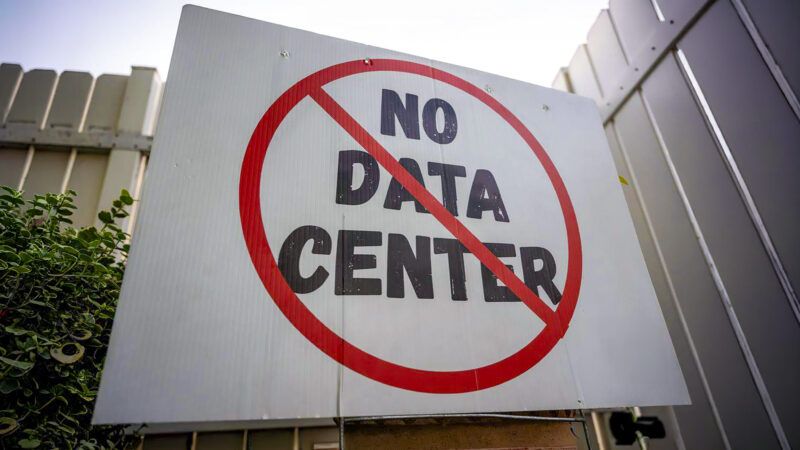
Americans really don't like data centers.
According to a recent poll from Heatmap Pro, 75 percent of Americans "would oppose a new data center being built near where they live." And as the responses from a March Gallup poll show, opponents of these facilities think data centers are noisy, bad for the environment, and bad for property values. Other commonly cited concerns include the data centers' exorbitant water and electricity use.
These would be valid reasons to oppose data centers if they weren't unfounded. Yet, true to form, politicians are trying to capitalize on the misdirected public fury.
On Sunday, Texas Republican Gov. Greg Abbott went on ABC News' This Week with George Stephanopoulos to discuss why he had "pressed pause" on new data center construction in the state. After calling Texas the "epicenter of AI development" last November, Abbott recently mounted an about-face to slow data center buildout in his state. In June, he ordered the Public Utility Commission (PUC) of Texas and the Electric Reliability Council of Texas (ERCOT) to take steps to protect Texas residents "from the costs of data center expansion." In August, Abbott escalated his campaign, directing the PUC and ERCOT to audit all data centers in the process of connecting to the state's electricity grid and pause all new construction until the audit is complete.
The public backlash is understandable, Abbott said, because data centers "pop up in places that nobody ever heard of before, until they started the construction." Of course, considering the reasons people cite for opposing data centers, the middle of nowhere seems the most prudent place to build one.
Abbot also accused developers of not working "in collaboration with the state," or "with local governments," adding they "basically dug their own grave for the problem that's been caused for them, and that's why they got the backlash they deserve." Between zoning laws, environmental impact requirements, and the capital required to develop large infrastructure projects, it's hard to imagine a data center being built without collaboration from state or local government.
In Texas, the city of Temple has five data centers currently approved or under construction. Each project was subject to Temple's "zoning, engineering, utility, fire, building and public review processes," reports KCEN-TV, the local NBC News affiliate. Under its current approval process, the city also requires developers to outline "project-specific standards to establish and address topics such as noise, lighting, landscaping, buffering, traffic and site design."
If jumping through every state and local regulatory hoop isn't collaboration enough, it's unclear what else Abbott would have data center developers do to earn public approval. Apart from the capital they invest in the data center itself, developers have also invested in the communities they're building in.
Meta has committed $1.7 million to funding local school districts and nonprofits in the Temple area and invested $8 million in local infrastructure improvements. Google, which has several data center projects in the state, has started a $10 million Texas Water Impact Fund to offset the water usage of its data centers and has set a goal to replenish more water than its developments consume by 2030. Community improvement sparked by data centers isn't limited to the Lone Star State. In Loudoun County, Virginia, the data center capital of the world, property taxes have dropped by nearly 30 percent over the past decade. In Richland Parish, Louisiana, some teachers will receive bonuses of up to $50,000 thanks to a Meta data center that is still under construction.
Abbott isn't the only governor shifting with public opinion. Last week, Democratic Pennsylvania Gov. Josh Shapiro signed an executive order establishing what he describes as guardrails that will effectively stymie any data center development in the state. It's a far cry from last July when Shapiro gave himself a pat on the back as he touted Pennsylvania's AI readiness. And last month, New York Democratic Gov. Kathy Hochul signed a first-in-the-nation, one-year moratorium on data centers.
The public outcry against data center development is a problem for contenders in political races from the battle for Ohio's Senate seat to the Florida governor's mansion, according to The New York Times. In Texas, where Attorney General Ken Paxton is running for Senate, Paxton has unveiled a preposterous four-point plan to regulate the industry that would make data centers criminally liable for the products their AI customers make.
For its part, the Trump administration has been unequivocal in its support of data centers. In July, the Environmental Protection Agency (EPA) proposed a rule change that would make it easier under the Clean Air Act for data centers to add backup generators to their facilities. The EPA says this will give states and local authorities the discretion to choose "when, and to what extent public participation" is needed to achieve the law's goals. And in a recent interview with Punchbowl News, President Donald Trump said the developments could be "bigger than oil."
Data centers are clearly unpopular. But accepting the flawed arguments of the industry's critics and introducing harmful legislation to ban the technology is tantamount to accepting mob rule.