

Police in Atlanta Settle Eric André Lawsuit, End Airport Drug Searches
While the settlement is a good thing, it's unfortunately still the case that at airports, the Bill of Rights is more of a list of suggestions.
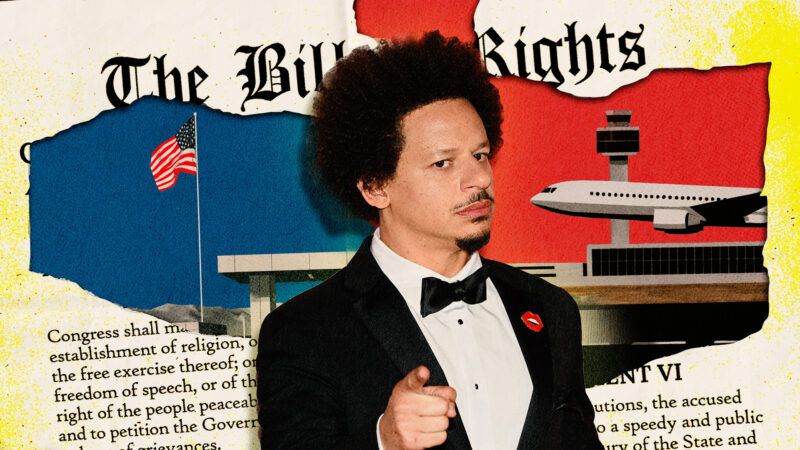
This week, a county police department in Atlanta settled a lawsuit brought by two comedians who were stopped and searched in the city's airport. As part of the settlement, police will no longer conduct such searches.
Unfortunately, airports still occupy a legal gray area where the Bill of Rights is more like a list of suggestions.
"I was just racially profiled by two plain clothes Atlanta PD police in @Delta terminal T3 at the Atlanta airport," comedian Eric André tweeted in April 2021. "They stopped me on the way down the bridge to the plane for a 'random' search and asked [if] they could search me for drugs." Atlanta-based comedian Clayton English later reached out to André and said he had been subjected to the same thing months earlier.
@Atlanta_Police "I was just racially profiled by two plain clothes Atlanta PD police in @Delta terminal T3 at the Atlanta airport. They stopped me on the way down the bridge to the plane for a "random" search and asked they could search me for drugs. I told them no. Be careful.
— Eric Andre (@ericandre) April 21, 2021
As André and English later elaborated in a lawsuit, the stops were part of the "jet bridge interdiction program" at Hartsfield-Jackson Atlanta International Airport, the world's busiest. According to the lawsuit, jet bridge interdictions involve officers from the Clayton County Police Department (CCPD) "waiting in jet bridges—the narrow tunnels that connect airplanes to airport gates—to selectively intercept passengers, take their boarding passes and identifications, interrogate them before they board their flights, and search their carry-on luggage, all in the name of combatting drug trafficking."
CCPD claims the stops are "consensual," which both men disputed. "When two cops stop you, you don't feel like you have the right to leave, especially when they start interrogating you about drugs," André said at an October 2022 press conference when announcing the lawsuit. English added that he felt "completely powerless" during his own stop.
Not only was the jet bridge interdiction program dehumanizing and unconstitutionally broad, but André and English—both of whom are black—said it was racially targeted: During the eight-month period in which they were stopped, "CCPD conducted 378 passenger interdictions in jet bridges where department records list the race of the passenger stopped," the lawsuit noted. "Of those, 56% of stopped passengers were Black," even though "only 8% of American airline passengers are Black."
Even on its face, the program seems particularly ineffectual: After all, targeted passengers have already gone through federally mandated security checkpoints.
In fact, as the lawsuit explained, jet bridge searches only found drugs in three out of 402 stops, and of those, only two resulted in charges.
On the other hand, the program was quite successful at seizing cash from unsuspecting passengers.
"Over the 8-month period in question," per the lawsuit, "the program seized $1,036,890.35 in cash and money orders via 25 civil asset forfeitures (with the seized amount of cash and money orders in each individual case ranging from $10,000 to $118,880). Yet, of the 25 passengers who had cash seized, 24 were allowed to continue on their travels, often on the same flight, and only two were ever charged with any related crime."
This, unfortunately, is not unique to Atlanta: Civil asset forfeiture allows law enforcement agencies across the country to seize large amounts of cash they find in people's possession, under the theory that it must have been involved in illicit activity. The owners must then go to court to prove a negative: that the money was not gained illegally. The practice varies by state, but most states have few if any protections against abuse.
Last year, the Drug Enforcement Administration ended its airport interdiction program after years of lawsuits and allegations of constitutional violations. This week, Clayton County announced it would do the same.
"For the first time, the Clayton County Police Department has publicly confirmed that it has ended the airport interdiction program at the center of the lawsuit," according to a press release from the Policing Project at the New York University School of Law, which was part of the plaintiffs' legal team. "As part of the settlement, the County has also agreed to require all Clayton County Police Department officers assigned to the airport to wear body-worn cameras and to receive training on the constitutional limits governing police encounters in airports."
The county also agreed to pay each comedian $15,000.
While the end of the program is certainly a positive development for travelers, it unfortunately remains the case that constitutional rights do not apply as consistently at airports and border crossings as they do anywhere else.
Though the Fourth Amendment protects against "unreasonable searches and seizures," airport security officials are allowed to conduct "administrative searches" akin to DUI checkpoints or metal detectors. "None of these searches requires either probable cause or a search warrant," University of Michigan Law School professor Eve Brensike Primus wrote in 2012. "Instead, courts evaluating administrative searches need only balance the government's interest in conducting the search against the degree of intrusion on the affected individual's privacy to determine whether the search is reasonable. This reasonableness balancing is very deferential to the government, and the resulting searches are almost always deemed reasonable. As a result, the administrative search exception functions as an enormously broad license for the government to conduct searches free from constitutional limitation."
Even where the Fourth Amendment does apply, government officials often just act like it doesn't, hence the notion of "consensual" searches.
"For too long, federal law enforcement has managed to expand the ever-growing security theater at airports, all while relying on 'voluntary' behavior," Matthew Feeney, then of the Cato Institute, wrote in 2017. "Passengers are not required to go through the body scanner machines at airport security, but you may not have noticed the signs telling travelers that they are free to opt out of the scan. In the post 9/11 world, million of passengers now consider it normal to step into a body scanner in order to get onto a domestic flight. This isn't because of a law requiring that passengers go through the scanners. Rather, it's because enough people go through them without question."
Just this week, Reason's Matthew Petti wrote about his experience reentering the United States, when border authorities detained him for four hours and declined to let him contact an attorney when he asked. "Crossing the U.S. border is the closest most Americans will come to experiencing life under the foreign dictatorships I report on," he wrote.




