

Government Regulations Are Keeping Drone Delivery Grounded
To fly a drone out of sight, you must get airline-level certification, which requires a lengthy approval process from the Federal Aviation Administration.
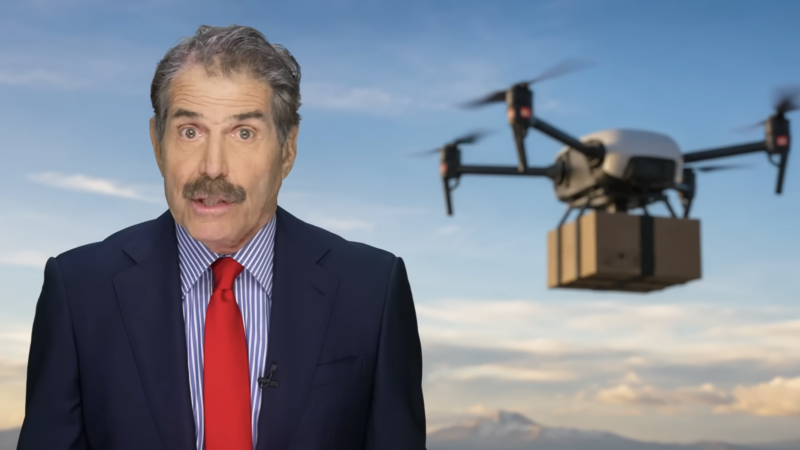
There's a new delivery system in town.
Well, maybe not in your town.
In some places, drones are now allowed to deliver small packages, groceries, and takeout.
Companies like Wing and Zipline bring people hot meals in under 10 minutes.
I had to watch it to believe it. You can see it in my new video.
Drone delivery makes sense. Drones are faster and usually more efficient than sending cars to people's homes—why use a whole car and driver for a single burrito?
Drone delivery was supposed to be common years ago. Jeff Bezos told 60 Minutes he expected Amazon to be sending out drone deliveries by 2017.
But most of us still don't have it. Why?
"Confusing regulations," says Adam Thierer, author of Permissionless Innovation. The Federal Aviation Administration (FAA) declared that drones may not fly "beyond visual line of sight" without special permission.
To fly a drone farther, you must get airline-level certification. The FAA must inspect your facilities, review operating and maintenance procedures, and certify you as an air carrier.
"It takes a lot of work from a company with the size and resources like Amazon to get these limited permits," explains Thierer. "Would the Wright brothers have even gotten into the air if the Federal Aviation Administration existed when they were trying to fly for the first time? Unlikely!"
Because it's so hard to get permission, only eight companies now do drone deliveries.
Of course, some people don't want drones making deliveries near them. I understand why.
Some worry about invasion of privacy, about drones with cameras "spying" on them. Amazon tells people, "Our drones use cameras and other sensors to navigate, sense and avoid obstacles," not to spy.
A bigger problem is that drones are often noisy.
Companies like Wing say they're making drones quieter and released a video about that.
Thierer points out, "We have trucks and delivery men come to our driveways every single day and we've just gotten used to it. There was a time when even that would have been very strange."
"But I don't want all these machines buzzing around my head!" I say.
"You probably don't want noisy trucks coming down your driveway either….It would actually be better and potentially quieter if we had a drone that came from far in the sky and then just came down right on our property….These technologies are so new and different, and then, all of a sudden, they're right in our face, right above us. But guess what? That was the way cars were originally. That was the way trains were."
He's right. When trains were first introduced, some people genuinely believed "women's bodies were not designed to go 50 miles an hour. Our uteruses would fly out of our bodies."
"It was silly," laughs Thierer, "and they're going to freak out a little bit about drones. It's understandable. Then they're going to get used to it because they're going to see them. They're going to bring them into their lives, and things will change."
President Donald Trump hopes to speed that process. He signed an executive order telling the FAA to fast-track drone deliveries by allowing drones to fly beyond line of sight.
But he did that more than a year ago. Government is, as usual, so slow! The FAA didn't even respond to Trump's order for months.
Now they have responded, but only with a proposed change. Who knows when, or if, it will go into effect.
But at least there's now some movement and experimentation.
"If America slows down," says Thierer, "the Chinese will step on the gas. Yes, they're a bunch of communists, but the reality is they've allowed a pretty vibrant marketplace to develop in things like drones."
Three cheers for Amazon, DoorDash Air, Wing, Zipline, DEXA, and drone delivery companies for taking risks to further this technology and make our lives better.
COPYRIGHT 2026 BY JFS PRODUCTIONS INC.




