

1 Year Later, Why Is the National Guard Still in D.C.?
As the National Guard deployment stretches into its second year, questions remain about why the $55 million-per-month show of force is necessary at all.
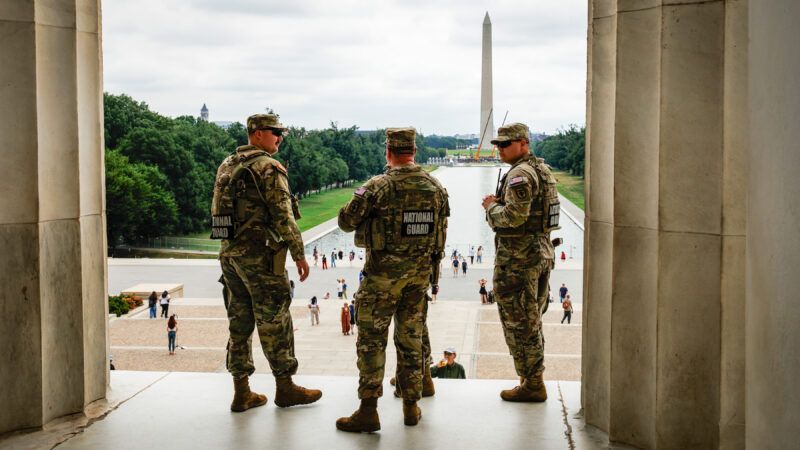
One year ago today, President Donald Trump announced a "public safety emergency" in Washington, D.C., leading to the deployment of nearly 2,000 National Guard members to the nation's capital. But what was meant to be a temporary measure has ballooned into a multiyear campaign costing around $2.1 billion, despite significant drops in crime and ongoing civil liberty concerns.
In August 2025, Trump issued an executive order declaring a "crime emergency in the District of Columbia," following the assault and robbery of Edward "Big Balls" Coristine, a former engineer for the Department of Government Efficiency. Within days, 450 federal law enforcement officers and nearly 2,000 National Guard members, including troops from Republican-led states, were patrolling the streets to "restore law and order" and address "the epidemic of crime in our Nation's capital."
At first, the troops' presence seemed to work as a crime deterrent. As Reason's Katherine Mangu-Ward reported in November 2025, carjackings, assaults, and homicides all dropped in neighborhoods that experienced an increased federal presence. But federalized National Guard members are generally prohibited from acting as domestic law enforcement, and reports soon emerged that the troops were not actually out fighting crime but working as expensive city janitors, picking up trash and raking leaves.
According to the Trump administration, these efforts have been necessary to transform D.C. "from a crime-ridden city into a safe and beautiful haven for residents and visitors alike," crediting the capital's crime reduction to the National Guard's presence. Indeed, in the first five months of 2026, the city saw a 2 percent reduction in violent crime and a 25 percent reduction in property crime compared to the same period in 2025. And as of Tuesday, the overall crime rate was down 20 percent, according to the Metropolitan Police Department.
But criminal justice experts believe that the real driving force behind the crime drop isn't the $55 million-per-month federal surge, but the city's own police department alongside a 9.3 percent drop in violent crime nationwide. "This is happening everywhere," Jeff Asher, a crime analyst, previously told Reason. "You could name dozens of places that are seeing similar drops without any sort of heavy-handed interventions."
Meanwhile, civil liberty advocates have pushed back on the Trump administration's occupation of the city, arguing the deployment is not only illegal and unconstitutional, but could potentially lead to rights violations if untrained military officers conduct law enforcement activities. And more insidiously, the deployment could lay the groundwork for an expansion of federal control over local policing across the country.
Although a federal court preliminarily ruled the deployment illegal last November, the Trump administration has been permitted to keep the National Guard members deployed while the appeals process is pending.
Today, court proceedings are still ongoing, and approximately 4,600 National Guard members are currently in the nation's capital, with plans moving forward to acquire up to 2,000 housing units to support long-term, and more permanent, deployment. And last week, details regarding the future of the deployment provided to Sen. Elizabeth Warren (D–Mass.) revealed an over $1.4 billion plan for roughly 2,500 troops to remain in the city between October 1, 2026 and January 2029.
For now, as the deployment stretches into its second year, it seems D.C. residents have grown accustomed to groups of armed troops roaming the community day and night. But questions remain around why such an expensive show of force is necessary at all without any genuine emergency justifying the National Guard's presence in the capital of the free world.




