FCC Rule Change Would Allow More Broadcast Mergers, but It's Not Clear the FCC Has That Power.
It's not clear if the agency even has the legal authority to make the change. But if it goes through, there's little to worry about.
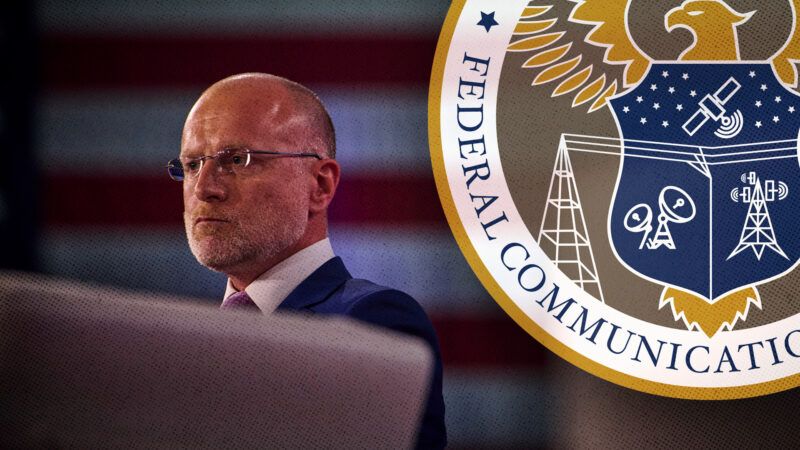
This week, the Federal Communications Commission (FCC) voted to abolish a rule that limited how many broadcast TV stations a single person or company can own.
Some fear the new move will let President Donald Trump's supporters monopolize broadcast TV. It's also not clear if the agency even has the authority to make the change. But if the rule change happens, it's not as big of a problem as it may seem.
"Today, the Federal Communications Commission voted to repeal its 39% national television multiple ownership rule and replace it with a granular, case-by-case review," the agency announced Thursday after its August Open Commission Meeting. "This will empower the FCC to approve deals that promote the public interest while allowing the agency to reject any deals that do not meet that standard."
While the major networks—ABC, NBC, CBS, and Fox—create or license content for broadcast, the local affiliate stations actually air it. In 1985, the FCC chose to "prohibit a single entity from owning television stations that collectively exceeded 25 percent of the total nationwide audience." The agency has since raised that level to 39 percent, where it remained until this week.
FCC Chairman Brendan Carr has long said the cap is outdated. "The broadcast and broader media industry has transformed dramatically in recent years," he wrote last month at Breitbart News. "And the cap no longer constrains the power of national programmers. Instead, it prevents local broadcasters from competing on a level playing field."
While cable channels, streaming services, and podcasts have a potentially unlimited reach, Carr added, "the 39 percent cap continues to apply uniquely to the owners of local broadcast TV stations—forcing the market out of balance. Today, the cap is not protecting local broadcasters, it is preventing them from gaining the same scale that their competitors are free to enjoy."
The FCC voted 2–1 this week to modify the rule, with Anna Gomez, the lone Democratic commissioner, in dissent.
"The FCC's decision to eliminate the 39 percent national audience reach cap is unlawful on its face. Congress set this cap in federal law, and only Congress can change it," Gomez said after the vote. "Eliminating the cap does not free local broadcasters from economic pressure, it just changes who is doing the squeezing. The large station groups positioned to grow even larger under this decision are not local broadcasters, they are national companies that own local stations and increasingly dictate what airs on them."
"Changing this limit requires congressional action, but Carr doesn't care. He'll do whatever it takes to clear the way for Trump-aligned billionaires to swallow up stations wherever and whenever they please," added Matt Wood, vice president of policy at the advocacy group Free Press, in a statement. "We intend to take the agency to court over today's unlawful power grab."
Changing the rule may, indeed, be outside the FCC's authority—even Sen. Ted Cruz (R–Texas) noted last month that he was "skeptical a change can be made absent an act of Congress."
And former Rep. Tom DeLay (R–Texas), who negotiated the 39-percent provision into law, wrote this week in The Daily Wire that it also "prohibited the FCC from changing the cap in its biennial review of media ownership rules. The FCC was not allowed to waive the requirement, except to help companies come into compliance."
In fact, Carr's FCC already waived the 39-percent requirement once, when it allowed Nexstar to acquire Tegna in March, creating a combined company that would reach 80 percent of households. A federal judge has since halted the merger.
For that matter, Carr's solution—reviewing mergers on a case-by-case basis—could be considerably more subjective than just scrapping the current rule altogether. "The change, if not stopped by courts, will make it easier for Carr to allow broadcast mergers that result in more favorable news coverage for President Trump," Jon Brodkin writes at Ars Technica. "Carr has consistently threatened to revoke licenses from broadcasters who have drawn Trump's ire, including by ordering an early license review of all ABC-owned stations."
But from a practical standpoint, scrapping the rule is not as extreme, or unprecedented, as it may seem. The FCC determined in 1984 "that repealing the national TV ownership rule would not harm competition or diversity," according to a 2003 order. "Consistent with our decision in 1984, we find that restricting national station ownership is not necessary to promote either of those policy objectives." It stopped short of ending the rule altogether at the time, finding that a national cap did benefit local affiliates, though it raised that cap from 35 percent to 45 percent. (Congress later rolled back the cap to 39 percent.)
"As the record before us indicates, the media marketplace is undergoing unprecedented change," the 2003 order continued. "Broadcast stations are subject to competition from cable and [satellite], and they face increased competition for viewers, advertising revenues, station network affiliations, and programming. We conclude that the 35% cap is no longer necessary to protect competition in the media marketplace and unnecessarily constrains the organization of, and investment in, free, over-the-air (i.e., non-subscription) broadcast television."
Indeed, in the two dozen years since, consumers have enjoyed countless new competitors to traditional TV: The internet brought YouTube, streaming, and social media, all of which are growing as traditional broadcast loses viewers.
Last year, Nielsen reported that broadcast now represents only 20.1 percent of total TV viewing, while streaming—including YouTube—accounts for 44.8 percent. And Pew found that 86 percent of Americans say they get news online, with 56 percent "say[ing] they do so often."
Given Carr's track record, it's certainly plausible he voted to amend the station ownership rule at least in part to benefit the president. In March, he threatened broadcasters that don't report good news on the war in Iran.
But it's also hard to imagine that broadcast TV, at this point in time, must still be regulated in ways that none of its other competitors are.