

Reason.com - Free Minds and Free Markets
Reason logo Reason logo
  • Latest
  • Magazine
    • Current Issue
    • Archives
    • Subscribe
    • Crossword
  • Video
    • Reason TV
    • The Reason Roundtable
    • Free Media
    • The Reason Interview
  • Podcasts
    • All Shows
    • The Reason Roundtable
    • The Reason Interview With Nick Gillespie
    • Freed Up
    • The Soho Forum Debates
  • Volokh
  • Newsletters
  • Donate
    • Donate Online
    • Ways To Give To Reason Foundation
    • Torchbearer Society
    • Planned Giving
  • Subscribe
    • Reason Plus Subscription
    • Print Subscription
    • Gift Subscriptions
    • Subscriber Support

Log In

Create new account

Supreme Court

No, Congress Can't Just Overrule the Supreme Court on Birthright Citizenship

Plus: An unconstitutional war is back on.
Damon Root | 7.16.2026 7:00 AM

Share on FacebookShare on XShare on RedditShare by emailPrint friendly versionCopy page URL Add Reason to Google
Media Contact & Reprint Requests
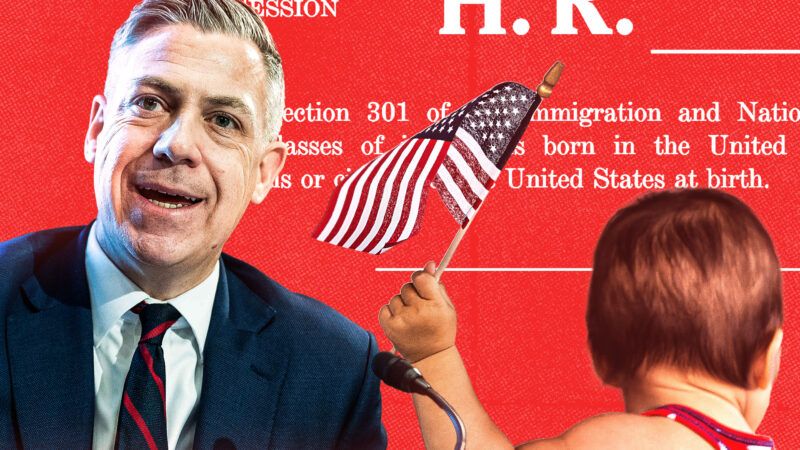
Birthright-Citizenship-7-15 | Illustration: Adani Samat. Photo: Michael Brochstein/ZUMAPRESS/Newscom
(Illustration: Adani Samat. Photo: Michael Brochstein/ZUMAPRESS/Newscom)

President Donald Trump failed in his efforts to persuade the U.S. Supreme Court into upholding his executive order on birthright citizenship, which would have stripped that constitutional guarantee from millions of babies born on U.S. soil.

Now a Republican lawmaker is hoping to effectively overrule that Supreme Court decision with a proposed bill that would resurrect Trump's unlawful order and place it in the federal statute books. As The Hill reports, "Indiana Republican Sen. Jim Banks on Monday introduced a bill that would codify President Trump's Day 1 executive order reshaping the definition of birthright citizenship in the U.S."

There's just one problem with Banks' scheme: Trump lost the birthright citizenship case Trump v. Barbara on constitutional grounds, which means that any federal law repeating Trump's already rejected position would be equally unconstitutional under the very Supreme Court precedent that Banks is now hoping to evade. In other words, this proposed bill is an unconstitutional dud.

You’re reading Injustice System from Damon Root and Reason. Get more of Damon’s commentary on constitutional law and American history.

This field is for validation purposes and should be left unchanged.

This is the kind of basic legal reasoning that elected officials should be able to understand. For example, let's say that a Democratically controlled Congress passed a law that banned all private handgun ownership in Washington, D.C., a federal enclave that falls under congressional control. Would that law pass constitutional muster?

No, it would not. Why? Because of the Supreme Court's 2008 decision in District of Columbia v. Heller, which struck down D.C.'s handgun ban because it violated the individual right to keep and bear arms secured by the Second Amendment to the Constitution.

Just imagine the Republican outcry that would follow if a Democratically controlled Congress tried to effectively overrule Heller by passing a gun control law that directly contradicted Heller. Those Republicans would point out—correctly—that the Supreme Court had already issued a clear and decisive ruling on the matter. Unless and until that judicial precedent is overturned by a future SCOTUS, Congress is bound to follow it. Any law that seeks to do what Heller said the Constitution does not allow the government to do would be unconstitutional under Heller. Pretty straightforward, right? This is not exactly rocket science.

Still, just to be safe, how about one more hypothetical to illustrate the point, this time centering on the First Amendment. What if a Democratically controlled Congress passed a law banning "hate speech." Would that pass constitutional muster? Again, it would not, under all sorts of Supreme Court precedents that many Republicans would surely invoke when attacking the proposed anti-hate speech law. "If there is a bedrock principle underlying the First Amendment," the Court said in one of those cases, Texas v. Johnson (1989), "it is that the government may not prohibit the expression of an idea simply because society finds the idea itself offensive or disagreeable." As long as such precedents stand, Congress must respect them.

The exact same thing holds true for this new Republican scheme to dodge the birthright citizenship decision. Unless and until a future SCOTUS revisits and overturns Trump v. Barbara, the president and his allies in Congress are bound to follow the Court's ruling.


In Other Legal News

Speaking of legal concepts that elected officials ought to be able to both understand and follow, the undeclared war on Iran is seemingly back on. The Constitution places the authority "to declare War" in the hands of Congress, not the president, so the fact that Congress never actually declared this particular war makes it an unconstitutional war. I realize that's kind of an old-fashioned, fuddy-duddy way to view presidential power nowadays, but I'm sticking to it.

Start your day with Reason. Get a daily brief of the most important stories and trends every weekday morning when you subscribe to Reason Roundup.

This field is for validation purposes and should be left unchanged.

NEXT: Why Foreign Tourism to the U.S. Is Declining Under Trump

Damon Root is a senior editor at Reason and the author of A Glorious Liberty: Frederick Douglass and the Fight for an Antislavery Constitution (Potomac Books). His next book, Emancipation War: The Fall of Slavery and the Coming of the Thirteenth Amendment (Potomac Books), will be published in June 2026.

Supreme CourtConstitutionDonald TrumpCongressBirthright CitizenshipLaw & Government
Share on FacebookShare on XShare on RedditShare by emailPrint friendly versionCopy page URL Add Reason to Google
Media Contact & Reprint Requests

Hide Comments (5)

Editor's Note: As of February 29, 2024, commenting privileges on reason.com posts are limited to Reason Plus subscribers. Past commenters are grandfathered in for a temporary period. Subscribe here to preserve your ability to comment. Your Reason Plus subscription also gives you an ad-free version of reason.com, along with full access to the digital edition and archives of Reason magazine. We request that comments be civil and on-topic. We do not moderate or assume any responsibility for comments, which are owned by the readers who post them. Comments do not represent the views of reason.com or Reason Foundation. We reserve the right to delete any comment and ban commenters for any reason at any time. Comments may only be edited within 5 minutes of posting. Report abuses.

  1. Fist of Etiquette   1 hour ago

    Just imagine the Republican outcry that would follow if a Democratically controlled Congress tried to effectively overrule Heller by passing a gun control law that directly contradicted Heller.

    Um...

    Log in to Reply
  2. Mickey Rat   51 minutes ago

    "Both illegal immigrants and lawful temporary visitors are "subject to the jurisdiction of the United States" under this original meaning because the U.S. government has "the right of making or enforcing laws" that apply against such persons when they are present on U.S. soil."

    And there are the "penumbras and emanations" of this ruling, of which the argument is that just being in the United States was not the intent or good faith interpretation of what being "subject to the jurisdiction of the United States" meant to the writers of the 14th Amendment. And then there is just that this expansive view of birthright citizenship just being bad policy with perverse incentives and results.

    Log in to Reply
    1. Moderation4ever   36 minutes ago

      I see no real problem with birthright citizenship. It has been in existence since the end of The Civil War and has not really created significant problems. This seem to be just a solution in search of a problem. Almost all Americans today are citizens because some ancestor was born in the country and gained citizenship at that time. It appears that real formal citizenship naturalization did not even come about until after 1906. My grandparent's citizenship was more likely due to birth in this country than that their immigrant parents were made citizens.

      Log in to Reply
      1. creech   15 minutes ago

        Ditto for mine. Grandpa born in U.S. of German immigrant parents who were naturalized after Grandpa's birth. Unfortunately, perhaps, the folks who wrote the 14th were unartful in the language they used if they intended some other definition of birthright citizenship?
        Now it appears an amendment is required if "anchor babies" are to be excluded from citizenship.

        Log in to Reply
  3. MollyGodiva   30 minutes ago

    The Constitution says nothing about the ability of SCOTUS to nullify federal law. It thus reasons that Congress could put into place a procedure to overrule SCOTUS.

    Log in to Reply

Please log in to post comments

Mute this user?

  • Mute User
  • Cancel

Ban this user?

  • Ban User
  • Cancel

Un-ban this user?

  • Un-ban User
  • Cancel

Nuke this user?

  • Nuke User
  • Cancel

Un-nuke this user?

  • Un-nuke User
  • Cancel

Flag this comment?

  • Flag Comment
  • Cancel

Un-flag this comment?

  • Un-flag Comment
  • Cancel

Latest

Baseball Is Being Watched More Than Ever. But Fewer People Are Falling in Love With It.

Michael Munger | 7.16.2026 8:00 AM

No, Congress Can't Just Overrule the Supreme Court on Birthright Citizenship

Damon Root | 7.16.2026 7:00 AM

Why Foreign Tourism to the U.S. Is Declining Under Trump

Eric Boehm | From the August/September 2026 issue

Brickbat: Well Housed

Charles Oliver | 7.16.2026 4:00 AM

A Texas Immigrant Detention Center Is a 'Human Rights Disaster,' Civil Rights Groups Say in Report

C.J. Ciaramella | 7.16.2026 1:00 AM

Recommended

  • About
  • Browse Topics
  • Events
  • Staff
  • Jobs
  • Donate
  • Advertise
  • Subscribe
  • Contact
  • Media
  • Shop
  • Amazon
Reason Facebook@reason on XReason InstagramReason TikTokReason YoutubeApple PodcastsReason on FlipboardReason RSS Add Reason to Google

© 2026 Reason Foundation | Accessibility | Privacy Policy | Terms Of Use

This site is protected by reCAPTCHA and the Google Privacy Policy and Terms of Service apply.

Reason's July 4 Special!

For America's 250th, Get 2 Years of Reason for $17.76

Celebrate your independence with a subscription to Reason magazine, your most trusted source of honest, insightful news and analysis.

Subscribe to Reason


