He Compared ICE's Chief to a Nazi, so ICE Tracked Him Down on Vacation With His Daughter
A new lawsuit accuses the Trump administration of violating the First Amendment rights of its critics by issuing warning notices to them.
In January, following the shootings of Renée Good and Alex Pretti by federal officers in Minneapolis, David Streever sent an email to the publicly available address of acting Immigration and Customs Enforcement (ICE) Director Todd Lyons, calling Lyons a "monstrous human being" and comparing him to Nazi official Reinhard Heydrich, one of the architects of the Holocaust. He also labeled Lyons a "sad, despised man" who will "never know peace."
Five months after his email, ICE agents appeared at Streever's home in Rochester, New York, to serve him a warning notice that his email may have been a "VIOLATION OF FEDERAL LAW." After finding out he wasn't home, federal agents then tracked him to a hotel in New York City—where he was returning from an international vacation with his daughter—to try to get in contact with him.
Now, Streever is pursuing legal action. In a lawsuit filed Monday in the U.S. District Court for the District of Columbia by the Foundation for Individual Rights and Expression (FIRE), Streever accuses the government of violating his First Amendment rights by attempting to silence and intimidate him.
The notice Streever received claims that his email may "constitute a violation of Title 18 of the U.S. Code," which makes it illegal to "threaten to assault, kidnap, and/or murder a federal official," or use an official's "restricted personal information" to incite violence against them, and instructs him to "remove and/or discontinue the aforementioned behavior."
However, Streever's email did not contain any threats of violence, nor did it reveal any personal information about Lyons. Labeling clearly nonthreatening speech as threatening has become a common tactic used by the Trump administration. As public backlash against its immigration enforcement has grown, federal officials have repeatedly claimed that assaults against ICE agents have increased by as much as 400 percent to 500 percent. Last July, the Department of Homeland Security (DHS) began collecting information about "individuals who have made credible threats against ICE personnel or facilities," including social media posts, metadata, and location-related data.
ICE has justified its surveillance and targeting of critics such as Streever as a way to crack down on threats against its officers. But JT Morris, Streever's attorney and the deputy director of litigation at FIRE, tells Reason that Streever's email is part of the "American tradition" of harshly criticizing public officials and is "strongly protected under the First Amendment."
Morris says the language in the email is "nowhere close" to the line the Supreme Court has drawn between "protected political speech and unprotected true threats."
Indeed, ICE's use of the warning notice to stifle criticism appears unconstitutional. In Bantam Books Inc. v. Sullivan (1963), the Supreme Court found the government's use of "legal sanctions and other means of coercion, persuasion, and intimidation" to be an unconstitutional "system of informal censorship." In Brandenburg v. Ohio (1969), the Court held that the government cannot restrict or forbid speech—even when it advocates for the use of force or unlawful conduct—unless it's directed to, or likely to, incite imminent violence.
As a result of the notice, Streever says he has "self-censored some speech on social media" and now fears reprisals from federal officials, including "surveillance, unwelcome visits," and "continued threat of arrest and/or prosecution."
It's not the first time ICE has tried to silence its critics by accusing them of inciting violence, nor is it the first time the agency has conflated constitutionally protected actions with unlawful conduct.
The same day federal agents attempted to serve Streever his notice, they handed a similar one to Syracuse poll worker Paigelynn Gonyea for an Instagram post she made, which named Jonathan Ross as the ICE officer who shot Good. Like Streever, Gonyea was issued a warning notice saying that she may be in violation of federal law, even though she was not the first to identify Ross. In fact, in her Instagram post, Gonyea clearly states that Ross was identified "by the Minnesota Star Tribune."
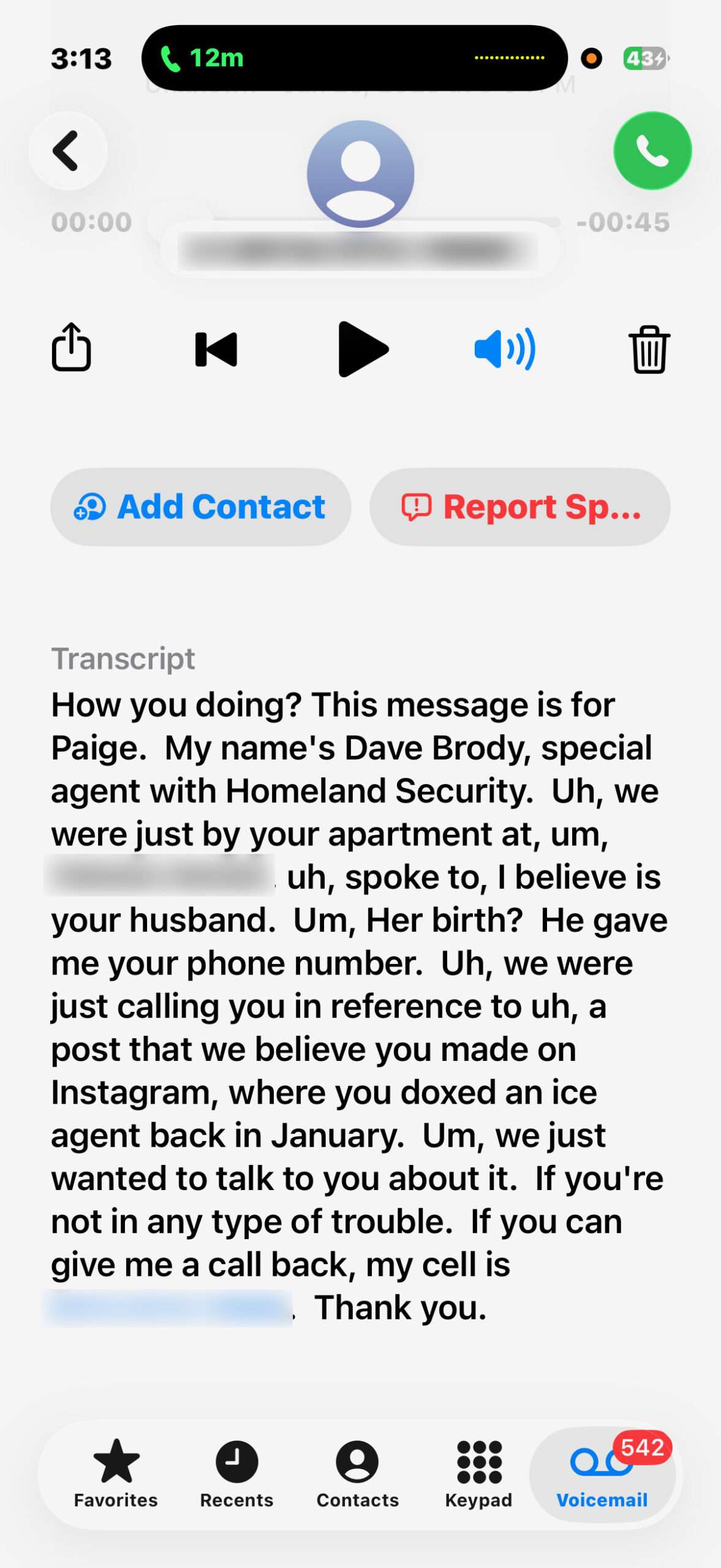
Gonyea tells Reason she was "scared and confused" when agents approached her while she was working at a polling station. In a voicemail transcript provided to Reason, agents from the Department of Homeland Security tell Gonyea that while she "doxed an ICE agent back in January," she was "not in any type of trouble."
When they showed up at the polling station to speak with her, Gonyea says agents repeatedly tried to get her to sign the warning notice, despite her refusal to do so without legal representation. As a result of ICE's actions, Gonyea says she's "more vocal" about First Amendment rights. She's now "exploring legal options" against the department.
It's unlikely that Streever and Gonyea will be the only Americans given warnings over constitutionally protected speech. The notices they were served came from ICE's Office of Professional Responsibility, which upholds the agency's "professional standards." However, instead of "impartially investigating" allegations of internal misconduct as its mission states, the office appears to be spending its resources investigating the public.
In April, Robert Piepiora, the acting assistant field office director at ICE's Boston Field Office, disclosed that the Office of Professional Responsibility had investigated "131 cases involving incidents of doxxing and threats directed towards ICE employees nationwide" from January 2025 to March 2026. That number presumably includes cases like Streever and Gonyea's, which involve the use of personal information yet lack the necessary aspects of threats or calls to violence that would make them unprotected speech.
According to Morris, the FIRE attorney, the warning notices are merely the "latest in a long line of tactics from the government trying to stifle critics of ICE and DHS."
In the past, those tactics have included arrests and attempts at public shaming. Now, the government is pivoting to warning notices that won't deter anyone truly threatening federal agents with violence, but will chill speech that the Trump administration finds distasteful.