

Reason.com - Free Minds and Free Markets
Reason logo Reason logo
  • Latest
  • Magazine
    • Current Issue
    • Archives
    • Subscribe
    • Crossword
  • Video
    • Reason TV
    • The Reason Roundtable
    • Free Media
    • The Reason Interview
  • Podcasts
    • All Shows
    • The Reason Roundtable
    • The Reason Interview With Nick Gillespie
    • Freed Up
    • The Soho Forum Debates
  • Volokh
  • Newsletters
  • Donate
    • Donate Online
    • Ways To Give To Reason Foundation
    • Torchbearer Society
    • Planned Giving
  • Subscribe
    • Reason Plus Subscription
    • Print Subscription
    • Gift Subscriptions
    • Subscriber Support

Log In

Create new account

Supreme Court

Gorsuch Warns About Executive Overreach While Expanding Trump's Power

The Supreme Court extended presidential control over federal agencies. What could go wrong?
Damon Root | 6.30.2026 7:00 AM

Share on FacebookShare on XShare on RedditShare by emailPrint friendly versionCopy page URL Add Reason to Google
Media Contact & Reprint Requests
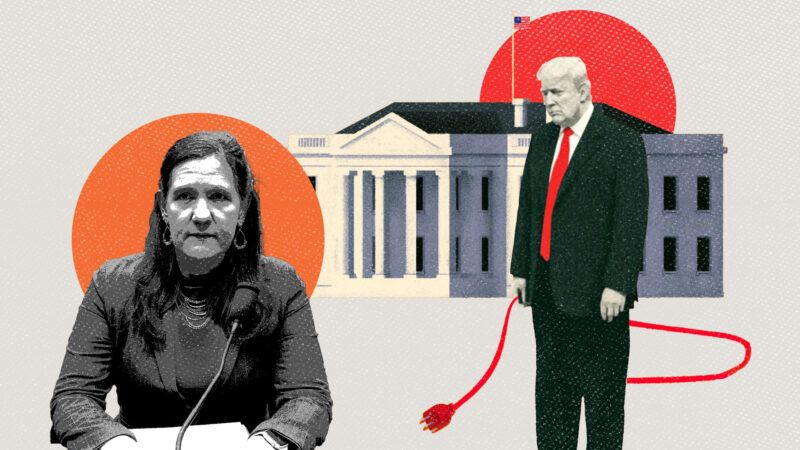
A sketch of Rebecca Slaughter, Donald Trump, and the White House with a white background, a red circle, and an orange circle | Mattie Neretin/Sipa USA/Newscom/Adani Samat/Midjourney
(Mattie Neretin/Sipa USA/Newscom/Adani Samat/Midjourney)

In 1935, the U.S. Supreme Court unanimously stopped President Franklin Roosevelt from firing a commissioner of the Federal Trade Commission (FTC) for purely political reasons. The FTC "cannot in any proper sense be characterized as an arm or an eye of the executive," the Court declared in Humphrey's Executor v. United States.

On Monday, by a vote of 6–3, the Supreme Court overturned Humphrey's Executor and allowed President Donald Trump to fire FTC commissioner Rebecca Slaughter at will. In other words, a theory of broad executive power that was once championed by a progressive president has just been successfully resurrected by a conservative one.

Why did the Supreme Court rule the way that it did?

You’re reading Injustice System from Damon Root and Reason. Get more of Damon’s commentary on constitutional law and American history.

This field is for validation purposes and should be left unchanged.

"The FTC unquestionably exercises executive power, and must therefore be controlled by the Chief Executive, in whom such power is vested," declared Chief Justice John Roberts in Trump v. Slaughter. "It follows, then, that Slaughter served as the President's subordinate at the FTC—and that the President was entitled to cut her tenure short."

But is the matter really as simple as that? Consider what else Roberts had to say about the FTC in the same opinion:

Since its creation in 1914, the FTC has accumulated vast rulemaking, enforcement, and adjudicatory powers under more than 80 statutes. Not only does it promulgate rules that carry the force of law, but it also enforces those rules against private parties, collecting civil penalties in the billions of dollars. [Emphasis added.]

To make or promulgate rules in this context basically means to make new federal laws. Yet the federal lawmaking power does not properly belong to the executive. Rather, it belongs to Congress under Article I of the Constitution. Yet now, as a direct result of Trump v. Slaughter, the federal lawmaking power that the FTC and other "independent" federal agencies have long wielded is suddenly resting in the sole hands of the president.

Doesn't that upset the constitutional separation of powers?

Notably, one of the six justices who voted for Trump in this case spelled out that very objection in a separate concurrence.

Writing alone, Justice Neil Gorsuch agreed with Roberts that independent federal agencies should be brought under the control of a unitary executive when those agencies exercise executive-like powers. But "today, independent agencies do not just exercise executive law-enforcement powers," Gorsuch wrote. "Congress has also delegated to them vast legislative and judicial powers, effectively allowing these agencies to make laws and decide disputes under them. And, after today's decision, the President can effectively exercise all those powers too."

As Gorsuch notes, this outcome raises a number of troubling new questions:

Would Congress have delegated so much power, including legislative and judicial power, to independent agencies had it known that the President would come to control them? How will Congress respond now—if realistically it can? And what, if anything, will this Court do about it?

It bears repeating that Gorsuch did not write those words of warning in dissent. Rather, he wrote them in concurrence after fully joining the very opinion whose "implications" he is so understandably worried about.

Here's how I read Gorsuch's concurrence: He is inviting new cases to be filed against Trump and future presidents if/when those presidents try to wield unconstitutional lawmaking power via their new control over the federal bureaucracy.

But will the Supreme Court actually stop Trump or any other president from doing the unlawful lawmaking that today's decision enables the president to do?

Gorsuch seems nervous about the answer to that question. Perhaps we should be nervous too.

Start your day with Reason. Get a daily brief of the most important stories and trends every weekday morning when you subscribe to Reason Roundup.

This field is for validation purposes and should be left unchanged.

NEXT: Archives: July 2026

Damon Root is a senior editor at Reason and the author of A Glorious Liberty: Frederick Douglass and the Fight for an Antislavery Constitution (Potomac Books). His next book, Emancipation War: The Fall of Slavery and the Coming of the Thirteenth Amendment (Potomac Books), will be published in June 2026.

Supreme CourtConstitutionSeparation of PowersExecutive PowerDonald TrumpTrump AdministrationFederal Trade CommissionLaw & GovernmentNeil Gorsuch
Share on FacebookShare on XShare on RedditShare by emailPrint friendly versionCopy page URL Add Reason to Google
Media Contact & Reprint Requests

Hide Comments (29)

Editor's Note: As of February 29, 2024, commenting privileges on reason.com posts are limited to Reason Plus subscribers. Past commenters are grandfathered in for a temporary period. Subscribe here to preserve your ability to comment. Your Reason Plus subscription also gives you an ad-free version of reason.com, along with full access to the digital edition and archives of Reason magazine. We request that comments be civil and on-topic. We do not moderate or assume any responsibility for comments, which are owned by the readers who post them. Comments do not represent the views of reason.com or Reason Foundation. We reserve the right to delete any comment and ban commenters for any reason at any time. Comments may only be edited within 5 minutes of posting. Report abuses.

  1. Mickey Rat   2 months ago

    "The Supreme Court extended presidential control over federal agencies."

    Or the Supreme Court affirmed the Chief Executive's Constitutional control over Article II executive branch agencies that always existed.

    Maybe the solution is that the executive branch should not have quasi-lawmaking and judicial powers, rather than agencies be independent of elected branch control and oversight?

    1. Rossami   2 months ago

      That is exactly the solution that Gorsuch is arguing for. I didn't read Gorsuch as "nervous" at all - just laying out that it will be a lot of work to unwind all the unconstitutional crap that's built up over the past century.

  2. Mickey Rat   2 months ago

    "Yet now, as a direct result of Trump v. Slaughter, the federal lawmaking power that the FTC and other "independent" federal agencies have long wielded is suddenly resting in the sole hands of the president.

    Doesn't that upset the constitutional separation of powers?"

    Does it not violate the separation of powers anyway? The problem is not that the Chief Executive controls the Executive Branch, but that the Congress is delegating such powers to the executive bureaucracy in the first place? The enabling legislation for these agencies is unconstitutional, not presidential control of them.

    I do not understand how Root is comfortable with these unaccountable bureaucratic powers as long as they are not directly controlled by the Chief Executive.

    1. DesigNate   2 months ago

      Because Root is a hack.

  3. Spiritus Mundi   2 months ago

    Oh noes!!! The chief executive has control over agencies in the executive department.

  4. Spiritus Mundi   2 months ago

    If Reeeeason were truely libertarian, they would be arguing for abolishing unaccountable agencies that have "vast legislative and judicial powers, effectively allowing these agencies to make laws and decide disputes under them."

    Alas, all we get is But Trump!!!!

  5. Spinach Chin   2 months ago

    Arguing in favor of a more powerful, less accountable bureaucracy. So libertarian!

  6. minus the clever name   2 months ago

    It is perverse of Damon to read it that way, it is the OPPOSITE

    Something that abused the core of our Founding (the Administrative State) is being pulled back on the leash. seems all comments so far repudiate Damon's obtuseness. That is gratifying.

    I have had personal experience with several government agencies and Trump softens some of the very bad memories.

  7. Uomo Del Ghiaccio   2 months ago

    Gorsuch is correct and Damon Root is just a Democrat pretending to be a libertarian. The Legislative branch write the laws that grants too much power to the Executive branch. The Executive branch has NOT SEIZED power, but the Legislative branch has GIVEN AWAY power. The Legislative branch has to take back the power they have given away. The Judicial branch and specifically SCOTUS rules on conflicts, but SHOULD NOT legislate from the bench.

    1. MoreFreedom   2 months ago

      I agree Congress has delegated law-making (as Pelosi said "We'lll have to pass the law to see what's in it") though I don't see Root as acting like a Democratic partisan here, unless one claims his lack of explanation for how and why this happened is supporting the Democrats.
      Root would have been more libertarian if he explained that Congress did this because it expected to always have a president that supported the political class in office, and that allowed Congress to pass laws the people didn't support, because they didn't write the laws and left it to the executive branch. Thus, if you don't like the bill Congress passed, then blame the President and don't vote against the congress politicians that voted for it.
      This strategy the political class foists upon us (we did vote collectively for the people we got) is a means to empower the political class via the executive branch's interpretation we do not see until the bureaucrats write the laws (which can be changed by EO to the extent the bill allows it, which seems to be very broad).

      The good news is that Congress will now be nearly forced to write laws that don't leave a lot of interpretation for the bureaucrats, or deal with presidents changing the laws via EO after every new president is elected.
      The bad news is that Congress will find it difficult to take this power back by passing laws where the executive branch has the power, because a president is unlikely to give up his power, unless Congress and the White House both agree to do so. I think that's more likely to happen if the GOP has control, because the Democrats+RINOs are unlikely to pass bills because the public generally doesn't like the laws they want to make.

  8. TJJ2000   2 months ago

    Gosh. Maybe SCOTUS should've grown some b*lls and ruled...

    "Congress can't delegate its Constitutional Powers out (i.e. Overwrite what the USA is) w/o a Constitutional Amendment."

    And in one ruling restored ~60% of the US Constitution that [D]emon-craps have destroyed delegating rule-making power to bogus 3rd parties.

    As long as restoring the US Constitution is seen as "Too Big of a Change" and "Universal Healthcare" is seen as standard procedure ?commerce (more like commie) regulating? the USA has ZERO hope for survival.

    1. Mickey Rat   2 months ago

      Like it or not thst is not the question the Court was asked to rule on. It is not within the Court's proper authority to expand its scope of work on a case, however we might like it.

      1. TJJ2000   2 months ago

        Funny.
        And here I thought upholding the Supreme Law which gave the law making authority to Congress was EXACTLY their job.

        Is that why they bow-down to the [Na]tional So[zi]al[ism]?
        Haven't quite figured out that they're doing there?

  9. MollyGodiva   2 months ago

    As the sane people keep saying, there is nothing in the Constituton that says what the MAGAs wants it to say, and much text that says otherwise. Congress sets the laws for the government and the president is duty bound to carry out those laws.

    1. But SkyNet is a Private Company   2 months ago

      Our Daily Minimum Retardation Allowance has been met

    2. Spinach Chin   2 months ago

      Really? What does the Constitution say on this? Please tell us.

      1. MollyGodiva   2 months ago

        Congress alone has the powers to make the laws for the Government.
        A1S9: "To make all Laws which shall be necessary and proper for carrying into Execution the foregoing Powers, and all other Powers vested by this Constitution in the Government of the United States, or in any Department or Officer thereof."

        Other Executive Branch Officers exist and have duties, thus no "unitary executive".
        A2S2: "he may require the Opinion, in writing, of the principal Officer in each of the executive Departments, upon any Subject relating to the Duties of their respective Offices,"

        The President is bound by federal law.
        A2S3: "he shall take Care that the Laws be faithfully executed"

        There is zero mention of the President being able to fire EB officers. The line "The executive Power shall be vested in a President" can not be read to invalidate what I quoted. The founders did not hide a vast presidential power in those 8 words.

        The independent agencies are accountable to Congress (and thus the people) and managed by the President. Not complicated.

        1. Clipton   2 months ago

          Also not complicated is the fact that the Founders never envisaged a vast Federal Bureacracy with lawmaking powers without direct accountability to the electorate.

          1. MollyGodiva   2 months ago

            Not relevant. We still need to follow the text of the Constitution.

        2. But SkyNet is a Private Company   2 months ago

          You dumbfvck, other executive branch officers exist? And - HE POTUS) MAY REQUIRE - because he is their boss

        3. Spinach Chin   2 months ago

          Rubbish.

          The President has the power to appoint and supervise federal officials. In what world would that not also mean disciplining and removing them, when necessary?

          You believe that the President is the only boss in the nation that lacks the authority to remove his own officers, lol.

  10. Clipton   2 months ago

    The fact that the FTC "makes rules" doesn't magically transform it into the Legislative Branch and thus off limits to Executive authority. The President also "makes rules" in the form of executive orders and Federal judges "make rules" when they hand down opinions so that distinction is meaningless lacking proper context. The fact is that Agencies act under the Executive Branch and whose personnel do not stand for re-election like legislators.

    1. Rossami   2 months ago

      You're missing the scope of the "rules" being made. Executive Orders are instructions to subordinate executive branch employees. EOs are not (or are not supposed to be) binding on either of the other two branches or on us, the governed. Likewise, judicial orders are applicable only on those subject to their immediate instruction and control. They are not free-standing rules that bind the rest of us.

  11. Agammamon   2 months ago

    >The Supreme Court extended presidential control over federal agencies. What could go wrong?

    The head of the executive is allowed to manage the executive? The legislative is not allowed executive functions?

    Sounds like how the constitution was written. Do we not like the constitutional separation of powers now?

  12. Rick James   2 months ago

    In 1935, the U.S. Supreme Court unanimously stopped President Franklin Roosevelt from firing a commissioner of the Federal Trade Commission (FTC) for purely political reasons. The FTC "cannot in any proper sense be characterized as an arm or an eye of the executive," the Court declared in Humphrey's Executor v. United States.

    On Monday, by a vote of 6–3, the Supreme Court overturned Humphrey's Executor and allowed President Donald Trump to fire FTC commissioner Rebecca Slaughter at will. In other words, a theory of broad executive power that was once championed by a progressive president has just been successfully resurrected by a conservative one.

    Why did the Supreme Court rule the way that it did?

    Because they're executive fucking agencies. English, motherfucker, do you speak it?

    As the preeminent lefty Tony Benn once enumerated:

    “What power have you got?”

    “Where did you get it from?”

    “In whose interests do you use it?”

    “To whom are you accountable?”

    “How do we get rid of you?”

    “Anyone who cannot answer the last of those questions does not live in a democratic system,” Benn explained.

    1. Rick James   2 months ago

      By the way, Reason, this was your perfect opportunity to opine, "What we really need to do is abolish the FTC" and you fucking blew it.

      1. Rick James   2 months ago

        When "I don't agree with your ____________ but I'll defend to the death your right to _______________" only applies when you agree with ___________ I guess.

  13. MWAocdoc   2 months ago

    "Would Congress have delegated so much power, including legislative and judicial power, to independent agencies had it known that the President would come to control them?"

    You betcha, Neil! It is very easy to ram Congressional abdication of its Constitutional authority when one party owns and operates the Congress and the White House. It is almost impossible to repeal such cessions of authority later. The speculating about what Congress might have done "had they but known" how it would turn out is not only fruitless, but obvious mental masturbation. Since Congress certainly intended for the President to take over all the hard parts of government so the Congress critters could get more time in on the golf links, this rhetorical question just looks silly.

  14. DRM   2 months ago

    The core problem remaining is INS v. Chadha (1983).

    Prior to that ruling, there were plenty of cases where Congress delegated the power to make rules or exceptions to Executive Branch agencies, subject to Congress retaining the power to veto any particular use of those powers by either house voting the use down. This retained the fundamental character of the US lawmaking system -- while the rule was written by an executive branch official, it required the (passive) concurrence of both houses of Congress to take effect. Concurrence of each house plus the executive is, after all, the constitutional order on lawmaking, right?

    SCOTUS instead decided that, somehow, the need of both houses of Congress to agree on lawmaking meant that it was perfectly okay for Congress to delegate all sorts of power to an agency to make what was effectively law (either in general or to make case0by-casec exceptions) unilaterally, but not to reserve a right for Congress to review and block those uses of delegated legislative power.

    Combined with Chevron v. NRDC (1984) and Morrison v. Olson (1988), the result was the Congress could create an "independent agency" whose head the President could not fire and delegate it legislative powers that the agency could use unilaterally, with the courts required to broadly defer to the agency's own interpretation of what the delegating legislation entailed.

    Thus, in the 1980s, the so-called era of deregulation, in a series of three cases a Republican-appointed majority on the Supreme Court handed the administrative state the power to make laws with the barest fig leaf of review or oversight by any holder of elective or judicial office.

    Well. Fortunately, those two latter cases have now been binned. All that is left is for a modern SCOTUS to take what was the core argument of the majority opinion in INS v. Chadha, and apply it correctly instead of backwards. No use of delegated legislative power should be lawful unless it is subject to a single-house veto, in order to ensure all use of legislative power is done with the (implicit, yes) consent of both houses of Congress.

    Then we'll have something at least passably resembling a Constitutional order. If an agency makes law, it will be done by someone properly subordinate to the President, with at least the implicit consent of both houses of Congress.

Please log in to post comments

Mute this user?

  • Mute User
  • Cancel

Ban this user?

  • Ban User
  • Cancel

Un-ban this user?

  • Un-ban User
  • Cancel

Nuke this user?

  • Nuke User
  • Cancel

Un-nuke this user?

  • Un-nuke User
  • Cancel

Flag this comment?

  • Flag Comment
  • Cancel

Un-flag this comment?

  • Un-flag Comment
  • Cancel

Latest

Inside Venezuela's El Helicoide Prison: How Dissident Jesús Armas Endured Torture and Outlasted Maduro

César Báez | 8.30.2026 6:00 AM

Lawmakers Want To Stop Kids From Nicknaming Their Pokémon

Andy Jung | 8.29.2026 7:00 AM

9/11 Turbocharged America's Worst Foreign Policy Impulses—but Didn't Change Its Direction

Emma Ashford | From the August/September 2026 issue

Milo Yiannopoulos Wanted Millions Deported. He Didn't Mean Himself.

Billy Binion | 8.28.2026 5:22 PM

The CIA Is Making AI-Generated Reports for Local Police

Matthew Petti | 8.28.2026 4:31 PM

Recommended

  • About
  • Browse Topics
  • Events
  • Staff
  • Jobs
  • Donate
  • Advertise
  • Subscribe
  • Contact
  • Media
  • Amazon
Reason Facebook@reason on XReason InstagramReason TikTokReason YoutubeApple PodcastsReason on FlipboardReason RSS Add Reason to Google

© 2026 Reason Foundation | Accessibility | Privacy Policy | Terms Of Use

This site is protected by reCAPTCHA and the Google Privacy Policy and Terms of Service apply.

Reason's July 4 Special!

For America's 250th, Get 2 Years of Reason for $17.76

Celebrate your independence with a subscription to Reason magazine, your most trusted source of honest, insightful news and analysis.

Subscribe to Reason


