Reason.com - Free Minds and Free Markets
Reason logo Reason logo
  • Latest
  • Magazine
    • Current Issue
    • Archives
    • Subscribe
    • Crossword
  • Video
    • Reason TV
    • The Reason Roundtable
    • Free Media
    • The Reason Interview
  • Podcasts
    • All Shows
    • The Reason Roundtable
    • The Reason Interview With Nick Gillespie
    • Freed Up
    • The Soho Forum Debates
  • Volokh
  • Newsletters
  • Donate
    • Donate Online
    • Ways To Give To Reason Foundation
    • Torchbearer Society
    • Planned Giving
  • Subscribe
    • Reason Plus Subscription
    • Print Subscription
    • Gift Subscriptions
    • Subscriber Support

Log In

Create new account

Credit Card

Capping Credit Card Fees Threatens To Hurt Consumers and Small Businesses

Lawmakers can’t change the fact that expenses must be offset somewhere.
J.D. Tuccille | 6.24.2026 7:00 AM

Share on FacebookShare on XShare on RedditShare by emailPrint friendly versionCopy page URL Add Reason to Google
Media Contact & Reprint Requests
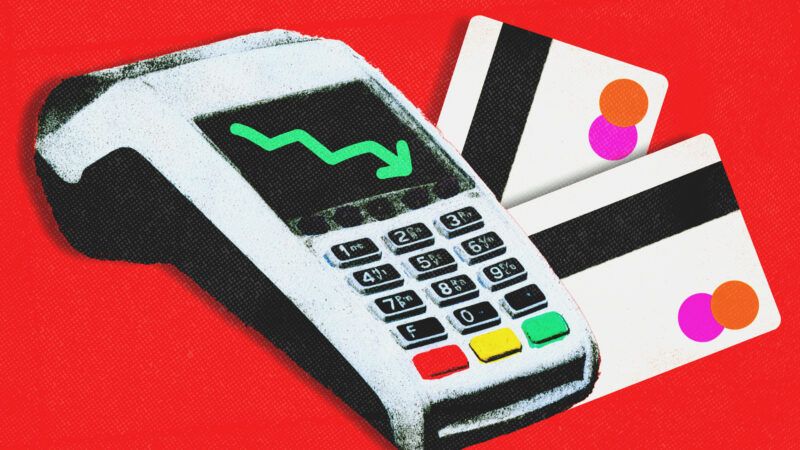
A credit card processor with a green arrow on the screen going down. Credit cards are nearby. | Illustration: Midjourney
(Illustration: Midjourney)

Two years ago, Illinois passed crowd-pleasing restrictions on credit card interchange fees, which are better known as "swipe fees." The ban on charging fees on processing payments for tips and taxes has now been delayed twice by skeptical federal judges and lawmakers worried that they've crafted a financial mess. These interventions may be saving the state from itself, as a new report points out that the law threatens to hurt consumers, small retailers, and local financial institutions.

You are reading The Rattler from J.D. Tuccille and Reason. Get more of J.D.'s commentary on government overreach and threats to everyday liberty.

This field is for validation purposes and should be left unchanged.

Delayed Ban on Fees for Processing Taxes and Tips

Passed as part of a 2024 revenue bill, the Interchange Fee Prohibition Act (IFPA) defines "interchange fee" as "a fee established, charged, or received by a payment card network for the purpose of compensating the issuer for its involvement in an electronic payment transaction." It adds: "An issuer, a payment card network, an acquirer bank, or a processor may not receive or charge a merchant any interchange fee on the tax amount or gratuity of an electronic payment transaction if the merchant informs the acquirer bank or its designee of the tax or gratuity amount as part of the authorization or settlement process for the electronic payment transaction."

"Although merchants have long advocated for this change, banking and payment industry representatives argue that it imposes an undue hardship by forcing them to process certain components of transactions without compensation," attorneys Thomas V. Panoff and Maxwell Earp-Thomas noted for the National Law Review at the time. They also commented that the law could force Illinois payments to be processed differently than those originating in the rest of the country and the world beyond.

The situation is now being fought in court and in public between advocates who argue the fees are hidden costs and opponents who say they're an industry-standard means to cover the cost of business.

Arguments back and forth convinced a federal judge to bar enforcement of the law—which, after delays, was set to take effect in July. State legislators almost simultaneously put the law on hold until July 2027. That may be for the best, given the problems that state intervention in financial transactions could cause.

"While purported to be relief for merchants, the law is more likely to produce unintended consequences for consumers, financial institutions, and the majority of the merchants the law was meant to help," argues Steve Swedberg of the Competitive Enterprise Institute (CEI) in a report published last week. "More broadly, the IFPA raises fundamental questions about whether state-level payment regulation is compatible with the uniform standards required for a functioning national payments system."

Popular or Not, Fees Offset Expenses

Swedberg points out that payment networks are intermediaries in transactions between cardholders and merchants. It's a potentially lucrative business, but one that requires significant infrastructure behind the scenes: "In 2025, Visa reported operating expenses of more than $16 billion. These expenses include network and processing costs, personnel, and depreciation of technology and equipment." Mastercard reports similar expenses. Banks and credit unions that issue cards also must maintain infrastructure.

Fees are meant to offset expenses. Hand-waving them away as hidden costs doesn't erase the reason they exist, even if people don't want to pay them on charges for taxes and tips.

Swedberg emphasizes that this isn't the first attempt to limit swipe fees. He points to the Durbin Amendment, enacted as part of the 2010 Dodd–Frank Act, that capped debit card interchange fees charged by large financial institutions.

Caps on Swipe Fees Hurt Those They're Supposed To Help

According to a 2019 study by Vladimir Mukharlyamov of Georgetown University and Natasha Sarin of the University of Pennsylvania, the amendment decreased annual bank revenue by $6.5 billion. The researchers found that "covered banks responded to this 25 percent decline in interchange revenue by doubling monthly maintenance fees on checking accounts, decreasing the share of consumers with free checking accounts from 60 percent to 20 percent." The Durbin Amendment, they added, "may well have pushed consumers out of the traditional financial system and toward more costly alternatives," and they found "little evidence of across-the-board consumer savings."

Swedberg draws on a 2015 brief from the Federal Reserve Bank of Richmond, which found that capping fees didn't save consumers money overall. According to authors Renee Haltom and Zhu Wang, "the vast majority of merchants in the survey (77.2 percent) did not change prices post-regulation, very few merchants (1.2 percent) reduced prices, while a sizable fraction of merchants (21.6 percent) increased prices."

So, the last national attempt to cap interchange fees resulted in higher banking costs and some increased retail prices for consumers.

Swedberg also foresees higher costs for community banks and credit unions with fewer resources than national players. He observes that under the Illinois law, "the added friction of data submission, verification, and delayed reimbursement would introduce new operational costs and timing mismatches, particularly for smaller financial institutions with limited compliance infrastructure."

Smaller institutions are also more likely than larger ones to make mistakes that subject them to the IFPA's $1,000 penalty for each noncompliant transaction, which can quickly add up.

Swedberg emphasizes that smaller retailers may be dinged as the law forces changes to payment systems used by merchants, card issuers, and payment networks. "Large retailers with fully integrated payment ecosystems are positioned to implement these changes through existing infrastructure," he adds, "while smaller merchants face higher relative costs from upgrades, middleware, or operational workarounds."

Haltom and Wang noted that after the Durbin amendment, for transactions of $10 or less, "only 2.8 percent of merchants are estimated to have lower debit costs, 31.8 percent had increased costs, and 65.4 percent had costs that were unchanged." The fee flexibility that existed before Durbin was replaced by a more rigid system that increased costs for some retailers.

Avoid Fees the Old-Fashioned Way

Overall, Illinois lawmakers' attempt to please the crowd by mandating lower costs looks poised to create a mess that could leave the state's consumers, small banks, and retailers with higher costs and fewer choices if financial institutions leave to avoid headaches.

"To protect the integrity of the checkout experience and avoid driving financial providers from the Illinois market, the IFPA must be either repealed or overturned," concludes Swedberg.

Credit card fees are undoubtedly burdensome for consumers and retailers. Ultimately the best way to avoid them is the traditional way: Use cash.


The Rattler is a weekly newsletter from J.D. Tuccille. If you care about government overreach and tangible threats to everyday liberty, this is for you.

This field is for validation purposes and should be left unchanged.

NEXT: Brickbat: No Good Deed

J.D. Tuccille is a contributing editor at Reason.

Credit CardUser feesBankingIllinoisDick DurbinMoneyPayment Processors
Share on FacebookShare on XShare on RedditShare by emailPrint friendly versionCopy page URL Add Reason to Google
Media Contact & Reprint Requests

Hide Comments (17)

Editor's Note: As of February 29, 2024, commenting privileges on reason.com posts are limited to Reason Plus subscribers. Past commenters are grandfathered in for a temporary period. Subscribe here to preserve your ability to comment. Your Reason Plus subscription also gives you an ad-free version of reason.com, along with full access to the digital edition and archives of Reason magazine. We request that comments be civil and on-topic. We do not moderate or assume any responsibility for comments, which are owned by the readers who post them. Comments do not represent the views of reason.com or Reason Foundation. We reserve the right to delete any comment and ban commenters for any reason at any time. Comments may only be edited within 5 minutes of posting. Report abuses.

  1. minus the clever name   2 months ago

    But those expenses are as high as they are BECAUSE the fees weren't capped. A rough analogy: Tuition and the rise in school administrative personnel

    THOMAS SOWELL
    Whatever colleges and universities choose to spend their money on is called a cost. If they hire more administrators, or build more buildings to house them, or send the college president on more junkets, these are all additional costs....What colleges and universities seek to insinuate—misleadingly—by saying that costs have gone up is that the cost of what they have always done is rising, necessitating an increase in tuition. But colleges and universities have been greatly expanding what they do—and, as long as they spend the rising tuition on something, that something will be called a cost.

    1. Don't look at me! ( Is the war over yet?)   2 months ago

      If it’s lucrative enough, someone will enter the market at lower cost.

      1. minus the clever name   2 months ago

        you are assuming a market, bad assumption.

        What is happening is the 3-year Bachelors degree

        "Three-year bachelor's degrees are a growing trend across the U.S., trimming standard 120-credit programs to 90 credits by reducing general education requirements. Nearly 60 colleges offer or are piloting these degrees."

        So you still charge a godawful sum but, protected by law and unions, you shove them out, unemployable, after 3 years.
        Thanks to Obama and Biden the market has been crushed, much like the EVs happened...Subsidize the producers, subsidizer the buyers that you approve of , and set the law on those not complying.
        For example , how can this possibly be

        "In Louisiana, natural hair braiders are currently required to complete at least 500 hours of training at a registered cosmetology school to obtain an "alternative hair design" permit. Nationwide, requirements vary wildly, with many states requiring no license, while others require anywhere from 300 to 1,500 hours"

    2. Rossami   2 months ago

      Bullshit. Those fees are "capped" by the market. If American Express sets exhorbitant fees, Mastercard will undercut them and steal their business. This has in fact happened multiple times. And, if left without government interference, will continue to happen.

      Tuition is a good analogy but not in the direction you think. Tuition is out of control because of government interference and subsidies, not in spite of it.

      1. minus the clever name   2 months ago

        I worked as a Bank Statistical Analyst and you are way wrong.
        Both AE and MasterCard join to control the market

        HERE IS REAL LIFE
        For years, merchants have alleged that Visa and Mastercard engaged in a conspiracy to artificially inflate and fix swipe fees. Following extensive legal battles, a U.S. District Court granted preliminary approval to a massive $38 billion settlement.

        Now you tell me that the $38 Billion had no basis.Really, try.

        1. Rossami   2 months ago

          You're still missing the point. Visa and MC were only able to set up that cartel because of government regulations that imposed artificial barriers to entry by smaller, more technologically agile competitors. Existing competitors (AMEX, Discover, etc) remained in and the market worked against them but the collusion you're complaining about was a result of government interference, not evidence that the interference worked.

    3. Stupid Government Tricks   2 months ago

      Damn you're stupid. This isn't even Econ 101 illiteracy, it's just plain stupidity.

      Everything has a cost. Banning businesses from charging a high enough price to cover the cost of some product or service means businesses won't provide that product or service. This should be obvious to anyone with more than a few brain cells, but Nixon's fuel price controls were just another in a long line of emperors and kings and politicians in general thinking they could command the tide to roll back.

      This is nothing that can be taught in school. It is just plain ordinary common sense, which is not at all common among statists of any sort.

      Fuck off, slaver.

  2. JesseAz (RIP CK)   2 months ago

    Forcing creditors to treat all clients the same is far more destructive. Not allowing people who can pay their debts to have lower fees and rates and subsidize bad credit is worse. Allow banks and creditors to deny or charge users with bad credit and bankruptcy. Stop with all users are the same or fear being called racist.

    1. minus the clever name   2 months ago

      Hmmm, again fighting shadows

      What about

      The Biden-Harris administration implemented Federal Housing Finance Agency (FHFA) rules through the Loan-Level Price Adjustment (LLPA) matrix that adjust mortgage fees. These rules lower costs and improve terms for borrowers with lower or riskier credit scores while increasing fees for borrowers with excellent credit to help subsidize the loans

      THAT IS PURE FORCING. I worked in banking checking for prejudicial mortgage lending. CFPB all but destroyed good lending practice with the result that many bad loans were made to avoid huge fines based on statistical breakdowns of mortagages. Many minority lenders were crushed (in league with the CRA act under Clinton) and net loss to housing,lending ,and real discrimination in lending.

      "You are just talkin sht" , as we used to say about the teenage Talaricos at my loathable prep school 🙂

      1. JesseAz (RIP CK)   2 months ago

        Where did I say democrat regulations were not to blame? It is exactly what I called out.

  3. See.More   2 months ago

    Is there not some sort of contract or ToS that merchants sign when they sign up for credit card processing? Are these fees not disclosed and agreed to up front?

    Obviously many merchants believe that paying the processing fees is worth the convenience (few people deal strictly in cash any more) and security (credit card transactions are guaranteed, unlike checks) or they wouldn't sign up to accept credit cards.

    1. Stupid Government Tricks   2 months ago

      And cash payments invite thieves and have to be taken to banks.

      1. richardwashby   2 months ago

        Indeed, cash and checks involve costs as well. The whole point of credit cards is 1) no bad checks 2) no counterfeit cash 3) secure transfer. This costs.

  4. Marc St. Stephen   2 months ago

    As a conservative libertarian, I disagree with capping these fees for many reasons mentioned here.

    Having said that, I am irritated that so many restaurants are now putting those fees on the bill. I'm especially irritated when restaurants do that for large bills - I can understand doing it for lunch or cheap meals, but if you're paying more than say $50-60 per person, that's just being greedy.

    I also find it highly ironic that there has been a push and continues to be a push for a cashless society, and now people are being punished for not using cash?

    Anyway, my address of this situation is this: If the restaurant in question is putting that fee on my bill for using a credit card and my meal is over $50 per person, I subtract it from the tip and tell them I'm doing so. Granted, this hurts the innocent servers, but I'm not getting fucked for not carrying around a wad of cash when I dine out, because the owners are being fucking greedy.

    Oh, and heads up - Tips are based on subtotal, NOT total (why the fuck would anyone tip based on taxes and fees?!). Many of these automated pay systems calculate based on total, so do the math yourself and point out to the server or manager that you're not happy with that attempted "taking".

    1. Get To Da Chippah   2 months ago

      I disagree. Make the costs known. Merchants' costs are passed on to the consumer. If they didn't charge people who chose to use credit cards then that expense would show up in the prices for meals for all customers, not just the ones who use plastic. And the profit margins of restaurants are so small that telling the business to just deal with it is amoral leftist thinking. Hurting the server as a result of a decision upon which they have no impact is despicable.

      However, basing the tip to include taxes and fees is crap as well, and I will look out for that in the future.

      In short, use cash if you don't want to be charged for using credit. If you don't want to "carry a wad of cash around," then don't, but don't expect the restaurant to pay the fees for you.

      1. Outlaw Josey Wales   2 months ago

        Tip 2. Don't go back to that restaurant and let them know why.

        I, for one, am suffering from the fatigue of everyone's hand out for every little thing. From rounding up my purchases to feed some vague charity to the - every counter service encounter - TIP Jar that wants my change or a buck back. And of course everybody's favorite add on tip to any iScreen transaction that involves sustenance.

        This leads to expectation. For me, the solution is go out less, if at all.

      2. See.More   2 months ago

        . . . but don't expect the restaurant to pay the fees for you.

        Restaurants accept credit cards for their own benefit as much as for yours. Why shouldn't they pay some fees?

        Now, I completely agree. I would rather be rewarded for paying in cash rather than subsidizing, in the form of higher prices, other people's credit card transactions. I seek out businesses that charge lower prices for my cash transactions.

        But, there is no reason that both customers (the merchant and the patron) of the credit card processing interchanges should not bear the burden of the costs.

Please log in to post comments

Mute this user?

  • Mute User
  • Cancel

Ban this user?

  • Ban User
  • Cancel

Un-ban this user?

  • Un-ban User
  • Cancel

Nuke this user?

  • Nuke User
  • Cancel

Un-nuke this user?

  • Un-nuke User
  • Cancel

Flag this comment?

  • Flag Comment
  • Cancel

Un-flag this comment?

  • Un-flag Comment
  • Cancel

Latest

Post-9/11 Fear Grew the Surveillance State. 25 Years Later, It's Still Growing.

Abigail R. Hall | From the August/September 2026 issue

This Mamdani-Backed Bill Would Kill Jobs, Boost Unions, and Make Deliveries More Expensive

C. Jarrett Dieterle and Adam Lehodey | 8.22.2026 7:00 AM

Harry and Meghan's Security Problem Is Really a Gun-Control Problem

Reem Ibrahim | 8.21.2026 4:58 PM

Trump Administration Plans New Facility To House 3,000 Migrant Kids. Many of Them Lack Legal Representation.

Autumn Billings | 8.21.2026 4:54 PM

Trump Once Promised International Students Green Cards. Now The Government Might Charge Them $100,000 To Work.

Billy Binion | 8.21.2026 4:24 PM

Recommended

  • About
  • Browse Topics
  • Events
  • Staff
  • Jobs
  • Donate
  • Advertise
  • Subscribe
  • Contact
  • Media
  • Amazon
Reason Facebook@reason on XReason InstagramReason TikTokReason YoutubeApple PodcastsReason on FlipboardReason RSS Add Reason to Google

© 2026 Reason Foundation | Accessibility | Privacy Policy | Terms Of Use

This site is protected by reCAPTCHA and the Google Privacy Policy and Terms of Service apply.

Reason's July 4 Special!

For America's 250th, Get 2 Years of Reason for $17.76

Celebrate your independence with a subscription to Reason magazine, your most trusted source of honest, insightful news and analysis.

Subscribe to Reason