

ABC Asks Viewers To Defend the Network Against the FCC
FCC Chairman Brendan Carr is targeting the Disney-owned broadcaster with two different government enforcement actions.
In recent months, Brendan Carr, chairman of the Federal Communications Commission (FCC), has taken aim at broadcast TV networks that are critical of President Donald Trump.
Earlier this year, Carr targeted ABC on two fronts. The broadcaster is now asking its viewers, via TV commercials, to speak out on its behalf.
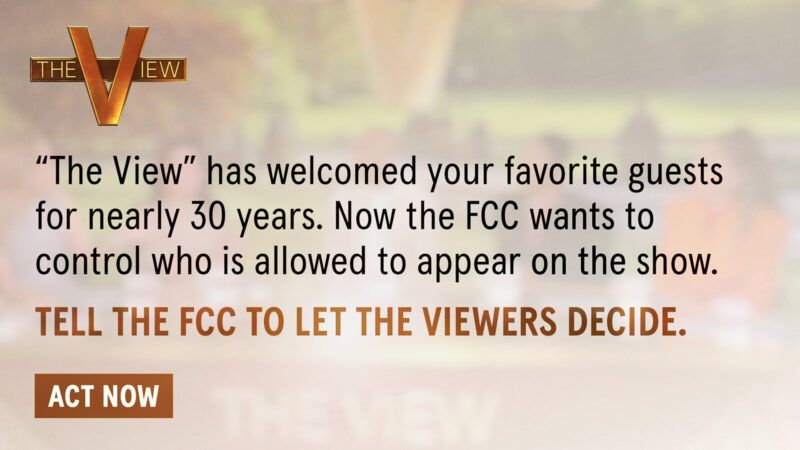
One ad, currently airing nationally, specifically mentions The View, ABC's longrunning daytime chat show whose progressive hosts often rankle the president.
"The View has welcomed your favorite guests and covered the issues you care about for nearly 30 years," per the voiceover. "Now, the FCC wants to control who is allowed to appear on the show."
A separate ad, airing on New York City's WABC, makes a similar plea. "Channel 7 has proudly served you for more than 75 years," it says. "Now, the FCC is questioning our commitment to the community."
The ads address the two different paths Carr's FCC is taking in an apparent attempt to punish the network for insufficient fealty to the president. Each ad presents a QR code that, when scanned, will let viewers weigh in to the FCC on ABC's behalf.
The national ad refers to an FCC complaint related to the federal equal time rule, which stipulates that when a qualified candidate for public office appears on a broadcast network before an election, the network must "afford equal opportunities" to all other candidates for the same office.
But since candidates are often newsworthy, the law makes exceptions for "bona fide" news content, like interviews, newscasts, and documentaries. Without that exception, the equal time rule would be completely unworkable: If the president is running for reelection, news broadcasts could only mention him if they then offered to run free ads for all his competitors to balance out the coverage.
As Reason's Jacob Sullum noted last month, the FCC first granted "bona fide news interview" exceptions to daytime talk shows in 1984, and it extended the same exception to The View in 2002.
In January, Carr threatened to revoke The View's exemption. "For years, legacy TV networks assumed that their late night & daytime talk shows qualify as 'bona fide news' programs," Carr wrote on X, "even when motivated by purely partisan political purposes."
The FCC announced in a new directive that when considering exemptions to the equal time rule, it would now evaluate "whether decisions on the content, participants, and format are based on newsworthiness, rather than partisan purposes, such as an intention to advance or harm an individual's candidacy." While it acknowledged that daytime or late-night broadcasts could qualify for an exemption, "the FCC has not been presented with any evidence that the interview portion of any late night or daytime television talk show program on air presently would qualify."
Without an exception to the equal time rule, The View could not feature any political candidates in the weeks before an election without potentially having to host all other candidates for that same office. In the more likely scenario, the network would simply not host any.
The WABC ad refers to a separate enforcement action. In April, the FCC announced it was investigating Disney, ABC's parent company, for illegal actions, "including the agency's prohibition on unlawful discrimination." As such, it was "calling in Disney's ABC licenses for early renewal."
Network affiliates are licensed by the FCC to broadcast in their particular regions, and those licenses must be periodically renewed. While most affiliates are owned by other companies or individuals, Disney owns eight ABC affiliate stations. Even though none of those eight affiliates' licenses were set to expire until at least 2028, the FCC says they must now apply again.
While the FCC's stated purpose was an ongoing investigation into Disney's hiring practices, the announcement came just days after ABC late-night host Jimmy Kimmel made a joke about President Donald Trump and first lady Melania Trump that the White House found particularly distasteful.
"FCC's broadcast license renewal process must be grounded in predictability, fairness and transparency, principles reflected in the license terms Congress established and later extended," National Association of Broadcasters President Curtis LeGeyt said in a statement. "The Media Bureau's nearly unprecedented request for one company to quickly reapply for all of its licenses—rather than utilize its traditional enforcement process—runs contrary to these principles and creates significant uncertainty for all broadcasters."
"It is pretty clear that this review is politically motivated," added David Inserra of the Cato Institute. "And rather than just threats or investigations, this review directly puts ABC broadcast licenses at risk. This action by the FCC is a dangerous escalation that makes clear the need to fundamentally change the FCC's authority to protect free expression."
The FCC's prescribed role is to regulate broadcast licenses, ensuring that TV and radio stations can transmit without interference. But increasingly, the agency wields government authority in a way that bears little resemblance to that purpose and looks a lot like punishing the president's ideological opponents.




