

Major League Baseball Teams Have the Right To Offer Pride Uniforms. Should They?
The league’s conduct is indisputably protected by the First Amendment. But that doesn't make it wise.
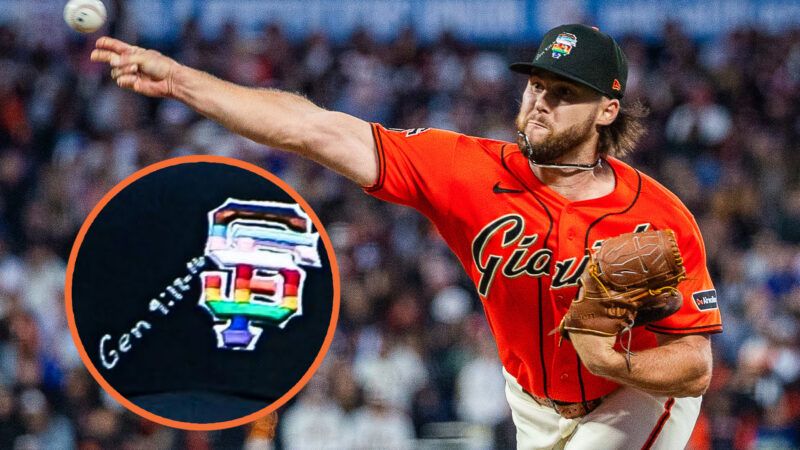
Major League Baseball (MLB) found itself mired in controversy this past week after three San Francisco Giants players—Landen Roupp, J.T. Brubaker, and Ryan Walker—inscribed Bible verses on their hats that had been designed for the team's Pride night. Another, Sam Hentges, declined to wear the hat altogether. Whether people were mad at the players for their lack of pride or at the team and league for their alleged abundance of pride depends on vantage point. But people were mad.
Put differently, we are living in Groundhog Day, but make it gay. We've had this fight before. Around and around we have gone. A lot of people are wrong. So why are we still doing this?
The league may be wondering the same thing. "We have told teams, in terms of actual uniforms, hats, bases, that we don't think putting logos on them is a good idea just because of the desire to protect players," said MLB commissioner Rob Manfred in 2023, "not putting them in a position of doing something that may make them uncomfortable because of their personal views." The Giants and the Los Angeles Dodgers, however, have continued incorporating the Pride uniforms because of a standing agreement.
This fight is not constrained to the outfield or the infield or the minefield-ridden culture war battlefield. "I write with grave concern over your reported decision to issue a formal warning to three Major League Baseball (MLB) players for publicly expressing their Christian faith," Sen. Josh Hawley (R–Mo.) said in a letter to Manfred. "You must answer for what appears to be a pattern of discrimination within MLB against baseball players who profess their Christian faith." The senator was joined by other government actors promising to intervene, including the U.S. Department of Justice's Harmeet Dhillon, who referred the league to the Equal Employment Opportunity Commission for an investigation.
That probe came in response to news that MLB had admonished the three players who wrote on their Pride hats. "This routine verbal warning not to wear the hat in future games is not disciplinary and had absolutely nothing to do with the content of the message," the league said in a statement. "We respect players' right to free expression. However, writing of any kind, with any message, is prohibited per Major League Baseball's uniform regulations….We have given the same warning numerous times in the past to players for messages such as 'Dad,' 'Happy Mother's Day, I Love Mom' and names of family members."
Dear reader, you are entitled to the view that such a policy is silly. You are also entitled to the view that teams could and should avoid this carousel ride of controversy altogether by not politicizing uniforms. But MLB's rule is unequivocally, uncontroversially protected by the First Amendment. Yes, the league receives subsidies (too many, in fact!). So do a lot of private organizations and companies: Amazon, Intel, Boeing, Ford, tech companies and agricultural companies and energy companies and on. That does not mean they forfeit their constitutional rights. Baseball is a symbol of Americana, after all. Appropriately, it is not an arm of the U.S. government.
One person who provides a good reminder that this is constitutionally protected is, ironically, Dhillon. "The Civil Rights Act prohibits MLB and its franchises from unreasonably burdening the rights of players with religious objections to serving as the League's vehicle for pro-Pride messages," she writes in her letter. "Federal law is clear: employers must modify their uniform requirements to reasonably accommodate their employees' exercise of religion."
They did. The Pride hats were not mandatory; Hentges opted out, which players are permitted to do, and he thus received no verbal warning. That is "reasonably accommodat[ing]" by every measure. A team offered its employees clothing that aligned with its values and the league enforced rules it has about writing messages on uniforms—two things that are indisputably within the purview of private actors. If a franchise gave players hats inscribed with the Ichthys (a.k.a. the Jesus fish), it would be similarly vindicated in admonishing employees who added anti-religious screeds.
The difference, of course, is that an MLB team offering such a hat would be nearly beyond belief, including (maybe even more so?) to the devoutly religious. Which does tell you something.
Teams are working toward a collective goal. But they are made up of individuals. Some players are religious, some are not. Some support gay rights, some do not. Some believe ranch dressing is the best condiment, some have no taste. This is, fortunately, their right. "I'm thankful we live in a country where, you know, we have the freedom to believe what we want…and express what we want," Roupp said after the game last week. Pressuring players under a national microscope to take sides on any given political issue mostly just breeds conflict for the sake of virtue signaling. And for what? Expressions of support—for gay rights, or for anything—mean much more when they are done voluntarily, by your own initiative, on your own time.
"By resorting to 'us' and 'them' instead of truly understanding the humanity of the people asking for help, those who chose to make a statement on or with their hats completely missed the point," wrote Grant Brisbee in a viral column for The Athletic, a subsidiary of The New York Times. "If anyone is looking to make the world better, they might try listening and understanding." The author, respectfully, could stand to take his own advice.




