

Lawsuits Accuse Corporate 'Cartel' of Monopolizing Missouri's Weed Market
A 10 percent ownership cap was supposed to prevent monopolies in Missouri's marijuana market. Instead, the state's licensing regime may have created a blueprint for companies to build one.
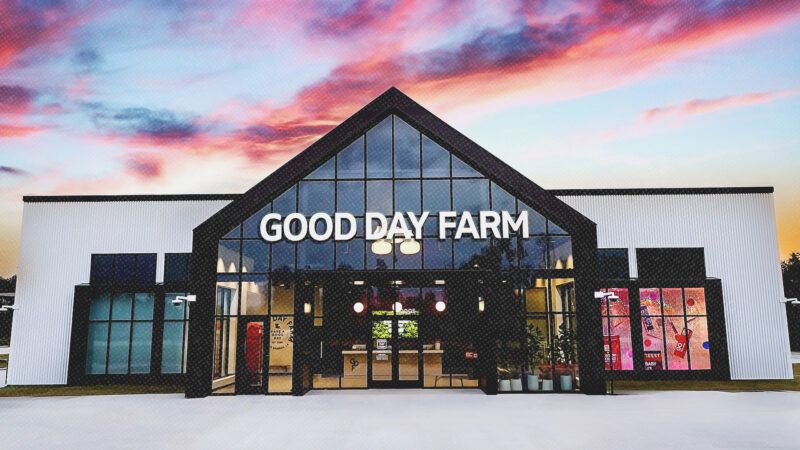
When Missouri legalized recreational marijuana in 2022, it put laws on the books to prevent monopolization of its weed market. Now, one cannabis provider is allegedly skirting these regulations to take over the state's market and establish a monopoly, according to two recent lawsuits filed within weeks of each other.
The first suit was filed in April by Local Cannabis and VIBE, two Missouri cannabis wholesalers, accusing Arkansas-based marijuana company Good Day Farm of using its employees and 48 different LLCs to circumvent Missouri's marijuana licensing cap. The second case, filed in May by Damon Frost Jr., a Missouri resident and recreational cannabis user, alleges Good Day Farm engaged in "anticompetitive and unlawful conduct" to gain its market share.
Both suits accuse Good Day Farm of owning and operating 61 of Missouri's 229 dispensaries, about 27 percent of the state's total. This would violate Missouri law, which prohibits any single entity from owning "more than ten percent" of the total number of dispensary, cultivation, and manufacturing licenses. Moreover, Local Cannabis and VIBE allege that Good Day Farm also controls "upwards of 40%" of wholesale cannabis purchases in Missouri.
Both have petitioned the court for an injunction that would void any agreements made by Good Day Farm, as well as monetary damages, "including restitution" and "disgorgement" of the company's alleged illegal holdings.
But it's unclear whether Good Day is, in fact, violating the state's law.
In the 2018 constitutional provision that legalized medical marijuana, the state prohibited any entity under "substantially common control, ownership, or management," defined as having "the power to direct or cause the direction of the management or policies of a facility," from owning more than five dispensary licenses. Following the 2022 amendment legalizing recreational use, Missouri dropped the "common control" language and instead said that no single entity can own 10 percent of the state's licenses, reports the Missouri Independent.
This change, while largely unnoticed by the public, "helped create an opening for Good Day Farm" to expand in the Show-Me State, says the Independent. Indeed, in documents included in the court records, the company touts the "limited license nature" of Missouri's marijuana laws as "one of the foundational reasons" for its heavy investments in the state.
As a vertically integrated company that owns or controls multiple stages of the legal marijuana supply chain, including cultivation, manufacturing, and retail, Good Day Farm navigated the language change by establishing several LLCs as separate legal entities. They did so by filing each vertical with the Missouri secretary of state.
While each LLC has its own investors and board of directors, they're all tied to Good Day Farm or one of its verticals and share the same address as the company's corporate headquarters. For instance, Alex Gray, Good Day Farm's chief strategy officer and president of sales, holds 19 dispensary licenses operating under the Good Day Farm brand and another 14 dispensary licenses operating a Good Day Farm vertical called CODES. That would give Gray 14 percent ownership of the total dispensary licenses issued in Missouri.
Angela Irby, the former head of investor relations at Good Day Farm, registered the fictitious name CODES CANNABIS. She is also listed as the organizer of two other LLCs, Bon Vert Ventures and 3 Leaf Health, that control nine dispensary licenses.
This wasn't a veiled strategy; in its presentations to potential investors, Good Day Farm acknowledged that it couldn't assure regulators wouldn't "take issue with the number of marijuana dispensaries [it] operated or supervised," Lisa Cox, communications director at the Missouri Department of Health and Senior Services (which regulates cannabis in the state) tells Reason.
Additionally, Cox confirms that the Division of Cannabis Regulation within the Health Department reviewed each application under question by the plaintiffs for a license and the accompanying documentation. The agency has "no upcoming legal action" planned against the company, says Cox.
Irby, Gray, Good Day Farm, and attorneys for both class action suits did not respond to Reason's request for comment at the time of publication.
Owning 27 percent of the dispensary market may seem like a lot to Good Day's competitors, but it hardly means that the company is a monopoly. Instead, it seems to indicate that Good Day has tapped into something and is offering a superior product that more consumers enjoy.
Taking into account the potential for market growth (the state saw over $1.5 billion in cumulative sales in 2025 and $506 million already so far in 2026) the lawsuits by local cannabis providers read as sour grapes at losing their hometown market to an out-of-state company. In Frost's case, with 168 recreational marijuana retailers in Missouri unaffiliated with Good Day Farm, he could simply shop at a different store.




