

Reason.com - Free Minds and Free Markets
Reason logo Reason logo
  • Latest
  • Magazine
    • Current Issue
    • Archives
    • Subscribe
    • Crossword
  • Video
    • Reason TV
    • The Reason Roundtable
    • Free Media
    • The Reason Interview
  • Podcasts
    • All Shows
    • The Reason Roundtable
    • The Reason Interview With Nick Gillespie
    • Freed Up
    • The Soho Forum Debates
  • Volokh
  • Newsletters
  • Donate
    • Donate Online
    • Ways To Give To Reason Foundation
    • Torchbearer Society
    • Planned Giving
  • Subscribe
    • Reason Plus Subscription
    • Print Subscription
    • Gift Subscriptions
    • Subscriber Support

Log In

Create new account

Retirement

Trump's Government-Funded Retirement Plan Misses the Point

The fiscal objection is serious. But the deeper problem is that the proposal misunderstands the saving behavior of the households it aims to help.
Veronique de Rugy | 5.7.2026 11:55 AM

Share on FacebookShare on XShare on RedditShare by emailPrint friendly versionCopy page URL Add Reason to Google
Media Contact & Reprint Requests
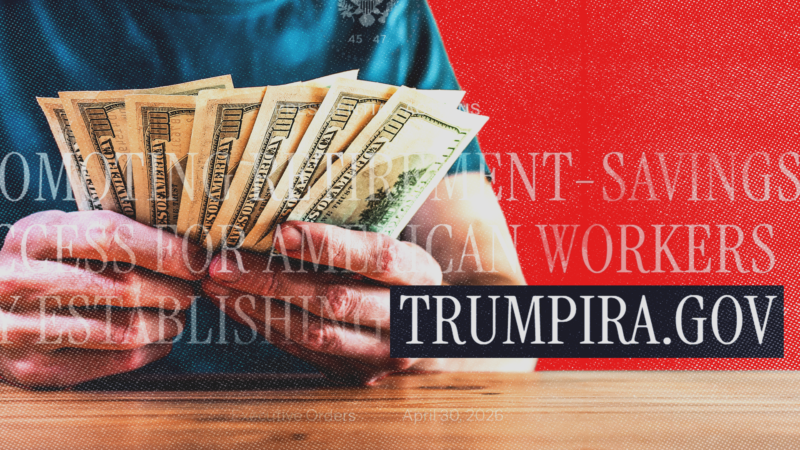
A man holds cash next to "TrumpIRA.gov" | Envato/The White House
(Envato/The White House)

President Donald Trump and Congress want to help you increase your savings. And you should. At the household level, saving is the foundation of financial security and the seed capital for a better retirement. At the economy-wide level, savings fund investment that expands the capital stock, raises wages, and grows the economy. A society that does not save is a society slowly consuming its future.

So, any politician who wants to help Americans save more deserves at least a hearing. What should such a politician propose?

The first thing to do is remove all government-made barriers to savings. This includes a Social Security design that disincentivizes saving, and a tax code that hits much of our savings twice, as both income and investment returns. Addressing our massive debt—which threatens to bring inflation back and literally destroy the value of the savings we already have—would help too.

Alas, this isn't what Trump has in mind with his new executive order directing the Treasury to launch "TrumpIRA.gov," a portal where workers without employer-sponsored retirement plans can shop for private accounts. And some of them will be able to claim a federal Saver's Match of up to $1,000 a year.

The plans are vague, but we can get an idea from a bipartisan bill currently before Congress. The Retirement Savings for Americans Act would automatically enroll workers earning below the national median income in new retirement accounts and provide government matching contributions. According to RAND Corporation research, roughly 63 million workers would be eligible for these accounts, and 42 million would qualify for the match.

Bipartisan support for the idea is growing. Wall Street firms see new customers. Progressives see expanded government involvement in retirement. Some conservatives see a backdoor route to Social Security privatization. I urge skepticism.

Start with the core of the proposal. The Saver's Match is not a Trump innovation. It was created by the 2022 SECURE 2.0 Act under former President Joe Biden. Trump's executive order merely accelerates its rollout and expands its visibility. It will be very expensive.

Romina Bocca at the Cato Institute writes in The Washington Post that if modeled after the bill mentioned above, then "starting in 2027, low-income workers with existing retirement accounts are set to receive up to $1,000 in matching funds, at a cost to federal taxpayers of $9.3 billion through 2032. Expanding eligibility and automatically enrolling workers without existing accounts, as proposed by the bipartisan Retirement Savings for Americans Act, would be far more costly. Some projections put the price tag at $285 billion over the first decade alone."

That's real money being added to a federal balance sheet already groaning under the weight of a Social Security system facing roughly $28 trillion in long-term shortfalls.

But the fiscal objection, while serious, is not the deepest one. The deeper problem is that the proposal's backers misread the savings behavior of the households they claim to help.

Decades of economic research tell a consistent story: Low-income households are not failing to save because they lack tax-advantaged ways to do it. They fail to save because when you live paycheck to paycheck, locking money in an account you cannot access without incurring penalties, such as IRAs, 401(k)s and 529s, is risky.

Vanguard data show that households at the lowest income levels have the highest early withdrawal rates from existing retirement accounts, with penalties accounting for a disproportionate share of their tax burden. According to Boccia, penalties account for 43 percent of all taxes paid by individuals with adjusted gross incomes below $5,000.

Automatic enrollment, which animates much of the enthusiasm for expanded accounts, does not change this calculus for everyone. Research using Danish pension data found that some workers simply offset mandatory contributions by reducing voluntary saving. A large-scale United Kingdom study found that 18-21 cents of every dollar saved through auto-enrollment is offset by taking on debt. A recent study shows that the benefits of auto-enrollment are much smaller than original estimates assumed.

The better path is genuine simplification: a universal savings account that shields its owner from the tax bias against saving, allows contributions from any after-tax income, imposes no restrictions on withdrawals, and requires no government match and no new federal spending. Canada and the United Kingdom have run this experiment. Accounts were used enthusiastically across all income levels, including by moderate- and lower-income households who value flexibility above all else.

Finally, if politicians truly care about securing Americans' retirement income, they should have the courage both to reform Social Security (to stop lower-income seniors from being hit with an automatic 23 percent benefit cut while preventing massive increase of the debt) and to reform a tax code that creates silly disincentives to save.

COPYRIGHT 2026 CREATORS.COM

Start your day with Reason. Get a daily brief of the most important stories and trends every weekday morning when you subscribe to Reason Roundup.

This field is for validation purposes and should be left unchanged.

NEXT: Trump’s Health Bureaucrats Are Undermining Confidence in Vaccines

Veronique de Rugy is a contributing editor at Reason. She is a senior research fellow at the Mercatus Center at George Mason University.

RetirementInvestmentGovernment SpendingTrump AdministrationDonald TrumpJoe BidenIncomeSocial SecurityFederal governmentEconomyTaxpayersNational DebtExecutive order
Share on FacebookShare on XShare on RedditShare by emailPrint friendly versionCopy page URL Add Reason to Google
Media Contact & Reprint Requests

Hide Comments (13)

Editor's Note: As of February 29, 2024, commenting privileges on reason.com posts are limited to Reason Plus subscribers. Past commenters are grandfathered in for a temporary period. Subscribe here to preserve your ability to comment. Your Reason Plus subscription also gives you an ad-free version of reason.com, along with full access to the digital edition and archives of Reason magazine. We request that comments be civil and on-topic. We do not moderate or assume any responsibility for comments, which are owned by the readers who post them. Comments do not represent the views of reason.com or Reason Foundation. We reserve the right to delete any comment and ban commenters for any reason at any time. Comments may only be edited within 5 minutes of posting. Report abuses.

  1. Neutral not Neutered   2 hours ago

    "Decades of economic research tell a consistent story: Low-income households are not failing to save because they lack tax-advantaged ways to do it. They fail to save because when you live paycheck to paycheck, locking money in an account you cannot access without incurring penalties, such as IRAs, 401(k)s and 529s, is risky."

    Which is why giving them $1000.00, locked away, helps them...

    Log in to Reply
    1. Stupid Government Tricks   1 hour ago

      Locked away? Doesn't help them at all by the time inflation dilutes it down to nothing in 50 years. And it won't stay locked away. They will scream bloody murder "I can't pay my rent! Give me my $1000!" and sure enough, the government will let them withdraw it prematurely. So much for retirement savings.

      Log in to Reply
      1. Neutral not Neutered   1 hour ago

        If they never earned it, whatever amount it is, when eligible they can take it and it's theirs. Did I say, they didn't earn it? Expecting to take it whenever is not allowed?

        Log in to Reply
      2. Spiritus Mundi   53 minutes ago

        It is an IRA not a traditional savings account. Inflation has never outpaced an IRA.

        Log in to Reply
        1. Rossami   43 minutes ago

          Over short terms, inflation most definitely has outpaced some (and sometimes even most) IRAs. But you are right that over the long term, inflation has not yet outpaced IRAs.

          But a large part of that favorable return is attributable to the US dollar's status as the preferred global reserve currency. The closer we get to default and losing that reserve currency status, the more likely that inflation will start to outpace our IRAs. If we continue to let Congress spend like a bunch of drunken sailors, it's a statistical inevitability.

          Log in to Reply
    2. Rossami   1 hour ago

      And where, precisely, do you think that $1000.00 will come from?

      Here's a hint - the very taxpayers this idea purports to help. It will come indirectly, either through increased costs of government debt or through inflation that erodes not only the value of that $1000 but every other dollar they ever earn or spend. IT'S NOT FREE MONEY!

      Log in to Reply
      1. Spiritus Mundi   52 minutes ago

        It will come from the 'rich.' It is just more wealth transfer.

        Log in to Reply
  2. Don't look at me! ( Is the war over yet?)   1 hour ago

    Investment returns are income, that’s why they are taxed.

    Log in to Reply
    1. Rossami   49 minutes ago

      And taxing them disincents people from making those investments. Again, if you want to encourage saving behavior, step one is to stop actively dis-incenting it.

      Let's see if I can find an analogy you'll understand. Say I want to encourage you to eat more healthy foods. Currently, all foods have a sales tax rate of 20%. Are you more likely or less likely to buy more rice, broccoli and apples if I drop the sales tax rate to zero (while keeping the sales tax rate on the behaviors I want to discourage like doritos at 20%)? It's all food (just like you're argument that it's all income) so I'm completely justified in taxing it. But do you now understand how differential taxing drives behaviors?

      Mind you, as a good libertarian, I'd prefer to see no taxes on food or income but that option is not on the table.

      Log in to Reply
      1. Don't look at me! ( Is the war over yet?)   47 minutes ago

        Didn’t say it was a good thing, just reality.

        Log in to Reply
  3. Neutral not Neutered   1 hour ago

    "Research using Danish pension data found that some workers simply offset mandatory contributions by reducing voluntary saving."

    Most likely these folks have lower debt, paying less interest, while boosting the economy as they spend more save less income. But they still gain the savings provided and the banks have more money shoring them up.

    Tax Free Savings Accounts are for taxed dollars to be put into funds and no interest charged on the gains made. There are no penalties to withdraw because the taxes are paid on the money put into the TFSA and it is not specifically designed as retirement savings. Folks will take the money given and spend it if this type of account design.

    The difference with a 401K is the invested dollars are not taxed when put into the funds, only when removed from the funds. These are retirement savings plans which is why there is a penalty if withdrawn early. This is where the money should be given if it is.

    Log in to Reply
  4. Ron   44 minutes ago

    personal experience. After paying my taxes there is rarely enough to put aside. this is another level that is not needed and will eventually be abused, taxed or raided by our government just like with social security

    Log in to Reply
  5. Sometimes a Great Notion   39 minutes ago

    are set to receive up to $1,000 in matching funds, at a cost to federal taxpayers of $9.3 billion

    More money printed, pushing the USA further into debt; what could go wrong?

    Log in to Reply

Please log in to post comments

Mute this user?

  • Mute User
  • Cancel

Ban this user?

  • Ban User
  • Cancel

Un-ban this user?

  • Un-ban User
  • Cancel

Nuke this user?

  • Nuke User
  • Cancel

Un-nuke this user?

  • Un-nuke User
  • Cancel

Flag this comment?

  • Flag Comment
  • Cancel

Un-flag this comment?

  • Un-flag Comment
  • Cancel

Latest

Trump's Government-Funded Retirement Plan Misses the Point

Veronique de Rugy | 5.7.2026 11:55 AM

Trump's Health Bureaucrats Are Undermining Confidence in Vaccines

Ronald Bailey | 5.7.2026 10:30 AM

Florida Wins the Curriculum Wars

Liz Wolfe | 5.7.2026 9:30 AM

11 Big SCOTUS Cases That Will Be Decided Soon

Damon Root | 5.7.2026 7:00 AM

Photo: Technology Is Bringing Lost Paintings Into the Public Eye

Fiona Harrigan | From the June 2026 issue

Recommended

  • About
  • Browse Topics
  • Events
  • Staff
  • Jobs
  • Donate
  • Advertise
  • Subscribe
  • Contact
  • Media
  • Shop
  • Amazon
Reason Facebook@reason on XReason InstagramReason TikTokReason YoutubeApple PodcastsReason on FlipboardReason RSS Add Reason to Google

© 2026 Reason Foundation | Accessibility | Privacy Policy | Terms Of Use

This site is protected by reCAPTCHA and the Google Privacy Policy and Terms of Service apply.

r

I WANT FREE MINDS AND FREE MARKETS!

Help Reason push back with more of the fact-based reporting we do best. Your support means more reporters, more investigations, and more coverage.

Make a donation today! No thanks
r

I WANT TO FUND FREE MINDS AND FREE MARKETS

Every dollar I give helps to fund more journalists, more videos, and more amazing stories that celebrate liberty.

Yes! I want to put my money where your mouth is! Not interested
r

SUPPORT HONEST JOURNALISM

So much of the media tries telling you what to think. Support journalism that helps you to think for yourself.

I’ll donate to Reason right now! No thanks
r

PUSH BACK

Push back against misleading media lies and bad ideas. Support Reason’s journalism today.

My donation today will help Reason push back! Not today
r

HELP KEEP MEDIA FREE & FEARLESS

Back journalism committed to transparency, independence, and intellectual honesty.

Yes, I’ll donate to Reason today! No thanks
r

STAND FOR FREE MINDS

Support journalism that challenges central planning, big government overreach, and creeping socialism.

Yes, I’ll support Reason today! No thanks
r

PUSH BACK AGAINST SOCIALIST IDEAS

Support journalism that exposes bad economics, failed policies, and threats to open markets.

Yes, I’ll donate to Reason today! No thanks
r

FIGHT BAD IDEAS WITH FACTS

Back independent media that examines the real-world consequences of socialist policies.

Yes, I’ll donate to Reason today! No thanks
r

BAD ECONOMIC IDEAS ARE EVERYWHERE. LET’S FIGHT BACK.

Support journalism that challenges government overreach with rational analysis and clear reasoning.

Yes, I’ll donate to Reason today! No thanks
r

JOIN THE FIGHT FOR FREEDOM

Support journalism that challenges centralized power and defends individual liberty.

Yes, I’ll donate to Reason today! No thanks
r

BACK JOURNALISM THAT PUSHES BACK AGAINST SOCIALISM

Your support helps expose the real-world costs of socialist policy proposals—and highlight better alternatives.

Yes, I’ll donate to Reason today! No thanks
r

FIGHT BACK AGAINST BAD ECONOMICS.

Donate today to fuel reporting that exposes the real costs of heavy-handed government.

Yes, I’ll donate to Reason today! No thanks


