

Trump's Government-Funded Retirement Plan Misses the Point
The fiscal objection is serious. But the deeper problem is that the proposal misunderstands the saving behavior of the households it aims to help.
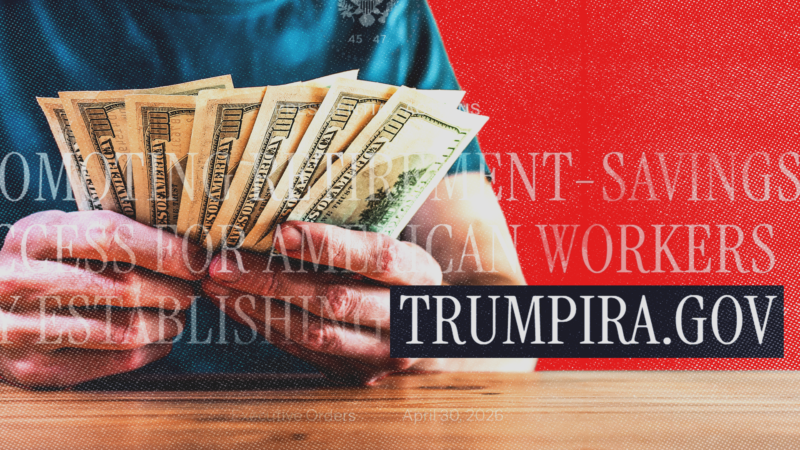
President Donald Trump and Congress want to help you increase your savings. And you should. At the household level, saving is the foundation of financial security and the seed capital for a better retirement. At the economy-wide level, savings fund investment that expands the capital stock, raises wages, and grows the economy. A society that does not save is a society slowly consuming its future.
So, any politician who wants to help Americans save more deserves at least a hearing. What should such a politician propose?
The first thing to do is remove all government-made barriers to savings. This includes a Social Security design that disincentivizes saving, and a tax code that hits much of our savings twice, as both income and investment returns. Addressing our massive debt—which threatens to bring inflation back and literally destroy the value of the savings we already have—would help too.
Alas, this isn't what Trump has in mind with his new executive order directing the Treasury to launch "TrumpIRA.gov," a portal where workers without employer-sponsored retirement plans can shop for private accounts. And some of them will be able to claim a federal Saver's Match of up to $1,000 a year.
The plans are vague, but we can get an idea from a bipartisan bill currently before Congress. The Retirement Savings for Americans Act would automatically enroll workers earning below the national median income in new retirement accounts and provide government matching contributions. According to RAND Corporation research, roughly 63 million workers would be eligible for these accounts, and 42 million would qualify for the match.
Bipartisan support for the idea is growing. Wall Street firms see new customers. Progressives see expanded government involvement in retirement. Some conservatives see a backdoor route to Social Security privatization. I urge skepticism.
Start with the core of the proposal. The Saver's Match is not a Trump innovation. It was created by the 2022 SECURE 2.0 Act under former President Joe Biden. Trump's executive order merely accelerates its rollout and expands its visibility. It will be very expensive.
Romina Bocca at the Cato Institute writes in The Washington Post that if modeled after the bill mentioned above, then "starting in 2027, low-income workers with existing retirement accounts are set to receive up to $1,000 in matching funds, at a cost to federal taxpayers of $9.3 billion through 2032. Expanding eligibility and automatically enrolling workers without existing accounts, as proposed by the bipartisan Retirement Savings for Americans Act, would be far more costly. Some projections put the price tag at $285 billion over the first decade alone."
That's real money being added to a federal balance sheet already groaning under the weight of a Social Security system facing roughly $28 trillion in long-term shortfalls.
But the fiscal objection, while serious, is not the deepest one. The deeper problem is that the proposal's backers misread the savings behavior of the households they claim to help.
Decades of economic research tell a consistent story: Low-income households are not failing to save because they lack tax-advantaged ways to do it. They fail to save because when you live paycheck to paycheck, locking money in an account you cannot access without incurring penalties, such as IRAs, 401(k)s and 529s, is risky.
Vanguard data show that households at the lowest income levels have the highest early withdrawal rates from existing retirement accounts, with penalties accounting for a disproportionate share of their tax burden. According to Boccia, penalties account for 43 percent of all taxes paid by individuals with adjusted gross incomes below $5,000.
Automatic enrollment, which animates much of the enthusiasm for expanded accounts, does not change this calculus for everyone. Research using Danish pension data found that some workers simply offset mandatory contributions by reducing voluntary saving. A large-scale United Kingdom study found that 18-21 cents of every dollar saved through auto-enrollment is offset by taking on debt. A recent study shows that the benefits of auto-enrollment are much smaller than original estimates assumed.
The better path is genuine simplification: a universal savings account that shields its owner from the tax bias against saving, allows contributions from any after-tax income, imposes no restrictions on withdrawals, and requires no government match and no new federal spending. Canada and the United Kingdom have run this experiment. Accounts were used enthusiastically across all income levels, including by moderate- and lower-income households who value flexibility above all else.
Finally, if politicians truly care about securing Americans' retirement income, they should have the courage both to reform Social Security (to stop lower-income seniors from being hit with an automatic 23 percent benefit cut while preventing massive increase of the debt) and to reform a tax code that creates silly disincentives to save.
COPYRIGHT 2026 CREATORS.COM




