

The Supreme Court's 'Shadow Docket' Has Sprung a Leak
Plus: a credible new report on the Alito retirement rumors.
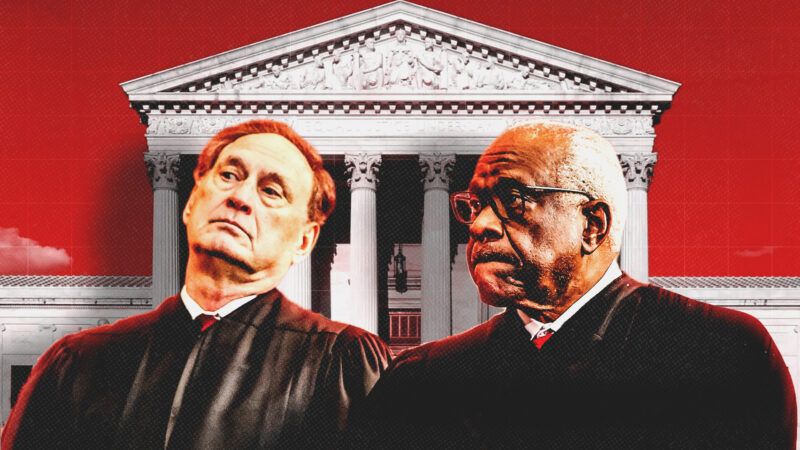
Greetings and welcome to the latest edition of the Injustice System newsletter. There is a lot of news swirling around the U.S. Supreme Court this week and these two stories in particular are worth noting.
You’re reading Injustice System from Damon Root and Reason. Get more of Damon’s commentary on constitutional law and American history.
1. The Shadow Docket Has Sprung a Leak
The New York Times managed to get its hands on a cache of private memos written by members of the Supreme Court to each other about a hugely important 2016 case. A leak of this sort would be a big deal in and of itself, as the justices' private papers tend to stay private until after their deaths. But this leak is doubly noteworthy because it involves a pressing legal matter that was decided on an emergency basis without the benefit of either full briefing or oral arguments, a somewhat less than transparent phenomenon that critics have dubbed "the shadow docket." Here is how Jodi Kantor and Adam Liptak of The New York Times characterized their big scoop:
Writing on formal letterhead, but addressing one another by their first names and signing off with their initials, they sound notes of irritation, air grievances and plead for more time. In addition to the usual legal materials, they cite a blog post and, twice, a television interview. They sometimes engage with one another's arguments. But they often simply talk past each other.
The papers expose what critics have called the weakness at the heart of the shadow docket: an absence of the kind of rigorous debate that the justices devote to their normal cases.
I count myself among the critics of this secretive judicial process, particularly when the Supreme Court resolves an important legal matter without even offering an accompanying written opinion to explain its thinking. We shouldn't need to read leaked memos in a newspaper to fully understand why the Supreme Court has undertaken an important legal action.
2. No Alito Retirement This Year
Jan Crawford Greenburg of CBS News, a veteran SCOTUS reporter and author of the superb 2007 book, Supreme Conflict: The Inside Story of the Struggle for Control of the United States Supreme Court, reported on Friday that "sources close to Supreme Court Justice Samuel Alito confirm that he is not planning to retire this year. Sources close to Justice Clarence Thomas also tell CBS News that he does not plan to step down."
Crawford is a very well-sourced journalist on all matters SCOTUS, so I would treat this news coming from her as highly credible. It also makes sense. As I've previously noted, there were already good reasons to doubt the rumors of an impending Alito retirement, such as the fact that "Alito has only been a justice for twenty years, which is not really such a long stint nowadays on the high court. When Justice Anthony Kennedy voluntarily stepped down in 2018, for example, he had served for just over three decades….The 75-year-old Alito is not exactly a spring chicken, to be sure, but if his health holds out, he may have many more judicial clucks left to give in the decade ahead."
Democratic strategists are probably jumping for joy at the news of Alito and Thomas sticking around on the bench for a bit longer. If either Alito or Thomas did retire this year, after all, his Trump-picked successor would almost certainly sail through the confirmation process in the Republican-controlled Senate. But now, if the Democrats manage to take control of the Senate in this year's midterm elections, any future SCOTUS nominee from Trump will stand about zero chance of ever getting confirmed. That's a pretty good campaign message if you happen to be a Democrat running for the Senate.




