

Pittsburgh Thinks the NFL Draft Is Worth $19 Million of Taxpayer Money. Here's What Past Draft Data Say.
Plus: NFL draft rookies get screwed by the players union, and governments are charging a ton to get to the World Cup
Hello and welcome to another edition of Free Agent! Don't worry if you end up in a tough spot this week, everything will be alright.
If hosting the NFL draft or getting drafted seems like a great deal to you, I'm sorry to say those two things are not as glorious as they seem. Keep reading to find out why. We'll close with some thoughts on the shockingly high prices being charged for transit and parking at the World Cup.
Don't miss sports coverage from Jason Russell and Reason.
Locker Room Links
- An ESPN version of Jeopardy! is apparently in the works, with Joe Buck likely to host.
- Zachariah Branch, who will probably get drafted this weekend, was arrested for obstructing a sidewalk and obstructing a law enforcement officer.
- For sports bars, streaming sports is more complicated and expensive than you think.
- President Donald Trump apparently wants former President Teddy Roosevelt inducted into the Pro Football Hall of Fame (a bit odd, considering Roosevelt was a critic of professionalizing sports and had more of a direct impact on the college game).
- Sen. Tammy Baldwin (D–Wisc.) has a plan to regulate sports broadcasts.
- Kansas City (the Missouri one) is prepared to spend "up to $600 million" on a new Royals stadium.
- Dallas might demolish its city hall to build a new entertainment district, including a Mavericks arena.
- An online mob got mad at Nike for a Boston Marathon ad that said "Runners welcome. Walkers tolerated." Nike gave in and removed the ad.
- Now the Justice Department is investigating MLB's streaming deals, after recently opening an investigation into the NFL's deals.
- "The Shocking Secrets of Madison Square Garden's Surveillance Machine"
- Elsewhere in Reason: "The Promise and Limits of Trump's Psychedelic Therapy Order"
- The Commanders added a spear in their alternate logo and people got mad:
The Association on American Indian Affairs called the Commanders' logo update "disappointing and inappropriate," adding, "We are not your mascot," per @USAToday.
The team called its new alternate logo, which features a spear and interwoven "W," "a powerful joining of past and… pic.twitter.com/Q4J5sQIwiQ
— Yahoo Sports (@YahooSports) April 17, 2026
Pittsburgh's Draft Debacle
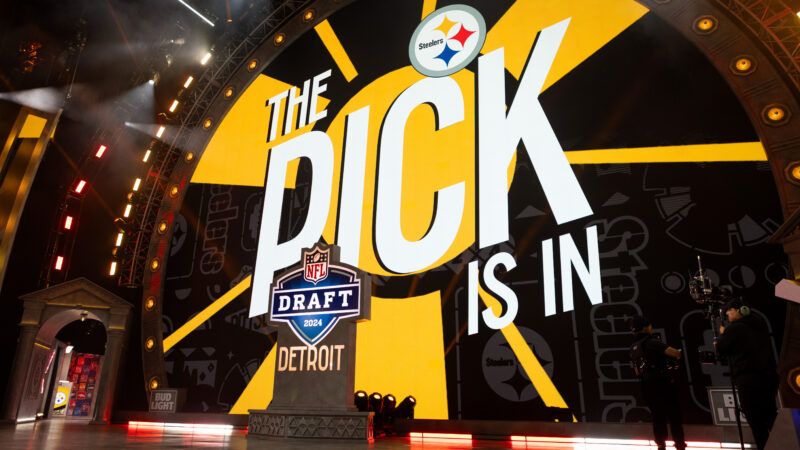
If you believe the NFL and local authorities, hordes of football fans are about to descend on Pittsburgh from all over the country to spend gobs of money watching the NFL draft in person, forever altering the region's economy for the better. As many as 700,000 fans might attend, they say, with the expected economic impact well within the range of "$120 million to upwards of $213 million." (Don't worry, the draft will also result in 500 new trees planted in Allegheny County, plus "400 hanging flower baskets and 420 yellow-and-black planters" installed downtown.)
If you really think all that is going to happen, then spending a measly $19 million in taxpayer dollars to bring the draft to town seems well worth it. Pennsylvania is spending about $13 million of that, with the rest coming from county and city sources. It is mostly flowing to Pittsburgh's tourism nonprofit, VisitPittsburgh, which has vaguely said it is spending $16 million on "essential services" (according to great reporting by Mia Hollie of Pittsburgh's Public Source). The main intent of that spending is on tourist marketing, though.
The problem is that most draft attendees are not traveling from the farthest corners of the country—it's mostly locals and day-trippers. The total attendance numbers and economic projections are overly rosy too. Once you realize that, the whole facade of the draft as an economic engine worth public subsidies starts to fall.
"The overwhelming majority of visitors are local residents or day-trippers and much of their spending is likely redirected from other local entertainment or dining options rather than being economic gains for the host cities," economist E. Frank Stephenson from Berry College wrote in a paper last year. "The net gain in room rentals in the 2019-2024 host cities varies greatly from a decrease of nearly 20,000 room nights in Las Vegas to an increase of about 9,000 room nights in Nashville, but in all cases is a small fraction of the claimed number of people attending draft-related events."
That $19 million in taxpayer spending on the event is just the floor, too. "Pennsylvania State Police said they, too, are coordinating security planning, traffic tactics, risk assessments and interagency exercises, while declining to provide an estimated cost for that work, citing security reasons," writes Adam Annaccone with the University of Texas at Arlington. "That means the public cost of hosting the draft may be visible only in part." The cost isn't just financial, but time: Authorities have spent months training and preparing for the event instead of working on other priorities.
It's not just law enforcement spending time on the draft, the city is also using in-kind staff time from at least nine city departments, "including, but not limited to: Office of the Mayor; Office of Management and Budget; Innovation and Performance; Finance; Permits, Licenses, and Inspections; Public Safety; Public Works; Parks and Recreation; Mobility and Infrastructure," according to a 2024 city resolution.
Perhaps worst of all, the city's public schools are switching to remote learning from Wednesday through Friday because of the draft—even though the draft doesn't start until late Thursday night.
So overall, Pittsburgh hosting the draft is costing tens of millions of taxpayer dollars (largely spent on marketing), likely won't meet its overly optimistic attendance and economic impact projections, involves spending a secret amount of money on security, takes up hours and hours of law enforcement and city government staff time, and also keeps kids out of schools for three days.
But hey, at least Pittsburgh is going to get some new trees and flowers out of it.
The Picks Are Screwed
I'm not trying to persuade you to skip watching the draft in person or on TV. If you're into that, great! Since the Lions are a bit unpredictable with their draft strategy, I usually just wait until I get a phone notification that tells me who we got, and then I'll read some grade reports afterward.
Either way, draft picks are going to be all smiles when they put on the hat for their new team this weekend. What they might not be thinking about is how much more money they could be earning if it weren't for the league's collective bargaining agreement with the players union.
Since 2011, drafted players have basically no negotiating power with their teams. Instead of arguing for their fair market value, they get a preset salary for four years (with a fifth-year option for first-rounders). Because the average career of a drafted player is roughly five or six seasons (though the data here is contested and murky), most NFL players don't get paid their real market value for most of their career, especially considering the dampening effects of the salary cap. Even with inflation and league growth, the first overall draft pick in 2026 still won't have a rookie contract as valuable as the first overall draft picks in 2009 and 2010 (partially because those picks, Matt Stafford and Sam Bradford, negotiated for longer deals).
It's an odd quirk of the law that this arrangement—preset salaries and employers assigned by draft—is only legal because it's been agreed on between the players union and NFL owners. "The system works out well for the league's owners, who get to keep a below-market ceiling on a large portion of their player contracts," as I wrote last year. "It works well for veteran players, who get to soak up a bigger portion of the salary-capped pie. It doesn't work out for young draft picks—and it's a surprise more of them don't speak out about it."
The Real Journey Is the Fares Paid Along the Way
As the World Cup gets closer, there was lots of discussion last week about some eye-popping public transit news: New Jersey is charging fans $150 for a round-trip regional train ticket to MetLife Stadium (far more than the usual $12.90).
Fortunately, C.C. Sabathia is here to help: He says you can park at his house for $75.
Similarly to New Jersey, Boston is charging $95 for a round-trip bus ticket or $80 for the train. Parking isn't an easy alternative either: To park near MetLife it'll cost you $225, and in Boston it's at least $175. Both stadiums are largely sealed off from other access points because they're surrounded by parking lots in the suburbs—it's not like you can just park in a nearby garage with a competitive price and walk a little bit further. Even Uber and Lyft aren't allowed within a mile of MetLife.
FIFA having its corrupt way with every single city and country its ever touched until suddenly being shocked and stunned into submission by a final, even more corrupt thing: New Jersey
— Conor Rogers (@conorjrogers) April 17, 2026
The economics at play here are interesting. Most fans have already paid hundreds of dollars, possibly thousands, for their match tickets—even more than the average price of an NFL game at these stadiums. They might grumble about adding an unexpectedly high transit cost to their expenses, but having already paid so much for tickets, they'll almost certainly suck it up and pay.
What's also interesting is the tightly controlled access to Gillette and MetLife stadiums. A bus service can't just undercut the expensive options with a budget-friendly $20 fare—it would need approval from FIFA's local organizers, the stadium operators, and the local governments if it wants access to stadiums past otherwise closed roads.
Basically, there's high demand for transit to stadiums, and governments (with some help from FIFA) are artificially limiting competitive options that would bring prices down.
Ideally fans would have multiple private sector options competing on price and quality to choose from. But because FIFA promised huge economic benefits that are unlikely to pan out, some governments are starting to look for ways to make up the money they're going to lose spending on security and other costs.
Fortunately, some cities have figured out ways to get private sector help: Fans leaving World Cup matches in Philadelphia can ride the subway for free, thanks to a sponsorship by Airbnb.
Replay of the Week
I've also never seen an indented center field wall like this.
You ever seen an inside-the-park grand slam?
WELL YOU HAVE NOW! pic.twitter.com/OnA6rGczTN
— Oklahoma City Comets (@OKC_comets) April 15, 2026
That's all for this week. Enjoy watching the real game of the week, the Sun Belt Women's Golf Championship.




