
Viktor Orbán and His American Apologists All Deserve To Lose
J.D. Vance in Budapest: 'We have got to get Viktor Orbán reelected as Prime Minister of Hungary, don't we?'
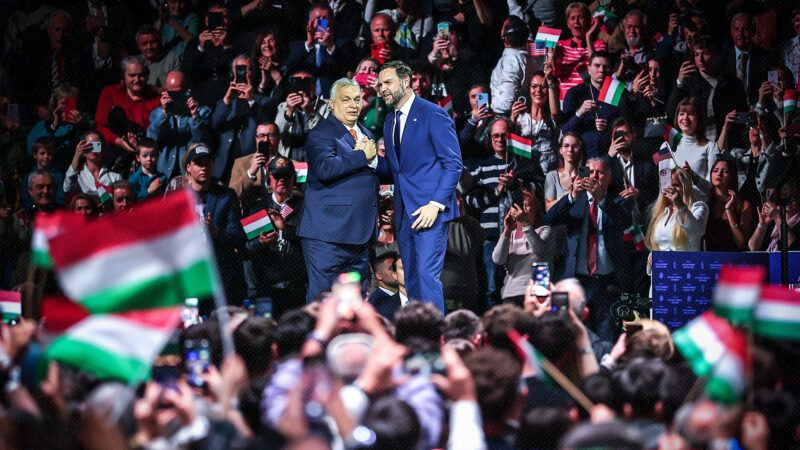
Five days before an election that threatens to unseat the longest-serving and most corrupt government within the European Union, Vice President J.D. Vance kicked off a campaign speech in Budapest Tuesday night by declaring, "We have got to get Viktor Orbán reelected as Prime Minister of Hungary, don't we?"
This raises some intriguing questions about we.
Does we refer to the American companies doing business in Hungary who were hit with anti-foreigner "windfall taxes" in 2022 to plug Orbán's latest budget deficits? Maybe it's the boys from General Electric, who made a historic 1989 investment in the region's first major privatization deal, only to see their financial wing get pushed out of the country in 2014 when Orbán began renationalizing banks?
We know that we isn't referring to Hungarian citizens living in America, because those who go vote at their local embassy or consulate are almost certain to back Orbán's opponent, the front-running Péter Magyar. And we're damn certain it isn't the overwhelming majority of Americans who sympathize with Ukraine rather Russia in the ongoing war next door, given that barely a day goes by without another embarrassing leak of a top official kissing Vladimir Putin's ring amidst an electoral campaign—very much including the events attended yesterday by Vance—whose main villain has been Volodomyr Zelenskyy.
So it's a narrower, political we, filled with people like Vance's putative rival for the 2028 GOP presidential race, Secretary of State Marco Rubio, who cooed to Orbán during his own campaign visit to Hungary in February: "Your success is our success." Though even there, Rubio's sincerity may be questioned, given that as senator in 2019 he co-wrote a letter to President Donald Trump expressing "concern about Hungary's downward democratic trajectory and the implications for U.S. interests in Central Europe," noting that "Hungary has experienced a steady corrosion of freedom, the rule of law and quality of governance according to virtually any indicator" while developing a concerning "close relationship" with Moscow.
There has understandably sprouted a whole journalistic cottage mini-industry to explain the inexplicable: Why has this administration shredded all precedent by going whole-hog campaign mode for the fading autocrat of a country whose GDP ranks somewhere between Greece and Uzbekistan? While I appreciate and learn from these efforts (and have contributed my share), there is, I think, a far more pressing issue for those Americans who may or may not give a rat's ass about Magyarország: Regardless of motivation, U.S. politicians are telling on themselves, and advertising their own potentially appalling behavior, by shilling for a proven anti-liberal failure.
"The president loves you, and so do I," Vance glazed Orbán on Tuesday, "because you're such an important part of what has made Europe strong and prosperous." Note well here the would-be next president's conception of prosperity.
Hungary, whose economy led all Central European countries out of the post-communist starting gate, now languishes in the per-capita second tier with once-devastated Romania. It is the 17th-largest economy in the 27-member European Union, despite having the 13th-largest population. Importantly, none of these numbers is obscure, even to a vice president. It's that Vance and other American Orbánistas define prosperity differently, there and here.
"In 2016, when the rest of Europe threw open its gates, you said no," Vance said at the campaign rally. "When strange activists came to tell you to erase your heritage, you said no. And when a war erupted in your neighborhood, you were kind and generous, you opened your neighborhoods, your homes, and your hospitals, but you never forgot the needs of your own people."
Or, if you prefer it in the original Hungarian, Orbán bragged of bilateral comity "especially in four areas: one, migration; number two, gender ideology; number three, family policy; and number four, global security." The migration issue is paramount, providing AmeriCons with the threefer of border security, disdain toward refugees from culturally dissimilar shithole countries, and contempt for out-of-touch multilateral elites.
It was on that latter note that Vance went HAM on Tuesday, alleging at a joint press conference with Orbán that "what has happened in the midst of this election campaign is one of the worst examples of foreign election interference that I've ever seen or ever even read about." (It can be noted here that in his controversial February 2025 speech at the Munich Security Conference, Vance dismissed Russia's documented influence campaigns on continental elections as "a few hundred thousand dollars of digital advertising.") More: "The bureaucrats in Brussels have tried to destroy the economy of Hungary. They have tried to make Hungary less energy independent. They have tried to drive up costs for Hungarian consumers, and they've done it all because they hate this guy."
While the hate is very much real (and mutual), what with Orbán exercising Hungary's policy veto far more than any other country, the accusations of economic destruction are bizarre. As economist Johan Norberg wrote in a damning and detailed Cato Institute report at the end of March, "Hungary has received more in EU funds than any other major postcommunist EU country, both as a share of GDP and per capita."
The biggest relevant E.U./Hungary policy action during reelection season was Orbán's February decision to renege on his December 2025 vote in favor of a €90 billion E.U. loan to Ukraine (none of which Hungary is paying for), a reversal that came in the wake of Zelenskyy slow-walking repairs to the Druzhba pipeline that brings Russian crude oil to Hungary and Slovakia via Ukraine. (The pipeline was hit by Russian bombing on January 27.) E.U. negotiators have been leaning on Zelenskyy to expedite the fixes.
What crosses from the bizarre to the risible is that, on a day that Zelenskyy was serially portrayed in his presence as an uber-villain, the vice president of the United States repeatedly praised Viktor Orbán's defense of sovereignty.
"I stand here today because President Trump and I stand with Europe. We stand for sovereignty, we stand for Hungary, and we stand shoulder-to-shoulder with the man who has done more to defend those values than anyone else, Viktor Orbán," Vance claimed, on a day when Orbán had said right next to him that "it was an extremely strange idea to actually help the Ukrainians." Dressing up reverence for Western civilization in the language of national sovereignty while sneering at a nation fighting a defensive war for its existence may find an audience in Hungary, a country that has for more than a century nursed nationalist, paranoid, and sometimes irredentist grievances against its immediate neighbors. But the pretzel logic seems unlikely to play in Peoria.
It will be morbidly fascinating to see how Vance, Trump, and Rubio will react if Orbán loses the election but then engages in legal chicanery to dispute or overturn the results. He has, after all, expanded and packed the Hungarian Supreme Court; embedded his political party's control over whole swaths of the country's commercial, media, and civic institutions; and spent the past few weeks making increasingly lurid accusations of Ukrainian election interference. Trump, no stranger to fantastical election-contestations of his own, has put more personal investment in this one faraway election than any American president has in any foreign election in history, while touting a National Security Strategy that openly backs "patriotic European parties" and cultivates "resistance to Europe's current trajectory within European nations." The incentives going in are a mess.
Asked Tuesday whether the White House will still have a "golden age" relationship with Hungary if Péter Magyar wins, Vance demurred: "Well, of course we're going to work with whoever wins the Hungarian election, because we love the people of Hungary and it's an important relationship. But Viktor Orbán is going to win the next election in Hungary, so I feel very confident about that."
American postliberal conservatives know Viktor Orbán's voluminous track record of steering his country downward on virtually every comparative international ranking of freedom, prosperity, and the rule of law. They know that he has serially expropriated private pensions, seized private property from foreigners, regulated whole private industries out of business, and taken government stakes in hundreds of previously private companies. They don't care. In fact, they see it as aspirational.
They all deserve to lose.
