

Trump Is Openly Targeting Innocent Civilians
He's using tools that were advertised as humane, but he isn't hiding the cruelty involved.
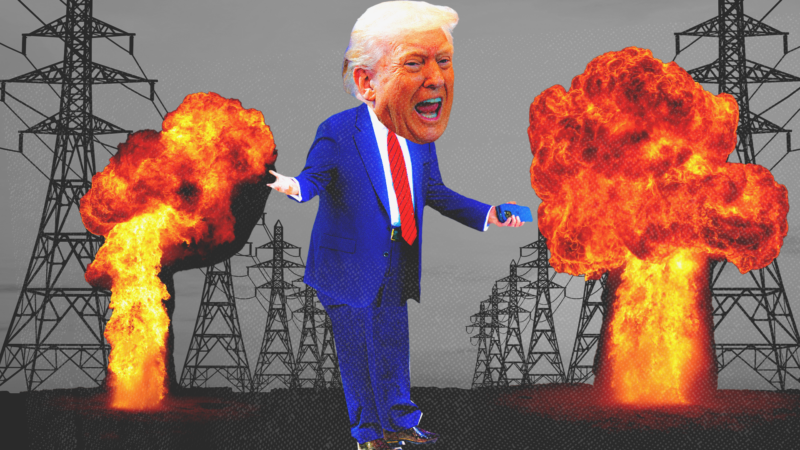
President Donald Trump got straight to the point. "A whole civilization will die tonight, never to be brought back again. I don't want that to happen, but it probably will," he wrote in a Tuesday morning social media post directed at Iran. Despite unfounded speculation that Trump was planning a nuclear attack, the post likely referred to Trump's earlier threat to blow up all the bridges and power plants in Iran.
For years, bureaucrats and the chattering class in Washington have tried to justify innocent people's suffering from war and sanctions. America's enemies hide among civilians and weaponize civilian infrastructure, they argued. Military strategy and sanctions policy were designed to leave civilians alone, they claimed. Wars and sieges would actually liberate people suffering under evil regimes, they asserted. Trump keeps making their job harder by speaking frankly about what his goals actually are.
When the U.S. military bombed the B1 highway bridge outside Tehran, killing eight people at a nearby family picnic, Axios breathlessly repeated anonymous officials' claims that Iran was using it as a "military supply route." Except that was impossible, because the bridge wasn't finished when it was bombed. And Trump himself bragged about destroying "the biggest bridge in Iran," making it clear that the attack was meant to send a message to Iranians.
When Trump first threatened to blow up the Iranian power grid, The Wall Street Journal reported that electrical infrastructure is fair game in war if attacking it "makes a concrete contribution to a military operation and the potential harm to civilians is minimized." CNN's Jake Tapper similarly claimed that "the President could argue that the infrastructure has dual use and also is utilized by Iran's military." But Trump said bluntly that his goal was to send Iranians "back to the Stone Age, where they belong."
Although Trump is unique in his verbal aggression, the project of sending Iran to the Stone Age was years in the making—and bipartisan. Both the first Trump administration and the Biden administration imposed sanctions on Iran's civilian industries, for example, on the grounds that steel mills and automakers were supporting the Iranian military. The first Trump administration even put terrorism sanctions on an Iranian university, calling it a "recruitment network" for the Iranian military and intelligence services.
The exact same logic was on display when warplanes bombed Iranian factories and college campuses over the past week. (The Israeli army, which carried out the campus bombings, claimed that some of these campuses trained future military officers and researched weapons technology.) Ironically, one of the targeted universities, the Sharif University of Technology, had been the site of renewed anti-government protests right before the war.
The difference is that back then, the U.S. government tried hard to deny the cruelty of its actions. The first Trump administration insisted that its sanctions on Iran were only aimed at the government, not the people, and even whined that journalists were spreading enemy "propaganda" when they reported on civilians suffering from the sanctions. The Biden administration similarly denied the civilian impact of its sanctions campaigns around the world.
And while supporting the Israeli military campaign in Gaza, former President Joe Biden made sure to put a moral gloss on it. He highlighted Hamas' role in starting the violence, distanced himself from Israeli excesses, made a show of sympathy for the Palestinian people, and hid evidence of Israeli troops abusing Palestinian civilians. The consistent through line was keeping the moral high ground, honestly or not.
Trump, however, has no need for such niceties. He has said for years that moral restraints, such as the laws of war, make America weaker. And he is specifically attracted to the idea that brutality against defenseless targets—torturing prisoners, threatening enemies' family members, and killing negotiators in the middle of negotiations—is a clever way to gain leverage that no leader should eschew. "We could have won every war, but we really chose to be very politically correct or wokey and we just fight forever," Trump said in a September 2025 speech.
Whether that sort of strategy works is another question. (So far, it has not gotten Iran to stop fighting.) But morally, it is what it is. Trump openly wants to make innocent people suffer as a form of power, including by possibly killing "a whole civilization." And he has found plenty of tools in the U.S. policy toolbox, once sold as humane, that can accomplish that goal.




