

Your Steak Isn't Killing the Planet
Some climate activists want a meat-free future. The science says otherwise.
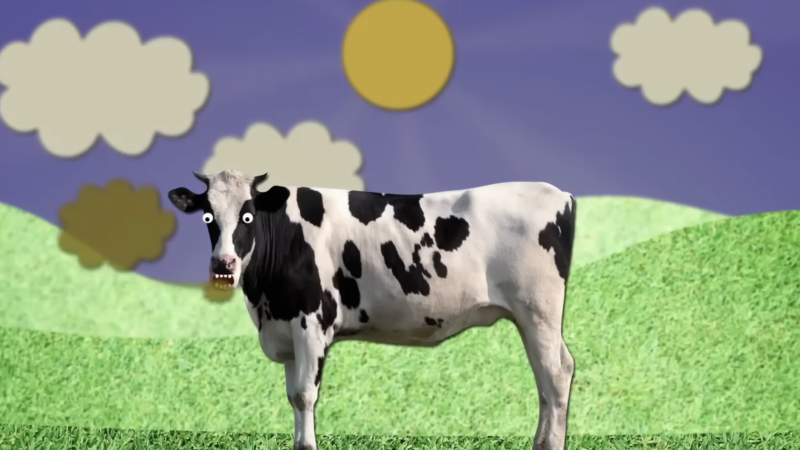
Do you eat steak? You're killing the planet! So say climate activists.
Silly media agree: Vox warns that beef is the "worst thing we eat when it comes to global warming."
The World Economic Forum (WEF), which says it's "committed to improving the state of the world," released a video promoting a future where "you'll own nothing and you'll be happy. You'll eat much less meat."
How does meat threaten the climate?
Cows give off methane—a greenhouse gas.
"Cow flatulence," says Rep. Alexandria Ocasio-Cortez (D-N.Y.) on MSNBC, "it actually is an issue."
As usual, she gets it wrong. It's not flatulence that produces most methane—it's burping, from the other end.
Bill Gates suggested the world should genetically modify cows to "not be so much a source of methane emissions."
Celebrities believe.
Ellen DeGeneres tells viewers: "Be neat. No meat."
Arnold Schwarzenegger went vegan and now says, "Less meat, less heat!…Livestock…creates more pollution than all the transportation combined."
Is it true?
Probably not.
In our newest video, Stossel TV Fellow Linnea Lueken checks out the facts.
She interviews Sailesh Rao of Climate Healers, a group that promotes global veganism and the end of all animal agriculture. That means no leather for shoes, no wool or cashmere, no eggs or milk.
Rao claims animal agriculture has "caused more than half of the warming we are experiencing today."
"That's just nonsense," says Gregory Wrightstone, director of the CO2 Coalition.
"The life cycle of methane is just 11 years. Any methane emitted today will be gone by the year [2037]."
Lueken pushes back, "The United Nations says methane is 80 times more potent than carbon dioxide."
"It is 30 times, not 80," replies Wrightstone, "and CO2 population in the atmosphere is 300 times as much as methane. That means methane's warming potential itself is actually 10 percent of that of CO2."
He acknowledged that methane does increase warming, but he says that's not a threat.
"We're going to see 0.05 degrees Celsius warming in the next 50 years from methane," says Wrightstone. "That's an extremely small number that you can't even measure."
"You're just a science denier," replies Lueken.
"That's not only wrong, it's quite insulting to me and my other scientists," says Wrightstone. "What we're doing is trying to bring the scientific method into the climate change debate."
I assumed science is what climate scientists do, but Wrightstone says reasonable research rarely gets published.
"A lot of the experts, particularly at universities, only get funding if they toe the company line."
The "company line" says climate change is a horrible crisis, so climate researchers need more money.
The climate activists push imitation meats like Beyond Meat and Impossible burgers.
"Veggie burgers," says Rao. "Burgers made of mushrooms. The planet is paramount!"
But mock meats have never surpassed a 2 percent market share, and lately, sales have been dropping.
"Do you really think that Americans are going to give up their hamburgers?" Lueken asks.
"It's a hard sell," admits Rao, "but nature cannot be argued with."
Activists at the United Nations and WEF push even more dubious alternatives, such as "insect-based proteins." The WEF lists "5 reasons why eating insects could reduce climate change."
Ready to eat bugs?
Fortunately, the conversation around climate has shifted. The doom and gloom narrative has weakened.
"There is no climate crisis," says Wrightstone. "Earth's ecosystems are thriving and prospering. Humanity is benefiting. We should celebrate that, not demonize it."
And we should stop spending taxpayer money subsidizing crackpot schemes of climate hysteria promoters like Al Gore and his rich friends.
Linnea Lueken is the newest Stossel TV Fellow. To apply to be a Fellow, and make a video with our team in New York City, apply at johnstossel.com/fellow.
COPYRIGHT 2026 BY JFS PRODUCTIONS INC.




