
Prairieland Verdict: Texas Man Found Guilty of Transporting Constitutionally Protected Pamphlets
Eight others were convicted on vague "terrorism" charges—causing serious concern among First Amendment advocates.
A federal jury in Fort Worth, Texas, convicted eight protestors on charges ranging from rioting to attempted murder after a noise demonstration turned violent outside Immigration and Customs Enforcement's (ICE) Prairieland Detention Center last summer. Federal prosecutors claim the group was part of an "Antifa Cell" and provided "material support to terrorists." First Amendment legal scholars have raised serious concerns about the chilling effect these prosecutions and convictions will have on future political dissent.
One man's conviction emphasized just how far that chilling effect could go. Daniel Rolando Sanchez-Estrada, the husband of one of the convicted protestors, wasn't present at the time of the July 4 demonstration. After receiving a call from his wife, Maricela Rueda, from the Johnston County Jail, in which she told him to do "whatever you need to do" and "move whatever you need to move at the house," officers began watching Sanchez-Estrada, according to the criminal complaint filed against him.
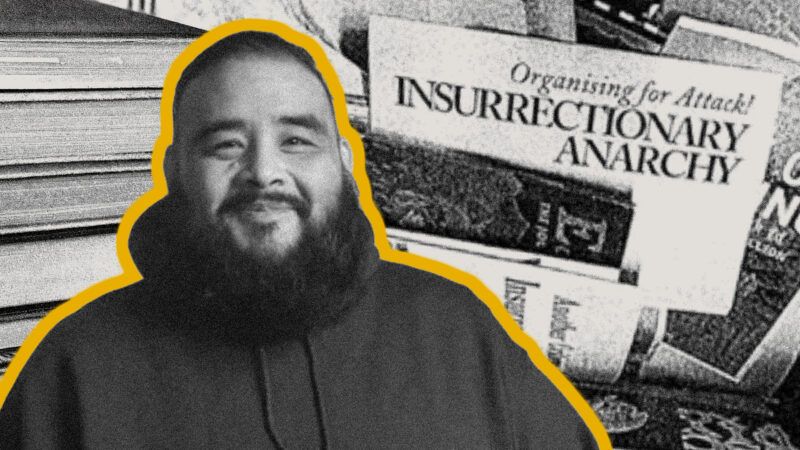
Shortly after, officers observed Sanchez-Estrada load and move a box from his home to another residence. Sanchez-Estrada was then arrested on state traffic offenses, and officers obtained a search warrant to locate and search the box. Inside, they found "numerous Antifa materials, such as insurrection planning, anti-law enforcement, anti-government, and anti-immigration enforcement documents," according to a November indictment. Sanchez-Estrada was subsequently charged federally with corruptly concealing a document and conspiracy to conceal documents.
Sanchez-Estrada was convicted on both counts on March 13 and now faces up to 40 years in federal prison. But despite ICE proclaiming in a post on X that the contents of Sanchez-Estrada's box contained "literal insurrectionist propaganda," these controversial materials fall squarely under constitutionally protected speech.
"I feel like the U.S. lost here with this verdict and what it means for future defendants," Christopher Weinbel, Sanchez-Estrada's federal public defender and a U.S. Army veteran, told The Washington Post. "I feel like it turned its back on justice with this."
The other eight protestors were charged and convicted of rioting, providing material support to terrorists, conspiracy to use and carry an explosive, and using explosives after they set off fireworks outside the Prairieland ICE facility. Rueda was also convicted of conspiracy to conceal documents along with Sanchez-Estrada. Additionally, Benjamin Song was convicted of attempted murder of a U.S. officer and discharging a firearm in furtherance of a crime of violence after he allegedly shot and wounded a police officer during the demonstration.
In response to the convictions, Attorney General Pam Bondi said the guilty "verdict on terrorism charges will not be the last as the Trump administration systematically dismantles Antifa and finally halts their violence on America's streets." But First Amendment lawyers are wary of conflating constitutionally protected speech after President Donald Trump signed an executive order in September categorizing the loosely defined "antifa" as a "domestic terrorist organization."
Suzanne Adely, president of the National Lawyers Guild, a progressive legal group, told the Associated Press that the government wants to "squash" opposition, and a case like this one creates fear, "hoping that folks in other cities then will think twice over protesting." The U.S. district judge presiding over the case, a Trump nominee, Mark Pittman, also signaled First Amendment concerns, according to The Guardian, when he asked prosecutors about the relevance of including antifa in the jury instructions. "Whether it's antifa or the Methodist Women's Auxiliary of Weatherford, why does it matter?" Pittman asked during the trial, reported The Guardian.
Although free speech advocates sometimes fail to clearly acknowledge that some expressive activities—such as destruction of property, trespassing, or shooting someone, as allegedly happened in this case—are crimes not protected under the First Amendment, they are right to point out the danger inherent in broadly criminalizing protected political dissent—like owning anti-government zines. The more zealously the Trump administration prosecutes dissenting political beliefs as crimes such as domestic terrorism, the more content Americans will deem worthy of concealing, destroying, or shunning for its potential to be used as evidence of criminality—just like in Sanchez-Estrada's case—creating a mass chilling effect.
The Trump administration isn't wrong to point out that crimes, including property and violent crimes, have been committed during protests. But by broadly defining domestic terrorism to include constitutionally protected speech, the Trump administration will be successful in dismantling a lot more than the "antifa" movement, and will dismantle Americans' First Amendment rights instead.
