

After Paying Illegal Tariffs, Will Small Businesses Get a Refund? 'I'm Not Holding My Breath.'
Even if the refunds are made, business owners say they won't cover all the additional costs created by Trump's chaotic trade policies.
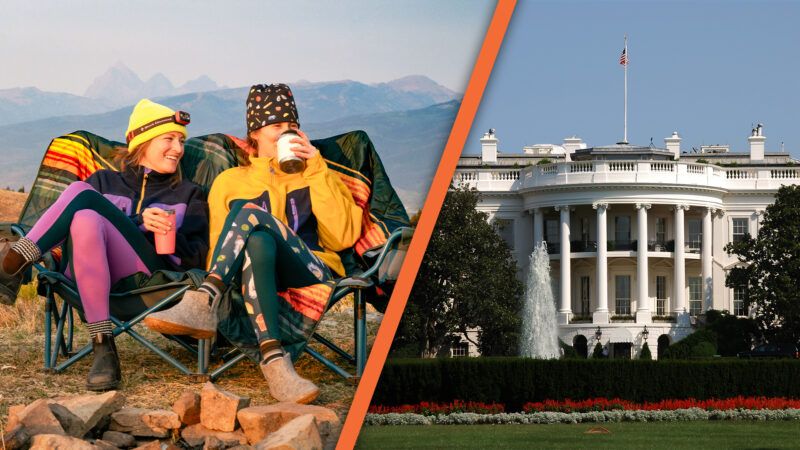
After being charged billions of dollars under President Donald Trump's unlawful tariff scheme, American business owners are now facing the prospect of a lengthy, costly process to obtain refunds—payments that some expect will never arrive.
"I'm not holding my breath," Brandon Eley, founder and president of 2BigFeet, a Georgia-based designer and retailer of large-sized footwear, told Reason in an interview this week.
Eley says 2BigFeet paid more than $10,000 in tariffs last year to import shoes from China and Brazil. The cost of the tariffs led him to lay off a product designer and postpone shipping on several new product lines.
With a small staff and no capacity to hire trade attorneys, small businesses like Eley's are stuck just waiting to see what happens with the refunds.
The Supreme Court ruled two weeks ago that Trump acted illegally when he imposed those tariffs under the International Emergency Economic Powers Act (IEEPA). Thousands of businesses have filed requests for refunds, but Treasury Secretary Scott Bessent says those payments could take "months" to litigate.
"It's really frustrating because so many businesses that could be growing the U.S. economy are hurting massively right now," Cassie Abel, founder and CEO of Wild Rye, an outdoor clothing company based in Idaho, told Reason.
Abel's business, which she launched in 2016, sells biking, hiking, and snow sports apparel to women and relies on supply chains that stretch from Italy to China. She says Wild Rye was hit with more than $500,000 in tariff payments over the past year—enough to force her to hike prices on consumers and pause plans to hire additional employees.
On Wednesday, the Court of International Trade ordered Customs and Border Protection to provide immediate refunds to importers who had paid the tariffs now invalidated by the Supreme Court. The administration is likely to appeal that ruling.
The administration could also try other tactics, like delaying "liquidation"—the technical term for Customs and Border Protection's final decision regarding the accuracy of an importer's customs entry, including the value of the goods and how they were categorized for tariff payments. That process is supposed to be finished within 314 days, but the treasury secretary has the power to delay liquidation by up to three years on certain entries, including to ensure "compliance with applicable law."
With all of that in play, some business owners aren't banking on those refunds.
"I feel like small companies like ours are going to be at the end. If we get a dime, it's going to be at the very end," said Eley.
More than 2,000 businesses have already sued over the refunds—including some big names like FedEx and Costco. Still, the $175 billion of unlawfully collected IEEPA tariffs came from more than 300,000 different importers, according to government data reviewed by Bloomberg. Many, and probably most, of those businesses will lack the resources for a protracted legal fight over the refunds—particularly as they brace for the additional tariffs Trump announced in the wake of last month's Supreme Court ruling.
Slow walking the refunds might be a deliberate strategy by the Trump administration, which seems to be preparing for a "war of attrition" against American small businesses, says Scott Lincicome, vice president of general economics at the Cato Institute.
If litigation over the refunds takes years, as Trump has suggested, then some businesses might decide it's not worth paying thousands of dollars in legal fees to fight it out in court. That means the government might get to keep some of those unlawfully collected taxes just because it made the refund process so complicated and costly.
"You're talking about a situation where it could take several years of litigation, and could even have to go back to the Supreme Court," Lincicome says. "There is a chance this is going to leave out a lot of small businesses, and that's really unfortunate."
It could also be unfortunate for taxpayers, who might end up on the hook for interest payments on those tariff refunds. In a response to the Court of International Trade this week, the executive director of the U.S. Customs and Border Protection's office of trade told the Court of International Trade that "applicable law" requires that "any validated refund of IEEPA duties would include interest."
Cato's calculations show that the government could end up owing $23 million for every day that the refunds go unpaid. That's $700 million per month and roughly $3 billion if courts grant the administration's request for a 120-day delay in judgment.
Getting the money back would be a big help, of course, but Abel says it wouldn't cover all the additional costs she absorbed due to the tariffs. Like the payment made for expedited shipping on an order last summer to beat the deadline when tariffs would increase. Or the anxiety that she had to see a doctor to treat last year.
"It's taken a physical toll, it's taken an emotional toll, it's been a huge drain on resources," she says. "It feels like we're being crippled. Our government is working against U.S. businesses."




