

Zohran Mamdani's $70 Million Grocery Gamble
Amid a $5.4 billion budget deficit, the mayor of New York City is pushing forward with a proposal that has historically yielded terrible results.
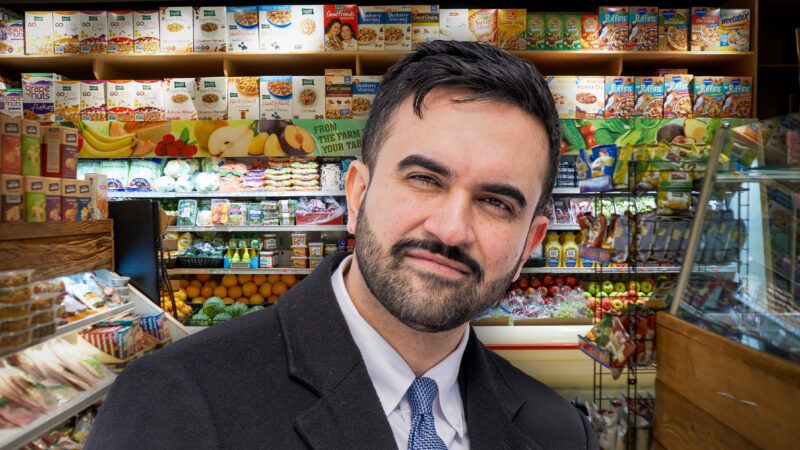
New York Mayor Zohran Mamdani is facing a tough reality check. Just a few months into office, the new mayor's dreams of free buses, free child care, and government-run grocery stores are running into the brick wall of New York City's massive budget deficit. But when it comes to government food stores at least, the mayor is doubling down anyway.
The city currently faces a $5.4 billion budget gap, which Mamdani has largely blamed on former Mayor Eric Adams. In turn, Mamdani's primary proposals for closing the gap are to either pressure New York Gov. Kathy Hochul and state legislators into raising taxes on the wealthiest New York City residents and corporations—the mayor's preferred path—or enacting a 9.5 percent property tax in the Big Apple.
Gov. Hochul has poured cold water on the tax-the-rich route, while an across-the-board property tax increase has unsurprisingly received substantial backlash. The latter would also require the acquiescence of the New York City Council, but City Council Speaker Julie Menin has already dismissed the idea as a "nonstarter."
Of course, other options beyond raising taxes exist for addressing NYC's budget mess. Namely, the city could cut spending and exercise fiscal restraint. But if spending cuts seem like a pipe dream for a democratic socialist mayor, one might at least expect a temporary moratorium on expensive new spending items.
No such luck. Despite NYC's fiscal situation, the New York Post reports that Mamdani plans to earmark $70 million for his central campaign proposal of government-run grocery stores. The funding would supposedly flow to the city's Economic Development Corporation (EDC), which would be tasked with scouting sites for the five proposed stores across Gotham's five boroughs, as well as spearheading the construction of the stores.
The $70 million price tag is an escalation from the mayor's $60 million campaign trail projection, and it's just the start. The Post confirmed with EDC that the reported $70 million doesn't even include the cost of a feasibility study for the new grocery stores, the price tag of which remains unknown.
It also doesn't cover the ongoing cost of running the stores, such as building maintenance or paying the salaries of government employees who may ultimately staff the stores (the mayor has left the operational details unclear so far).
As commentators across the ideological spectrum have pointed out, government-run grocery stores are a particularly bad policy idea. For one, past efforts have met with poor results and have cost cities money that can never be recouped.
There's also little evidence that they accomplish their intended purpose of helping city residents.
According to NYC's Deputy Mayor for Economic Justice, Julie Su (who served as President Biden's former Acting Secretary of Labor), the priority is to target so-called "food deserts" in NYC in order to provide better access to healthy food options. But research has failed to turn up much evidence that government-run stores lead to healthier eating habits among local residents.
Government-run stores would also inevitably inject more politics into the food supply. Food—like everything else—has become increasingly politicized in recent years, and putting the government in charge of stocking store shelves would simply accelerate this trend.
As I wrote about previously in these pages, what constitutes "healthy" eating has been controversial for decades. The federal government, in the form of its dietary guidelines, has vacillated back-and-forth about which food groups are good or bad, embracing recommendations that have arguably contributed to rising American obesity rates over the years.
It's similarly foolhardy to expect NYC's government to demonstrate nutritional clairvoyance in what it puts on government-owned shelves. A final lesson can be learned from the experience of state-run liquor stores—still present in 13 states—which have demonstrated that these government-run retailers are engines for corruption and political favoritism.
Mamdani's government-run grocery stores make neither political nor financial sense. But despite a massive budget shortfall, the mayor remains undeterred in his efforts to run up the grocery bill.




