

Trump Said Tariffs Would Reduce the Trade Deficit. Instead, It Hit a Record High in 2025.
It's a good thing that trade deficits aren't actually a national emergency.
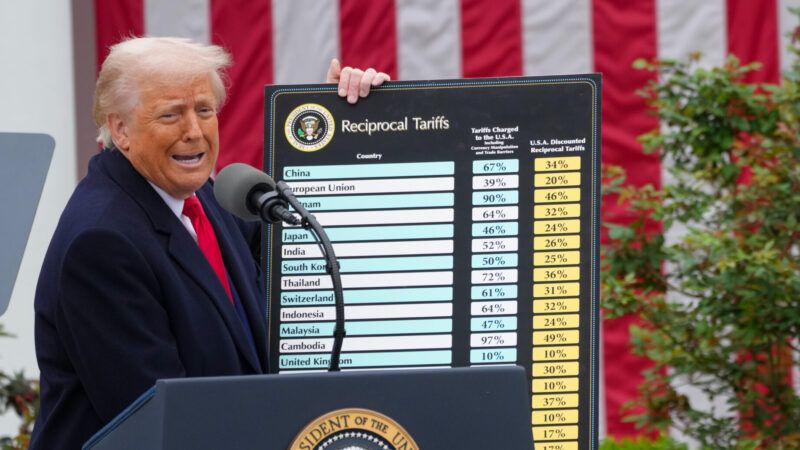
As he announced a broad set of new tariffs targeting imports from around the world, President Donald Trump declared his intention to reduce America's trade deficit.
"Chronic trade deficits are no longer merely an economic problem," Trump said in April during a speech from the White House's Rose Garden. "They're a national emergency that threatens our security and our very way of life."
If that's true, then the first year of Trump's tariff regime has heightened the threat.
New data released Thursday by the Census Bureau show that America's trade deficit—the gap between the total value of all imports and all exports—hit a record high in 2025.
America imported $3.44 trillion of goods during 2025, the Census report shows. That's a $143 billion increase over 2024, despite the higher taxes applied to many of those imports last year. Meanwhile, exports increased by $123.5 billion to a total of $2.2 trillion.
That leaves a trade deficit of $1.24 trillion for the year—a 2.1 percent increase over 2024 and the largest total ever reported.
Thankfully, trade deficits are neither an economic problem nor a national security one. In reality, a trade deficit is little more than an accounting gimmick, and America imports more than it exports because it is a very wealthy country that can afford to buy a lot of goods from the rest of the world.
That's a good thing. Indeed, the only time in recent history that the trade deficit declined was during the so-called "Great Recession" following the 2008 mortgage crisis. That's not a period of history most people would be eager to repeat, even if it meant the gap between imports and exports was falling.
After misdiagnosing a problem where there isn't one, Trump also applied the wrong policy choices to achieve his goal.
Tariffs don't reduce trade deficits. That's something that plenty of economists could have told the White House, if only the administration were willing to listen.
"When tariffs reduce imports, they also reduce the supply of dollars that pay for imports," warned Joseph Gagnon, a senior fellow at the Peterson Institute for International Economics, weeks before Trump's "Liberation Day" tariff announcement. "The result is that imports do not shrink as much as would be expected from the tariff alone, and exports shrink by an equal amount, leaving the deficit unchanged."
Or Trump could have looked at the trade deficit stats from his first term in office, when he hiked various tariffs. Despite that, America's trade deficit climbed from about $481 billion in 2016 to $679 billion in 2020.
Like all policies, Trump's tariffs ought to be evaluated by their consequences—rather than by their intentions or the peculiar preferences of the president's economic advisors. After the first year, the conclusion is inevitable: Trump promised a lower trade deficit, and the opposite has occurred.




