
Support for Republicans Is Tanking. But Why Are Democrats Hated Just as Much?
Trump's second term is wrecking the Grand Old Party—and Democrats' refusal to own up to Biden's failure is killing the party of Jefferson and Obama.
Just a few weeks before Donald Trump celebrated the start of the second year of his—potentially—last term as president, Gallup released a truly stunning poll about how Americans self-identify in political terms. When asked, "As of today, do you consider yourself a Republican, a Democrat or an independent?" 45 percent chose the latter—a historic high for that self-evidently attractive designation. (Disclosure: I coauthored a book called The Declaration of Independents.) Meanwhile, a paltry 27 percent of respondents confessed they were either a Republican or a Democrat. That's very close to the all-time low for Republicans and represents the absolute nadir, so far, for Democrats.
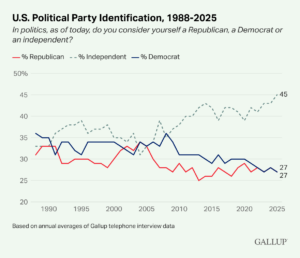
There's a lot to suss through in these results. I'll come back to what it might mean to be an independent later, but first let's focus on Republican and Democrat, two labels that predate the Civil War. Like a lot of things that old, they aren't doing so hot.
The plummeting in Republican identification surprises nobody outside of the president's Cabinet meetings, where his top officials routinely veer into parodies of North Korean politics by showering him with excessive praise and delusional reports on the effectiveness of his failing signature policies.
Reason's Brian Doherty exhaustively catalogued Trump's first year back in power as a specifically "libertarian nightmare," with the attacks on free speech, the imperial adventures, the stupid and self-defeating tariffs, the brazen family corruption, the unrestrained spending, and the murderous immigration enforcement actions. But of course, it's not just libertarians who are put out by Trump's return to power. At this point, everybody is sick of The Donald and they are taking it out on the party he leads. And that was happening even before Immigration and Customs Enforcement agents shot and killed two protesters in Minneapolis in late January and administration officials started attacking the Second Amendment, a move that "widens a split between Trump and gun rights groups," one of the GOP's most loyal contingents.
In a deeply polarized America, the president is doing the hard work of bringing a supermajority together in opposition to him and his party. Nate Silver notes that as of Valentine's Day, there was little love for Trump. His approval rating was just 40.5 percent, meaning that he was even less popular than Joe Biden at the same point in his presidency and Trump himself the first time around. As Trump officials and nominees talk up Scots-Irish whiteness as the sine qua non of American identity, it's not surprising that Latino votes are flowing back to the Democrats. "Just one year after Trump soared to victory with 48 percent of the Latino vote nationally," reported Politico after last fall's elections, Hispanics in places such as New Jersey, Virginia, and California "boomeranged back to Democrats…signaling the fraying of his coalition less than one year into his second term."
On the economic front, Trump's signature moves have all backfired and the failure is exacerbated by ideologically flexible defenders such as his chief economic adviser Kevin Hassett, whose long career promoting free trade at places such as the American Enterprise Institute ended when he joined the administration (most recently, Hassett called for researchers at the New York Federal Reserve to be "disciplined" for publishing research showing that domestic consumers shoulder 90 percent of the burden of tariffs). Tariffs have failed to bring back manufacturing jobs (indeed, by last December, almost 100,000 factory jobs had gone missing) or improve the admittedly useless metric of trade deficits. As Reason's Jack Nicastro wrote last year, the country's trade deficit grew since "Liberation Day," even as China exported more in 2025 than in 2024. At long last, America is tired of so much winning.
But if it's easy to make sense of why Republican self-identification is cratering, how to explain that the Democrats are not just doing badly, but historically badly—indeed, as badly as Republicans? Note that what Gallup shows is not a recent crash but a long, barely uninterrupted slide since 2009, when former President Barack Obama's honeymoon ended despite (or maybe because of) his stunningly expansive yet spectacularly ineffective stimulus spending during the Great Recession and the interminable and unprincipled wrangling within his own party to drag the Affordable Care Act over the legislative finish line (accomplished by giving away more and more "sweeteners" to Democratic holdouts). While Obama exited the White House far more popular than George W. Bush had, his lies about ubiquitous government spying on people—revealed by Edward Snowden—turned his boasts about running "the most transparent administration in history" into a joke. On his watch, the Democrats lost unified control of the House and Senate, the ultimate sign of voters being turned off by a particular president and his party (as Trump himself would learn in the 2018 midterms when his GOP coughed up the House).
Although Hillary Clinton deserves virtually all of the blame for the outcome of the 2016 presidential election—she ran a truly terrible campaign that failed to motivate Democratic loyalists along with undecided voters, all while blaming a fawning media for self-generated scandals—that the contest was close enough for Trump to win at all is also a testament to Obama's time in office and his party's inability to connect with voters.
Per Gallup, during Trump's first term, Democratic self-identification stabilized for a few years around 30 percent before dropping again during Biden's presidency. Like Trump in his first term, Biden enjoyed full party control of Congress during his first two years, a situation that has proven to be a curse to recent presidents. As political scientist Morris Fiorina has shown in books such as Unstable Majorities, when a single party enjoys full control of the federal government, they enact policies that reflect the ideological extremes of their party and alienate centrist voters, leading to what he calls "electoral chaos," meaning the party in power ends up losing control of all or part of the government in subsequent elections. Historically, there have been long periods of unified control of the government, but since the start of the 21st century, neither major party has been able to assert control for very long. In 2006, Bush and the Republicans lost control of the House and the Senate. After winning in a landslide in 2008, Obama and the Democrats lost control of the House in 2010 and then the Senate in 2014. In 2018, the Republicans under Trump lost the House. In 2022, under Biden, the Democrats lost the House before losing the presidency and both houses of Congress in 2024. It's important to understand that these flips happen precisely because a single party controls the government and is able to muscle through, however narrowly, an agenda that repulses most voters.
The bizarre circumstances of the 2024 election help explain why Democratic self-identification has reached a historic low. For understandable reasons, the Democratic Party doesn't want to dwell on how Biden, or his caretakers, only threw in the towel after his disastrous showing in his June 2024 debate with Trump. Forget all the gaslighting by the people around him and a pliant, you-gotta-believe media. Nothing prepared the country for the spectacle of Biden whispering hoarsely and going off on weird tangents about topics such as incest. "Here's the deal," he said while answering a question about abortion rights. "There's a lot of young women being raped by their in-laws, by their spouses, brothers and sisters, it's just ridiculous and they can do nothing about, they try to arrest them when they cross state lines." At another point, he announced, "We finally beat Medicare," which left even his most ardent supporters flummoxed as to the meaning. The chaos of the three weeks it took him to formally drop out, which he did via X rather than in a live press event, only cemented the idea that we were witnessing a "national pants-shitting moment" of truly historic proportions.
If the irrefutable reality of a deeply cognitively impaired president wasn't bad enough, the speedy coronation of widely disliked Vice President Kamala Harris without any sort of mini-primary or public selection system only added to the problems. Despite a strong convention and debate performance against Trump, Harris began losing steam as she made the election about Trump rather than outlining any sort of positive program that would improve our lives after four years of Biden, whom she also failed to separate herself from. Ultimately, reported the BBC, "she lost 13 points with Latino voters, two points with black voters, and six points with voters under 30." And she did worse with women than Biden did, pulling just 54 percent of their votes to his 57 percent. In her slim volume about the election published last fall, 107 Days, she expresses "apparent candor" but also fails to fully come clean about the dysfunction that ultimately made her a presidential candidate without ever once winning a primary.
Over Trump's first year in office, Democratic leadership has, at least until recently, mostly stayed quiet rather than noisily fight the Republican agenda. Such an approach might be channeling Sun Tzu's maxim to "never interrupt your opponent while he is in the middle of making a mistake," and all signs point to large gains by the Democrats in the midterms, especially if they end up being a referendum on Trump. But it is hard to see how the Democratic Party will staunch the long, slow bleed it's suffered since the early Obama years. In early polling about preferred presidential candidates, a large plurality (39 percent) chooses Harris, a result that can hardly inspire confidence, even as it mostly reflects name recognition more than anything else.
And to the extent that there is anything resembling a pulse in the Democratic Party, it belongs to younger, hard-left figures such as New York Rep. Alexandria Ocasio-Cortez and New York Mayor Zohran Mamdani, whose fan bases are as vocal as they are small in the overall scheme of things. Gallup reports that nearly six out of 10 Democrats identify as "liberal/very liberal" even as 74 percent of independents identify as moderate or conservative/very conservative. It seems unlikely that moving in the direction of the Democratic Socialists of America, which counts both AOC and Mamdani among its ranks, will increase self-identification for Democrats.
It is obvious that whichever party does better with independents will triumph both in the midterms and the 2028 elections. Most of the record-high 45 percent of self-identified independents lean to one party or the other, but a full 10 percent are nonleaners, more than enough to win virtually any election at any level. Exactly what or who those independents will vote for is unclear. In The Declaration of Independents, Matt Welch and I posited that just as voters were unbundling how they consumed media by dropping cable packages larded with unwanted and unwatched offerings, so too were voters unbundling their politics by deserting strong identification with two of the most-hated brands in America. When the paperback edition of our book came out in 2012, 28 percent of Americans called themselves Republicans, 31 percent called themselves Democrats, and 40 percent called themselves independent.
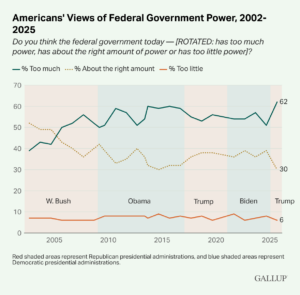
Fourteen years later, only one of those groups is growing, and for reasons that a different Gallup poll illuminates: A record high number of us believe that the federal government has too much power. In the 2024 presidential race, whatever else you can say about Trump and Harris, they constantly outdid one another in explaining exactly how they were going to take over more and more parts of your life. Ironically, the first party that takes Americans' views on federal government power seriously and lets people get on with their lives might just end up staying in office longer than a few years.
