

Was It a Coincidental Traffic Stop or AI-Powered Surveillance?
When former LSD kingpin Seth Ferranti was pulled over in Nebraska, police claimed a traffic violation.
Seth Ferranti was driving his Ford pickup on a southeastern Nebraska stretch of the interstate in November 2024 when law enforcement pulled him over, claiming that he had wobbled onto the hard shoulder.
As the Seward County sheriff's deputies questioned Ferranti, a filmmaker who had spent 21 years in prison for distributing LSD, they allegedly smelled cannabis. Declaring this probable cause for a search, they searched the vehicle and discovered more than 400 pounds of marijuana.
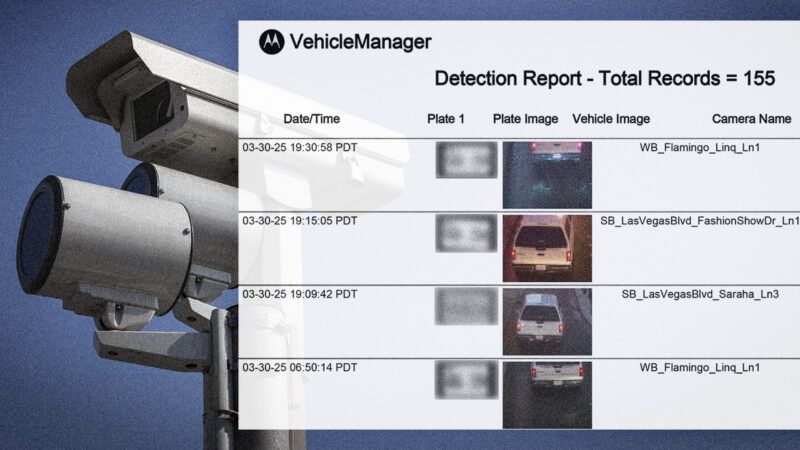
But were those the actual reasons for the stop and search? When Ferranti went on trial, his attorneys presented a license plate reader report produced by the security communications company Motorola Solutions. It revealed Ferranti had been consistently monitored prior to his arrest, including by the local sheriff on the day he was apprehended. (Neither the sheriff's office nor Motorola responded to Reason's requests for comment.)
Ferranti's legal team argued that it was unconstitutional to surveil somebody based on his previous crimes. The argument did not carry the day: Last month their client was sentenced to up to two and a half years for possession of cannabis with intent to distribute. But the case still raises substantial moral and constitutional questions about both the scale of these public-private surveillance partnerships and the ways they're being used.
Ferranti had long been a celebrity in the drug-reform world, going back to that LSD arrest in the early '90s. After that first bust, he jumped bail, went on the lam, landed on the U.S. Marshals' 15 Most Wanted Fugitives list, and even staged his own drowning to evade the authorities. After he started serving his sentence in 1993, he became a prolific prison journalist, writing the "I'm Busted" column for Vice. The New Jersey native always insisted that his crimes were nonviolent and that the drugs he sold, LSD and cannabis, had medicinal or therapeutic benefits.
After Ferranti came out of prison, his 2017 documentary White Boy—the true story of a teenage FBI informant who became a major cocaine trafficker—was a success on Netflix. He produced a number of further films, including 2023's Secret History of the LSD Trade. And apparently, the government kept watching him.
It's been watching a lot of people—and Motorola isn't the only company helping it. Flock Safety was founded in 2017, and within five years it had tens of thousands of cameras operational. As the American Civil Liberties Union (ACLU) has warned, Flock's AI-assisted automated license plate recognition (ALPR) system has been undergoing an "insidious expansion" beyond its supposed purposes of identifying vehicles of interest, such as stolen cars and hit-and-run suspects. Immigration and Customs Enforcement has used it to locate illegal migrants, and law enforcement in Texas used it to investigate a self-administered abortion, foreshadowing its potential use as a predictive policing tool for all Americans. Lee Schmidt, a veteran in Virginia, recently learned that the system logged him more than 500 times in four months.
"I don't know whether law enforcement officers are using [ALPRs] to do predictive policing," says Joshua Windham of the Institute of Justice, a public interest law firm that is campaigning to stop the warrantless use of license plate reader cameras. "We know that [Customs and Border Patrol] is using ALPRs generally to stop cars with what they deem 'suspicious' travel patterns."
After reviewing the document cataloguing the Ferranti's vehicle monitoring, Windham adds: "The records are consistent with an officer either looking up a car in his system to see where else that car was captured by ALPRs, or that car showing up as a 'hot list' alert in the Motorola system. But it's hard to tell, from the records alone, whether the stop was a 'predictive policing' stop."
Ferranti is convinced it was. "There were no warrants, investigations, informants, state police, DEA, or FBI involvement, just Seward County Sheriff's office [and an] AI-assisted license plate tracking service to perpetuate their outdated War on Drugs mission," he said in an Instagram post published by his family following his sentencing. "Traveling the highways as a person with a record is now considered [suspicious] activity by the AI."
What is clear is that Seward County sheriff's department has a history of pulling people over and forcing them into "civil forfeitures," seizing money from drivers on the interstate where Ferranti was arrested—racking up $7.5 million from 2018 to 2023 according to one local report.
Meanwhile, medical cannabis has been legal in Nebraska since November 2024, the month Ferranti was arrested. "Why can all these legal corporations transport money and marijuana wherever the fuck they want, but individual citizens can't?" Ferranti asked Vice shortly after his 2024 bust.
Sarah Hamid of the Electronic Frontier Foundation calls ALPRs "a massive, warrantless digital dragnet that track everyone everywhere they go, regardless of whether they're suspected of any crime. They can be used to target drivers who visit sensitive places such as health centers, immigration clinics, gun shops, union halls, protests, or centers of religious worship, painting an intimate portrait of a driver's life."
However, it is not the first time state or federal courts at both trial and appellate levels have concluded that using fixed-location ALPRs without a warrant does not violate the Fourth Amendment, with the latest such decision coming late last month in Virginia.
A Flock spokesperson says: "We do not engage in predictive policing. LPRs send alerts on vehicles known to be associated with crimes and missing persons reports, and are used for investigations when a crime has been reported. All searches conducted in the system require an 'Offense Type' and are fully logged in audit reports."
The surveillance network, Nathan Wessler of the ACLU says, is "a tremendously dangerous system. It is potentially a tool for politically motivated investigations, for harassment, or delving into people's privacy of life with no good reason. That's not a tool that should be in police hands."




