
Trump's $10 Billion Lawsuit Against the BBC
A federal judge has set the date for the president's push to punish a news organization he dislikes, again.
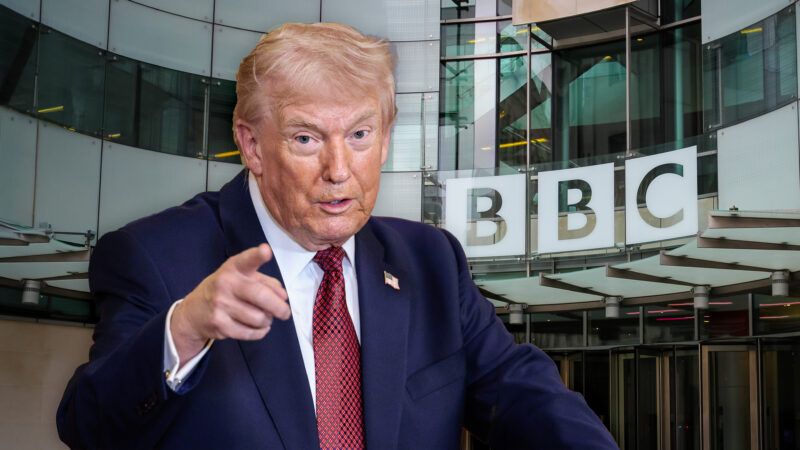
A trial date has been set for President Donald Trump's $10 billion lawsuit against the BBC. On Thursday, Judge Roy K. Altman of the Southern District of Florida set a provisional start date of February 15, 2027, for a two-week trial.
The lawsuit was filed following the release of an episode from Panorama, the BBC's investigative documentary series, titled "Trump: A Second Chance?" In it, the BBC cut together two parts of Trump's January 2021 speech to "Stop the Steal" protesters, right before they stormed the U.S. Capitol. The edit, taken from sections of Trump's speech that were almost an hour apart, gave the impression that he said, "We're going to walk down to the Capitol, and I'll be there with you, and we fight. We fight like hell."
Trump filed a 33-page complaint in December 2025, accusing the BBC of a "staggering breach of journalistic ethics." The suit claims "the BBC intentionally used the Panorama Documentary to maliciously, falsely, and defamatorily make it appear that President Trump explicitly called for violent action and rioting," and that this is part of "the BBC's longstanding pattern of manipulating President Trump's speeches and presenting content in a misleading manner in order to defame him." This edit led to "massive economic damage to his brand value and significant damage and injury to his future financial prospects," according to the suit, and as a result, Trump is seeking $10 billion in damages.
This is not the first time that the BBC has been accused of exuding bias in its reporting (although this would be the most expensive example of it). In its coverage of the Israel-Hamas war, the news agency has been accused of anti-Israel bias in its reporting. According to research led by British-Israeli lawyer Trevor Asserson, the BBC breached its own editorial guidelines over 1,500 times at the height of the conflict. During the Scottish independence referendum in 2014, independence campaigners claimed the BBC's coverage was biased toward staying in the union, leading to protests outside the BBC's Scotland headquarters in Glasgow.
It appears that Panorama was rife with the bias the BBC has long been accused of. The episode did not include the part of Trump's speech in which he encouraged the crowd to "peacefully and patriotically" march to the Capitol. Indeed, the editing of the speech could be easily interpreted as a deliberate distortion of the president's words.
Despite this, there are several reasons why Trump might not win the suit. As Reason's Robby Soave points out, Trump is bringing the suit forward in Florida—where it's unclear if the Panorama episode even aired—rather than the U.K., because "the statute of limitations has already expired in the latter venue." Additionally, "libel law in the U.S. is friendlier to the defendant than laws in the U.K., owing to our stronger First Amendment protections," explains Soave.
Furthermore, the BBC has already apologized and said it would not show the 2024 documentary again. BBC Director General Tim Davie and BBC News CEO Deborah Turness both announced their resignations, and BBC Chairman Samir Shah sent a personal apology letter to the White House.
The claim that Trump suffered billions of dollars in damages because of the documentary is also dubious. The documentary came out three years after he was impeached and four years after he lost his reelection bid to Joe Biden. Even so, Trump's broader public brand and base support have shown remarkable resilience, which prompted his successful return to the White House. Since then, he has openly leveraged his office to bolster the Trump brand through golf resorts, meme coins, and cryptocurrency ventures.
Factor in the fact that the BBC raises about $5.19 billion in licence-fee income and around $3 billion in commercial revenue, and it becomes clearer that this lawsuit is yet another example of Trump using frivolous lawsuits to bully news organizations that he disagrees with. This strategy was used last year when the president sued CBS News for airing two different responses during a 60 Minutes interview with then–Vice President Kamala Harris. Rather than fight it, CBS News' parent company, Paramount, settled the suit. In what may have been a coincidence, Paramount was later given federal approval to merge with Skydance Media.
Perhaps the BBC edited the documentary unfairly, but Trump appears determined to use the courts to silence critics and deter coverage he views as unfavorable. Even where journalistic standards may have fallen short, the solution to biased reporting has, at least traditionally, been scrutiny and competition, not multibillion-dollar lawsuits.
