
The U.S. House Just Voted To Stop Trump's 'Emergency' Tariffs on Imports From Canada
But the numbers are a long way from a veto-proof majority, so Wednesday's vote may be a purely symbolic victory for free traders.
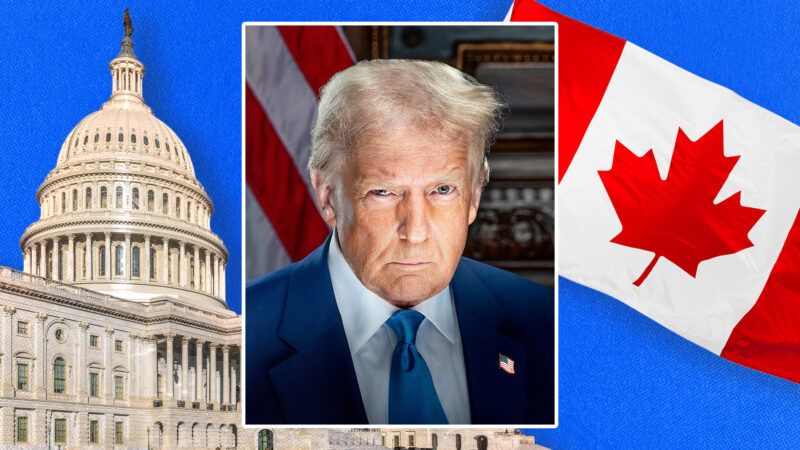
A small faction of Republicans broke ranks and voted Wednesday night to terminate President Donald Trump's "emergency" tariffs on many imports from Canada.
The 219–211 vote in the House is the first significant rebuke of Trump's tariff policies (and the emergency powers Trump has claimed to impose them) to emerge from the lower chamber of Congress. It may not be the last, as Democrats have threatened to put forward several resolutions to block various tariffs imposed, now that a procedural block on those votes has been lifted.
"I know tariffs are a tax on American consumers. I know some disagree. But this debate and vote should occur in the House," Rep. Don Bacon, one of the Republicans who supported the resolution on Wednesday night, wrote on X earlier in the day.
Shortly before the vote on Wednesday evening, Trump warned that "any Republican" who voted to revoke the tariffs on Canadian imports would "suffer the consequences come Election time."
That threat was not enough to hold all Republicans in line. In addition to Bacon, Reps. Brian Fitzpatrick (R–Pa.), Jeff Hurd (R–Colo.), Kevin Kiley (R–Calif.), Thomas Massie (R–Ky.), and Dan Newhouse (R–Wash.) voted for the measure. Rep. Jared Golden (D–Maine) was the sole Democrat to vote against it.
"We got it passed. We broke the Republican blockade," said Rep. Suzan DelBene (D–Wash.), who has headed the Democratic efforts to repeal the tariffs since shortly after Trump announced them last February.
The Senate has voted several times to terminate national emergencies underpinning Trump's tariffs on imports from Canada, Brazil, and elsewhere.
Still, Trump will probably have the final say: Even if the House-passed resolution makes it to his desk, he could veto it. Actually blocking the tariffs would require a veto-proof two-thirds majority in both chambers of Congress.
On Wednesday, Politico reported that the White House was working to limit the number of Republican defectors in order to prevent a future veto override. An unnamed administration official reportedly told Politico that the "baseline House Republican position" is tariff skepticism.
If that's true, it was not reflected in Wednesday's vote totals. As long as Trump continues to hold most House Republicans under his thrall, this vote will be only a symbolic victory for tariff critics.
Still, it is also an important acknowledgement of reality.
The "national emergency" underpinning the Canadian tariffs has never made much sense. The White House claims that the tariffs are part of an effort to block the flow of fentanyl into the United States, but little fentanyl is smuggled across the border from Canada. And even if that wasn't true, it's illogical to tax legal goods in order to stop the flow of illegal ones.
Trade between the U.S. and Canada is plainly not a national security threat by any definition of the term, and the tariffs have accomplished little besides raising taxes on Americans. The Congressional Budget Office was the latest to confirm that reality, reporting Wednesday that American consumers have borne 95 percent of the costs from Trump's trade barriers.
