

The Heavy Pot Taxes Favored by The New York Times Would Undermine Legalization
The newspaper’s plan to address marijuana abuse would compound the disadvantages that state-licensed suppliers face in competing with the black market.
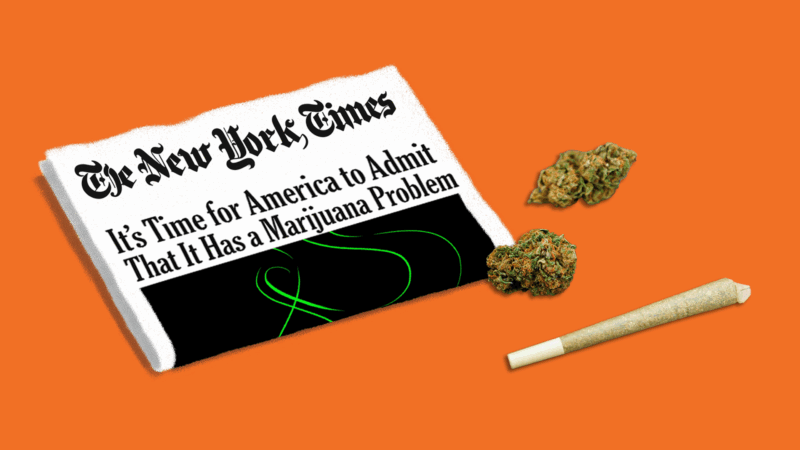
The New York Times embraced legalization of recreational marijuana in 2014, two years after Colorado and Washington became the first states to take that step. By that point, most Americans opposed pot prohibition, and that majority has grown since then.
Although the Times does not regret endorsing legalization, its editorial board now says stricter regulation and heavier taxation are necessary to curtail the costs associated with marijuana abuse. Those recommendations elide two inconvenient facts: Cannabis is still federally prohibited, and states are still struggling to replace unauthorized pot peddlers with government-licensed marijuana merchants.
The Times emphasizes that "occasional marijuana use is no more a problem than drinking a glass of wine with dinner or smoking a celebratory cigar." But while marijuana "is safer than alcohol and tobacco in some ways," the Times says, "it is not harmless."
Frequent cannabis consumption has increased substantially in recent years, the Times notes, and roughly one in 10 marijuana users "develops an addiction." Even nonaddicted cannabis consumers "can still use it too much," it says, since "people who are frequently stoned can struggle to hold a job or take care of their families."
The Times also mentions cannabinoid hyperemesis syndrome, "marijuana-linked paranoia," and the danger posed by stoned drivers. "Any product that brings both pleasures and problems requires a balancing act," the Times says, which means "personal freedom" must be curtailed to protect "public health."
That formulation is inherently paternalistic, since the "public health" burden to which the Times refers is borne mainly by cannabis consumers themselves. And the moral logic of the hefty marijuana taxes that the Times favors is questionable.
Those taxes would add to the difficulties that some heavy consumers face while punishing the occasional use that the paper says is no big deal. Although "adults should have the freedom to use" marijuana, the Times says, they must pay the government for that privilege.
A tax-based "balancing act" also raises practical difficulties. "The first step in a strategy to reduce marijuana abuse should be a federal tax on pot," the Times says, gliding over the point that Congress cannot impose an excise tax on marijuana products unless it is prepared to legalize them.
The editorial does not explicitly acknowledge the need for that step. To the contrary, it implicitly criticizes President Donald Trump's decision to reclassify marijuana under federal law, which falls far short of legalization.
That change, the Times complains, "will increase the profits" of "Big Weed" by allowing marijuana businesses to claim standard deductions on their income tax returns, eliminating a crushing financial disadvantage that has long plagued them. Although the Times sees that as self-evidently bad, the upshot is that state-licensed marijuana suppliers will be treated the same as every other legal business, which hardly seems like a special favor to the cannabis industry.
The Times also thinks states should increase their own marijuana taxes, which would create new obstacles on the bumpy road to a legal market. Despite recent progress, licensed marijuana merchants in New York account for perhaps a quarter of estimated total sales, while the legal share in California is pegged at just 40 percent nearly a decade after that state legalized recreational use.
The combination of higher state taxes with a new federal tax will not make this transition any easier. Yet the Times argues that taxes "high enough to deter excessive use" would be "on the scale of dollars per joint," which represents a huge increase.
The Times says that level of taxation would be consistent with the late drug policy scholar Mark Kleiman's 1992 vision of "grudging toleration" for marijuana use. Kleiman also imagined bolder steps, including monthly purchase limits and consumption licenses that could be revoked when marijuana users misbehave.
Questions of fairness aside, such policies would pose serious enforcement challenges and compound the disadvantages that licensed pot suppliers face in competing with untaxed and unregulated dealers. This does not sound like a formula for making legalization work.
© Copyright 2026 by Creators Syndicate Inc.




