

Reason.com - Free Minds and Free Markets
Reason logo Reason logo
  • Latest
  • Magazine
    • Current Issue
    • Archives
    • Subscribe
    • Crossword
  • Video
    • Reason TV
    • The Reason Roundtable
    • Free Media
    • The Reason Interview
  • Podcasts
    • All Shows
    • The Reason Roundtable
    • The Reason Interview With Nick Gillespie
    • Freed Up
    • The Soho Forum Debates
  • Volokh
  • Newsletters
  • Donate
    • Donate Online
    • Ways To Give To Reason Foundation
    • Torchbearer Society
    • Planned Giving
  • Subscribe
    • Reason Plus Subscription
    • Gift Subscriptions
    • Print Subscription
    • Subscriber Support

Log In

Create new account

Taxes

Dumping State Income Taxes Could Mean High Sales Taxes—or an Opportunity for Smaller Government

A new report warns that some plans for replacing income tax revenue rely on unrealistic assumptions.
J.D. Tuccille | 2.2.2026 7:00 AM

Share on FacebookShare on XShare on RedditShare by emailPrint friendly versionCopy page URL Add Reason to Google
Media Contact & Reprint Requests
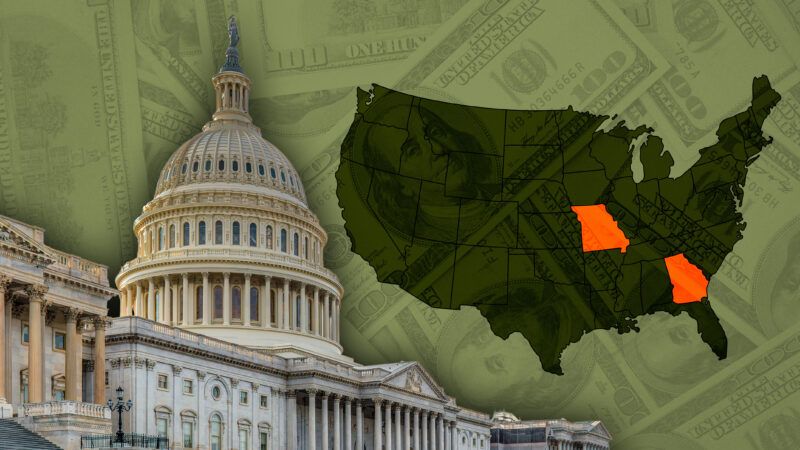
The U.S. Capitol is pictured alongside a map of the U.S., with Missouri and Georgia highlighted. | Illustration: Luckyphotographer/Lightvision/Dreamstime
(Illustration: Luckyphotographer/Lightvision/Dreamstime)

Missouri lawmakers are considering a proposal to abolish the state's income tax and replace it with a sales tax. They're not alone: Last year, Mississippi approved legislation that will decrease the state income tax over several years until it's eliminated. That follows in the footsteps of Kentucky and Oklahoma. New Hampshire, which has no income tax, phased out its tax on interest and dividends. Several states making the move are considering sales taxes to fill the revenue gap, and they have the backing of the White House. But a new report warns that sales taxes may have to be higher than anticipated to make up the difference—unless state governments shrink in size and expense.

You are reading The Rattler from J.D. Tuccille and Reason. Get more of J.D.'s commentary on government overreach and threats to everyday liberty.

This field is for validation purposes and should be left unchanged.

States Move To Shed a Hated Tax

"Mississippi will no longer tax the work, the earnings, or the ambition of its people," Mississippi Gov. Tate Reeves boasted last March in a statement that captured low popular opinions of income taxes (and taxes in general). "I believe in a simple idea: that government should take less so that you can keep more. That our people should be rewarded for hard work, not punished. And that Mississippi has the potential to be a magnet for opportunity, for investment, for talent—and for families looking to build a better life."

Unmentioned, but a worthy addition to Reeves' observations about income taxes, is the inquisitorial nature of their enforcement. People must open their financial lives to government officials, allowing collectors to know how much they make and from whom, and to track flows and expenditures. The intrusive nature of income taxes is compounded by dueling guesses between taxpayers assessing their liability and officials who have the final word (and the force of law behind them).

In coverage of the recent move to jettison income taxes, the American Legislative Exchange Council (ALEC) reports "the statutes set to eliminate income taxes in Kentucky, Mississippi, and Oklahoma have all followed the same basic principle: When the state has extra funds available, the first use of them should be to put money into taxpayer pockets, prioritizing reducing income tax rates over increasing government spending." Conditions—triggers—must be met before rates decline on their way to zero.

With income taxes going away, that raises questions about the implications for state finances since revenue will decline. Missouri Gov. Mike Kehoe proposes to hike sales taxes to make up the shortfall, though he vowed in his 2026 state of the state address that he will "never support extending sales taxes on agriculture, healthcare, or real estate." Georgia is considering a similar proposal. In this they have the support of the White House Council of Economic Advisors (CEA).

White House Supports Dumping State Income Taxes

In a January 28 report, the CEA points out that states without income taxes lead the way in attracting and retaining residents and businesses. In part, that's because "workers and businesses can avoid taxes by moving to lower-tax jurisdictions, and high-income individuals—those with the greatest tax liability and often the most career flexibility—are particularly responsive to income taxes." The report adds that throughout the 20th century, "implementation of a state income tax led to significant population losses. The out-migration was so substantial that states saw little net revenue gain from their new income taxes—the expanded tax base was largely offset by the loss of taxpayers who left."

The CEA concludes that most states could replace income tax revenue with "an average state sales tax rate of under 8 percent under full revenue replacement with no limits on spending growth." With spending growth limits, states could offset lost revenue from abolished income taxes with "an average state sales tax rate of 6.2 percent."

That sounds like a fair tradeoff. But the Tax Foundation's Jared Walczak finds it far too optimistic.

A Higher Price Tag Than Advertised

Walczak agrees that "reducing income tax burdens and shifting toward well-designed sales taxes is pro-growth tax policy." He also concurs with the CEA's prediction of a significant increase in prosperity produced by a revenue-neutral shift from income to sales taxes. But he worries the CEA is pitching sales tax rates at far too low a level to replace income tax revenue. Unfortunately, he says, "the CEA's calculations omit important factors and envision a sales tax base that violates federal law, among other serious impediments."

The CEA's proposal, for example, would tax all healthcare expenditures, even though many are off-limits to taxation under current law or involve no taxable transaction. Also, to arrive at the average replacement tax rate, the CEA assumed a sales tax on transactions in all states, "even those that already forgo an income tax, a sales tax, or both," Walczak writes. That distorts the economic calculations.

The CEA report also assumes 100 percent compliance—something never achieved by any tax regime.

By his own calculations, including an assumption of 89 percent compliance, Walczak arrived at replacement sales tax rates of 12.08 percent on the low end and what he believes to be a more realistic rate of 17.51 percent. Ignoring the CEA's proposed taxable base in favor of raising existing tax rates arrived at slightly lower rate of 15.66 percent.

Interestingly, the Georgia Budget and Policy Institute (GBPI), which prefers retaining the income tax, estimates a sales tax of 15.44 percent is required to replace lost revenue. That's closer to Walczak's figure than to the 7.19 percent the CEA proposes for full revenue replacement in the Peach State.

"Through flawed estimates, the CEA dramatically overstates the ease with which states could replace their income taxes," Walczak cautions. "Real reform is worth doing—but that starts with realistic figures."

An Opportunity for Smaller Government

Walczak and GBPI's Daniel Kanso both work from the credible assumption that many people would find high sales rates daunting, with Kanso emphasizing "painful tradeoffs" to make the transition work. But the switch from income taxes to sales taxes could also be an opportunity. If paying 12 or 15 or 17 percent in tax on every transaction is painful, it's pain that has been hidden from people through income withholding taxes even as the money was extracted behind the scenes. Mitigating that pain could be accomplished through smaller, leaner government that spends less and requires less revenue.

At the same time, smaller state governments funded by sales taxes wouldn't need to peer over everybody's shoulders, violating privacy and imposing a financial surveillance state.

Nine states currently have no state income tax, with several others planning to join them in the next few years. To prevent sticker shock at the cost of making the change, elected officials need to be honest about the cost of replacing the lost revenue with money from other sources, such as sales taxes. Or they could look at the end of state income taxes as an opportunity to shrink state government.

The Rattler is a weekly newsletter from J.D. Tuccille. If you care about government overreach and tangible threats to everyday liberty, this is for you.

This field is for validation purposes and should be left unchanged.

NEXT: Trump Administration Insists Blowing Up Boats Is Not 'Hostilities'

J.D. Tuccille is a contributing editor at Reason.

TaxesIncome taxState GovernmentsGeorgiaMissouriTaxpayersBig GovernmentLegislationEconomicsPolicyGovernment SpendingGovernment Waste
Share on FacebookShare on XShare on RedditShare by emailPrint friendly versionCopy page URL Add Reason to Google
Media Contact & Reprint Requests

Hide Comments (62)

Editor's Note: As of February 29, 2024, commenting privileges on reason.com posts are limited to Reason Plus subscribers. Past commenters are grandfathered in for a temporary period. Subscribe here to preserve your ability to comment. Your Reason Plus subscription also gives you an ad-free version of reason.com, along with full access to the digital edition and archives of Reason magazine. We request that comments be civil and on-topic. We do not moderate or assume any responsibility for comments, which are owned by the readers who post them. Comments do not represent the views of reason.com or Reason Foundation. We reserve the right to delete any comment and ban commenters for any reason at any time. Comments may only be edited within 5 minutes of posting. Report abuses.

  1. Don't look at me! ( Is the war over yet?)   2 months ago

    An Opportunity for Smaller Government

    Dream on

    1. Minadin   2 months ago

      I suppose that's the reason it was, by far, the shortest section of the article

    2. Rick James   2 months ago

      When the state is no longer looking over your shoulder-- even if its apparatus is just as big (or even bigger) that's an improvement.

  2. TJJ2000   2 months ago

    Sounds like a pretty good idea but the real GOOD idea will be efforts/legislation that requires transparency.
    i.e. 'All Taxes' figured on every invoice.

    I find it quite disturbing Fuel Excise Tax has gone completely UN-noticed. Packing up-to $0.90/gal in CA. No wonder the leftarded thinks oil & gas is greedy. They see the greed. It's just the the culprit isn't the one they think it is.

    1. TJJ2000   2 months ago

      'Guns' don't make sh*t CA and every other Leftard out there.
      For every ?free? pony you vote for; you will be CHARGED for it.

  3. Longtobefree   2 months ago

    "By his own calculations, including an assumption of 89 percent compliance, Walczak arrived at replacement sales tax rates of 12.08 percent on the low end and what he believes to be a more realistic rate of 17.51 percent."

    If only we could see the other assumptions he used to get that giant number.

    Somehow, in the real world, Florida survives, even thrives, with a mere six percent. (more or less)

    Key Florida Sales Tax Details for 2026 State Rate: 6%
    Local Surtaxes: Counties add 0.5% to 2.5%, making total rates 6.5%–8.5%
    Tax Base: Applies to most goods and services, including taxable items shipped from out-of-state
    County Surtax Rule: Often applies only to the first $5,000 of a single taxable item
    Tax Exemptions: Groceries for home consumption, medicine, and some personal items are exempt
    Tax Holidays: Florida frequently offers "sales tax holidays" for items like school supplies, clothing, and disaster preparedness 

    1. TJJ2000   2 months ago

      "other assumptions he used to get that giant number"
      All the Blue-States. The CEA report was on all-states.

    2. Nelson   2 months ago

      Florida benefits from large amounts of outside-the-state money for lodging and food due to its theme parks and tourist industry. Probably the only state that could match it in tourist dollars would be California. And their economy is so huge it probably isn’t as significant in the grand scheme of things as in Florida.

      The benefit of out-of-state dollars is startlingly large. The difference between the benefit of internal dollars and external dollars was something that fascinated me in college.

      1. charliehall   2 months ago

        Very similar to Alaska having the rest of the US fund its entire government via oil revenues. Getting someone with no vote to pay taxes is a brilliant idea as far as politicians are concerned.

      2. Longtobefree   2 months ago

        Florida
        #1 in Economy
        #6 in Best States Overall

        (From US News & World Report: doesn't give the date of the data)

  4. WellRedMan   2 months ago

    Income taxes are taxation without consent, exactly what the American revolutionaries fought to prevent. Sales taxes are consensual because they are, for the most part, voluntary and I can not pay them by not purchasing. Allowing tax on income was a fatal mistake and the entire reason we now have Leviathan.

    1. Quicktown Brix   2 months ago

      You can avoid income tax by not earning an income. If you're not buying anything to avoid sales tax, you won't need income anyway.

      Both taxes are equally voluntary, i.e. not voluntary at all.

      1. Rick James   2 months ago

        You can avoid income tax by not earning an income.

        Or earning an income under the table of off the books...

      2. Bruce D   2 months ago

        It's easier to reduce purchases and save money than it is to reduce income or not earn money or refuse to work.

      3. WellRedMan   2 months ago

        Which, of course, makes no sense at all.

    2. Nelson   2 months ago

      “ Income taxes are taxation without consent”

      Income tax is a Constitutional Amendment, ratified by 2/3 of both the Senate and the House, plus 3/4 of the states. You don’t get more consent than that in the American system. If that isn’t “the consent of the governed”, every single law on the books doesn’t either.

      “ I can not pay them by not purchasing”

      For many people, that’s not the case. You will always have to pay a certain amount each month for basic living expenses (food, clothing, housing, heat, electricity, etc.). And the less you make, the more of your paycheck you spend.

      The impact of sales tax is much higher on the poor and middle class than the upper class. If you are someone living paycheck to paycheck, the vast majority of your income (usually not 100%, due to common exemptions like food and healthcare) is taxed. If you are middle class that will drop a bit and if you are upper-middle class or above you will have virtually none of your income taxed. So the strain falls on the bottom half of citizens, who can’t afford it as much, and eases on the upper half, who can.

      1. WellRedMan   2 months ago

        Sorry, no. You think that simply having the option to vote legitimizes anything the government does. Nope. Income taxes are not consensual because I never consented to them. What somebody else did a hundred years ago means nothing in regards to consent which is given on an individual and not a group basis.

        1. See.More   2 months ago

          . . . Income taxes are not consensual because I never consented to them. What somebody else did a hundred years ago means nothing in regards to consent which is given on an individual and not a group basis.

          ^ This +9000!

        2. Nelson   2 months ago

          “ Income taxes are not consensual because I never consented to them”

          What are you, one of those sovereign citizen whackjobs? Just because YOU don’t consent doesn’t mean it wasn’t consented to. We aren’t going to rewrite the Constitution 350 million times so everyone gets exactly what they want.

          “ What somebody else did a hundred years ago means nothing in regards to consent which is given on an individual and not a group basis.”

          Your individual consent isn’t necessary or relevant. A very strict set of requirements were met to create and ratify the Amendment. Whether it happened a hundred years ago or a hundred seconds ago doesn’t matter. That’s what a democratic process means: if you support something that most people don’t, it sucks to be you.

          If you don’t like the way this country works, I’m sure you can find somewhere else to live that doesn’t have all these rules. In geopolitical terms, they’re called “failed states”.

          1. See.More   2 months ago

            You keep using that word... consent... I do not think it means what you think it means.

      2. Fats of Fury   2 months ago

        Income tax amendment was passed as a tax on Millionaires. The clowns who helped pass it never figured out it would come to eat them too. Same thing is happening now with the Wealth tax proposals.

    3. charliehall   2 months ago

      The income tax was enacted to replace tariffs, a tax that is far worse.

      1. WellRedMan   2 months ago

        The income tax is theft. Tariffs are not. Murray Rothbard called the income tax, "that great instrument of tyranny".

    4. See.More   2 months ago

      Allowing tax on income was a fatal mistake and the entire reason we now have Leviathan.

      Not quite the entire reason. The 17th Amendment is also complicit by making the Senate an extension of the House of Representatives, representing "the people" (i.e. the voters~ish) rather than representing their respective States.

  5. Nelson   2 months ago

    They neglect to mention that sales taxes are regressive, hitting the poorest people the hardest. It’s hard to imagine that states with such a high poverty rate like Mississippi would want to make that higher (or expand social safety net programs to mitigate the impact), but perhaps they feel that attracting more high-income, high-education, high-performance people will create the economic boon they need to make it work.

    1. Rossami   2 months ago

      Sales taxes are commonly assumed to be regressive. The calculation of how regressive, however, is quite difficult. Most attempts to quantify it assume that people do not change their behavior in response to incentives. That is, they'll keep buying exactly the same basket of goods even if you change the prices. Yet we know that's false. When you tax something and artificially raise its price, people buy less of it, either foregoing the good or switching to something else.

      There are a few staples that you must buy to survive. Rice, bread, simple foodstuffs. Taxing those is deeply regressive - which is why most sales tax regimes exempt (or have a much lower tax rate on) those products. Taxes on luxury goods (such as yachts and cigarettes), on the other hand, are effectively quite pro-gressive taxes. Depending on how they're structured, sales taxes are not necessarily more regressive than other tax schemes.

      Fundamentally, though, income taxes incent doing less work while sales taxes incent spending less - that is, saving money. Building up some personal savings is something we should be encouraging everyone to do

      1. Nelson   2 months ago

        “ Yet we know that's false.”

        Agreed. If for no other reason, when you spend 15% more for the same things you used to, you have 15% less to spend elsewhere. It would definitely have a negative effect on the number and types of products sold, although the total amount spent wouldn’t change. That would definitely be difficult for businesses that don’t sell necessary items (think home furnishings or appliances).

        “ Depending on how they're structured, sales taxes are not necessarily more regressive than other tax schemes.”

        Agreed, but to structure it in a way that wasn’t regressive, it would require a progressive sales tax based on some standard (Sticker price? Delta from average product price, so tax on a Dyson would be more than a Hoover?). Or perhaps creating categories of products that raised the tax rate based on how “frivolous” the product was (although that would come with its own set of problems).

        “ Fundamentally, though, income taxes incent doing less work while sales taxes incent spending less - that is, saving money.”

        I would quibble with the first and push back a lot against the second assumption.

        Income taxes don’t incentivize doing leas work until the return fails to outweigh the cost. Back in the 70s when the top rate was 70% or higher, that point could be reached. Now? With a top rate of 35% that is effectively much lower due to deductions? Most people wouldn’t choose not to work if they took home 75% of their salary. And that’s the top rate. It’s a higher percentage at lower income levels.

        Sales taxes don’t incentivize spending less. They certainly don’t cause people to save. If they weren’t saving before, having to spend more for the same things won’t change that. If they were saving before, they will be able to save less as they will now have to spend some of what they used to save or just have less.

        Granted, with the elimination of income tax some people will have more money to spend, but that would also flow to the higher-income people more than the middle- and lower-income people. In fact, since things like child tax credits and dependent deductions would no longer apply, the bottom 40% or so would probably pay more than under an income tax.

        “ Building up some personal savings is something we should be encouraging everyone to do”

        I agree completely, but I was raised to be frugal and get out of debt as quickly as possible (which is why I paid off my house ASAP and only buy a new car when I can buy it outright). People don’t understand the value of compound interest, probably because financial literacy isn’t taught in most high schools. But higher sales tax will decrease, not increase, savings rates. Particularly among the middle class, who will want to maintain their current lifestyle.

        Personally, I support a flat income tax and no sales tax as it prevents the gaming of the system that deductions allow wealthier people to exploit and it would decrease the cost of living for the lowest earners.

        1. Rossami   2 months ago

          Categories of products is already normal and I venture to say universal. I'm not aware of any state that doesn't already have different tax rates for different categories of products (though sometimes the categorization is a simple 'these products are exempt'). The evident "problems" with that approach seem pretty minimal based on the available evidence.

          re: "income taxes incent doing less work" - Your mistake in your rebuttal is confusing net return for marginal return. Even a small increase in tax rate increases the relative value of leisure time. A 1, 2 or 10% decrease in take-home pay may not convince me to stop working entirely but it definitely leaves me less inclined to work extra hours.

          Your criticism of my "sales taxes incent spending less" is more on-point - I think because I expressed that badly. I'm not yet sure how to express it better, though. I'll have to think more on your rebuttal. Thank you.

          1. Nelson   2 months ago

            “ Categories of products is already normal”

            I would look that up if I were you. Most sales taxes are universal except for certain exemptions (necessities being the most common). I’ve never actually heard of tiered sales taxes before, but my state has no sales tax so I’m not sure about that. I know that New Jersey, Maryland, and Pennsylvania don’t have it because I buy stuff in all three fairly regularly.

            There are sometimes additional taxes (like occupancy taxes for hotels), but those are in addition to, not a replacement for, sales tax.

            “ I'm not aware of any state that doesn't already have different tax rates for different categories of products”

            I mentioned the three neighboring states to Delaware that doesn’t have a tiered sales tax system. If you buy a two-story garage from the Amish (seriously, you can buy one and have it delivered and they’re HUGE, with stairs and everything) or a slice of pizza, the sales tax rate is the same. I am not aware of any state that has a tiered system, although like you mentioned many have exemptions for “necessities” (usually basic groceries, clothes, and healthcare). If you know of states with a progressive sales tax regime I would be very interested in seeing how they structured it. If there was a way to make sales tax progressive it would remove most of the reasons to oppose it.

            “ Even a small increase in tax rate increases the relative value of leisure time.”

            Perhaps, but that is completely dependent on how the individual values leisure time.

            Work rates in high-tax and low-tax states aren’t noticeably different, so income taxes in the real world doesn’t seem to decrease the amount of work the average person is willing to do. I can’t remember where I read it, but back when I was working there was a paper or article that discussed productivity and pointed out the higher income states (most of whom have higher income taxes) have higher productivity. This data seems to support that premise: https://www.bls.gov/charts/state-productivity/labor-productivity-by-regions-and-states.htm

            Perhaps at the margins leisure is worth 10 points (I retired as soon as I could because I wanted to work for a Lab rescue for free rather than anyone else, including myself, for money, but the thick part of the bell curve seems to be firmly in the “doesn’t make a difference” category.

            “ I'm not yet sure how to express it better, though. I'll have to think more on your rebuttal.”

            Been there, done that. You may want to consider how to frame the shift in available money (decrease in income taxes paid vs. increase in sales taxes paid) or consider the benefits of a sales tax in practical terms (perhaps the ability to micromanage your personal budget, so if you have a rough month you can immediately balance out by pushing purchases to the next month). I could imagine an argument about how that flexibility might make the potential to put away some savings more obvious to the average person, since income taxes kinda happens out of sight. Just a couple thoughts that might provide a spark.

    2. Rick James   2 months ago

      See my post below. They're not regressive. Almost every state eliminates sales taxes on 'necessities'. Just like an income tax, a sales tax can be infinitely tweaked to eliminate regression where it's identified.

      Edit: And even if it's even partially regressive, don't the benefits outweigh the negatives, especially when those negatives are a wide-ranging state-spying and surveillance system. Having to "define" income in 10,000 page documents and putting the collection apparatus on the general citizenry?

      1. Nelson   2 months ago

        “ They're not regressive. Almost every state eliminates sales taxes on 'necessities'.“

        Those two things are mutually exclusive. The fact that some necessities aren’t taxed doesn’t change the fact that they are regressive (meaning they impact those with lower incomes more than those with higher incomes). Simply not taxing some items doesn’t magically change that.

        The things that are “necessities” are limited. Usually it’s some food (prepared food and pre-made items, plus things like soda, bottled water, etc., are usually taxed), some clothing, and healthcare. The vast majority of what most people spend to live a decent life would be taxed. I’ve always found the “you can live on rice and beans, so it’s not a problem” arguments to be both completely out of touch with reality (as if someone wanting to eat steak is somehow a wastrel) and unrealistic in terms of quality of life.

        “ Just like an income tax, a sales tax can be infinitely tweaked to eliminate regression where it's identified.”

        Theoretically, yes. It’s never been done, but the possibility does exist that with enough data and enough granularity you could counteract the inherent regressiveness of a sales tax. I discussed some thoughts on how it might be done above.

        “ And even if it's even partially regressive, don't the benefits outweigh the negatives”

        If you’re in the upper half of income earners? Probably. But making it harder on those who are already struggling and easier for those who aren’t doesn’t seem like a good policy if you are interested in benefitting your citizens.

        “ especially when those negatives are a wide-ranging state-spying and surveillance system”

        Paranoid, much? It isn’t spying or surveillance. They aren’t trying to discover anything about you or your life except some (but not all) of what you make. Using scary words to describe mundane bureaucratic processes doesn’t make it any more convincing. Quite the opposite.

        “ Having to "define" income in 10,000 page documents”

        The vast majority of those pages address loopholes, exceptions, special dispensations, and other things that largely benefit corporate and wealthy taxpayers. Which is why I support a no-deduction, per-individual flat tax with a low starting point for taxation (say 30k, plus or minus?).

        1. Rick James   2 months ago

          Those two things are mutually exclusive. The fact that some necessities aren’t taxed doesn’t change the fact that they are regressive (meaning they impact those with lower incomes more than those with higher incomes). Simply not taxing some items doesn’t magically change that.

          No it doesn't magically change it, it scientifically changes it. People at sustenance levels of income aren't buying Lamborghinis, flat screen TVs and new cars off the dealership floor. Most of their income goes to rent and food (groceries). Rent doesn't have a sales tax, and most states don't tax unprepared food (often along with hundreds of other categories). That definitionally makes sales taxes non-regressive.

          The vast majority of those pages address loopholes, exceptions, special dispensations, and other things that largely benefit corporate and wealthy taxpayers. Which is why I support a no-deduction, per-individual flat tax with a low starting point for taxation (say 30k, plus or minus?).

          So you continue to support a state spying regime with a magickal starting point of $30k which creates a major and sudden speed bump for people who tip over the arbitrary $30k level.

          Plus you haven't defined "income" yet. Define 'income' in less than 500 words.

          1. Nelson   2 months ago

            “ No it doesn't magically change it, it scientifically changes it.”

            Not even close. Merely eliminating taxes on a few things doesn’t overcome the regressiveness of the tax, it just makes it less regressive. Unless you live in a house with no furniture and no appliances, don’t own a car, don’t have a phone, don’t have kids, don’t have eyeglasses, never eat out, never take a vacation … you get the idea. Just eliminating a few things doesn’t help in the grand scheme of things.

            “ People at sustenance levels of income aren't buying Lamborghinis, flat screen TVs and new cars off the dealership floor.”

            Strawman, much? Most people live between eating rice and beans in an empty room with no electricity and buying Lambos and flatscreens.

            “ That definitionally makes sales taxes non-regressive.”

            Only of you can’t do math. Your premise that the only things people living paycheck to paycheck buy is unprepared food (but not anything to cook it on or the electricity and/or gas necessary to run a stove), wear the same clothes every day, stink to high heaven (because they don’t have water in their empty room, so they can’t shower, plus they aren’t buying soap or shampoo in your world), walk everywhere (but barefoot, because shoes are also taxed … you get the point. Your belief a out what people living paycheck to paycheck buy is woefully ignorant and your claim that they wouldn’t be hit harder by a sales tax than people making more than them is delusional, as all but the most biased studies have shown for decades.

            “ So you continue to support a state spying regime with a magickal starting point of $30k which creates a major and sudden speed bump for people who tip over the arbitrary $30k level.”

            You don’t think very well. Or maybe it’s a comprehension problem. A flat tax that starts at $30k and taxes every dollar after that at the same rate regardless of income level with no deductions of any kind with every individual responsible for their own income is what I proposed, not whatever weird paranoid thing you’re saying.

            And like I said, simple bureaucratic systems to verify income isn’t a spying regime. If something so innocuous and simple is spying on your book, everyone from credit agencies to web browsers to loyalty programs are spying on you, too. They’re all out to get you and are trying to infiltrate your life, eh?

            “ Plus you haven't defined "income" yet. Define 'income' in less than 500 words.”

            Why would that make any difference? If I said it was money or other compensation from any other party to you, would you accept it or complain that it wasn’t specific enough? Because you seem like the kind who would throw edge cases around until the cows came home.

            1. Rick James   2 months ago

              Only of you can’t do math. Your premise that the only things people living paycheck to paycheck buy is unprepared food (but not anything to cook it on or the electricity and/or gas necessary to run a stove),

              You're certifiably insane. What is the sales tax on electricity, water and gas? Again, you're acting like a sales tax is some never-before-tried system that if implemented it will be platonic definition of crushing the proletariat. 45 fucking states have sales taxes right the fuck now.

              Based on your vague "blue state" assertions... let's see what sales taxes in the bluest of blue states-- and if sales taxes are as regressive as you say, surely those Democrats agree and set them lower than the non-blue states:

              Washington: 9.51%
              California: 8.99%
              Minnesota: 8.14%
              Illinois: 8.96%
              New York: 8.56%

              Now, if these bluer-than-blue-found-in-nature blue states believed that Sales taxes were fainting-couch inducing regressions on the poor... then why are they fucking high? And all those states except one have an income tax.

              So apparently no one else on the leftward side of the aisle seems to believe that sales taxes are all that regressive. Opinion on the matter does appear divided among Democrats. Nelson says they are, the rest of the Democrats clearly don't think so.

              A flat tax that starts at $30k and taxes every dollar after that at the same rate regardless of income level with no deductions of any kind with every individual responsible for their own income is what I proposed, not whatever weird paranoid thing you’re saying.

              So minimum wage earners get stuck with an income tax on $14,304 of their income?

              And like I said, simple bureaucratic systems to verify income isn’t a spying regime. If something so innocuous and simple is spying on your book, everyone from credit agencies to web browsers to loyalty programs are spying on you, too. They’re all out to get you and are trying to infiltrate your life, eh?

              How is me being forced to spend a week gathering every source of income and documentation and filing with the government on penalty of major fines not a spying regime? On a scale of 7 to 10, how retarded are you?

              1. Rick James   2 months ago

                Exemptions and Credits: How They Work

                Exemptions

                Exemptions are the most popular approach to reducing the regressivity of the sales tax. In practice, they eliminate sales taxes on particular retail items. If exemptions are targeted to exclude items that make up an especially large share of low- and moderate-income households’ budgets they can, in turn, make the sales tax less regressive. For example, thirty-two states, plus the District of Columbia, exempt groceries from their state sales tax and almost all states exempt prescription drugs. Many states also exempt the sale of residential utilities, such as electricity or natural gas.

                Credits

                Targeted tax credits are an innovative alternative to exemptions. Usually administered through the income tax, these credits provide a flat dollar amount for each member of a family, and are available only to taxpayers with income below a certain threshold. These credits are also refundable, meaning that the value of the credit does not depend on the amount of income tax paid and the credit is given even if it exceeds the amount of income tax owed. Refundability is a particularly important aspect of credits meant to offset sales taxes; they allow access to taxpayers with little or no income tax liability who pay a substantial portion of their income in sales taxes. When refundable, sales tax credits can provide a much needed income boost to help families make ends meet.

    3. Rick James   2 months ago

      Also, this is a libertarian board. The focus should always be to increase liberty, not 'make things easier for poor people'.

      Even if you could prove that sales taxes are marginally more regressive, dramatically increasing liberty for the entire population but make it slightly harder for poor people is definitionally an improvement from a libertarian standpoint.

      If your prime directive at every turn is to simply make it easier for poor people and all other factors--- especially liberty be damned... there are plenty of other systems you could choose from to achieve that.

      1. charliehall   2 months ago

        Liberty for rich people; let everyone else starve or freeze to death.

      2. Nelson   2 months ago

        “ The focus should always be to increase liberty”

        Considering you’re one of the most deeply conservative, coercion-loving paleocons here, claiming you support liberty is rich.

        “ not 'make things easier for poor people'.”

        That’s not the argument. The argument is that poor people have less ability to pay sales taxes, which will require either expanding social safety net programs or having more workers and families living in poverty. Governors are sensitive to expanding the poverty levels in their states, although states like Mississippi may be so used to it by now it might not register.

        “ Even if you could prove that sales taxes are marginally more regressive”

        It has been proved. Repeatedly. Over decades. It is something that has been proven so well and so often that it is accepted in economics as a base reality. And it isn’t marginally regressive. It’s very regressive. When you exclude “necessities” it just becomes plainly regressive. There has never been a sales tax implemented that hasn’t been regressive. It is theoretically possible to design one, but it’s never been done. And none of the proposed sales tax schemes are breaking the streak.

        “ dramatically increasing liberty for the entire population”

        You’ll have to explain how taxing people in a different way dramatically increases liberty. Because it doesn’t make any sense.

        1. Rick James   2 months ago

          Considering you’re one of the most deeply conservative, coercion-loving paleocons here, claiming you support liberty is rich.

          So you support a dystopian, aggressive system of state-spying on its citizens to make sure their daily activity and revenue generation is caught at every possible turn, watching bank account incoming and outgoing, and requiring byzantine reporting requirements at the end of the year, sometimes four times a year, because you're the liberty lover. The fuck outta here.

          “ not 'make things easier for poor people'.”

          That’s not the argument. The argument is that poor people have less ability to pay sales taxes, which will require either expanding social safety net programs or having more workers and families living in poverty. Governors are sensitive to expanding the poverty levels in their states, although states like Mississippi may be so used to it by now it might not register.

          So, making it easier for poor people IS the argument then. Thank you for making a clear case for making it easier for poor people.

          You’ll have to explain how taxing people in a different way dramatically increases liberty. Because it doesn’t make any sense.

          See my post below, I explained it in crystalline detail.

          1. Nelson   2 months ago

            I read your posts. None of them make a cogent argument that liberty is enhanced by a sales tax versus an income tax. The lack of an income reporting system wouldn’t increase liberty, it would just mean your income wouldn’t be known in that specific way. There are many other analogues (like credit ratings and various other financial reporting requirements by mortgage companies and the like) that make it pretty easy to pinpoint someone’s income. Your weird obsession with the government “spying” on you isn’t an example of less liberty.

            Your bizarre attempt to tie this into illegal immigrants doesn’t impact liberty, either.

            Your contention that a sales tax is more fair and the ultimate flat tax is wrong in so many ways (from the regressiveness of sales taxes to your clear lack of understanding of what a flat tax is) that it is pure gibberish. It is pure “begging the question” nonsense.

            You seem to be starting from “I hate income taxes” and working backwards. It results in illogical and untrue assertions in support of your desired conclusion.

            1. Rick James   2 months ago

              I read your posts. None of them make a cogent argument that liberty is enhanced by a sales tax versus an income tax. The lack of an income reporting system wouldn’t increase liberty, it would just mean your income wouldn’t be known in that specific way. There are many other analogues (like credit ratings and various other financial reporting requirements by mortgage companies and the like) that make it pretty easy to pinpoint someone’s income. Your weird obsession with the government “spying” on you isn’t an example of less liberty.

              If you think being forced to report directly to the government every dollar you make, followed by a very real chance an agent of the state will show up on your doorstep one day with a spiffy three ring binder and demand to see all of your financial records for the last 5 years is a 'weird obsession', you're more retarded than I ever thought

              Your bizarre attempt to tie this into illegal immigrants doesn’t impact liberty, either.

              It is an injustice to citizens to pay for the welfare and infrastructure of others who remain entirely in a black market from an income standpoint.

              Your contention that a sales tax is more fair and the ultimate flat tax is wrong in so many ways (from the regressiveness of sales taxes to your clear lack of understanding of what a flat tax is) that it is pure gibberish. It is pure “begging the question” nonsense.

              You're the idiot who chose an income flat tax that started at $30,000 a year. Clearly, you're not keeping up with five year old events, son, because despite all your incoherent winging and assertion that a sales tax (something that exists in 45 of the 50 states) as some theoretical, never been tried but sure-to-be-regressive without any evidence whatsoever-- that your eyebrow-raising $30,000 starting point for a flat income tax (which is definitionally a state spying regime) would stick minimum wage earners with an income tax. I don't know what flyover backwater you live in, but minimum wage (full time) is $45,000 a year.

              You seem to be starting from “I hate income taxes” and working backwards. It results in illogical and untrue assertions in support of your desired conclusion.

              You've literally not addressed a single point with any argument, except that you've just started from "I hate sales taxes" and worked your way backwards.

    4. TJJ2000   2 months ago

      I don't know why the left keeps trying to turn 'poor' into a religious symbol.
      Nobody is born with a 'poor' DNA gene that grants them special entitlement.

      1. Nelson   2 months ago

        No one has said otherwise. But poor people exist. They will always exist. That has to be considered when shaping policy because those people will continue to live in your state.

        You can’t get blood from a stone. If you think that people who are already living paycheck to paycheck are going to suddenly buy more stuff to create more tax revenue, you are fooling yourself. Especially since most of them weren’t paying much income tax to begin with, so they will now be taxes more. Which is why it is a regressive tax, one that impacts the poor more than the rich.

        1. TJJ2000   2 months ago

          Or maybe they just don't *EARN* anything because they personally *decided* to be lazy and incompetent for anyone else but themselves (i.e. selfish/greedy).

          You are still trying to turn 'poor' into a religious identity-symbol instead of being a consequence of personal-choices/mentality.

    5. charliehall   2 months ago

      "It’s hard to imagine that states with such a high poverty rate like Mississippi would want to make that higher"

      No it isn't. Mississippi is run by MAGA Republicans.

      How successful are they? Mexico City, and the state of Campeche in that country, have higher per capita incomes. Basically, Mississippi isn't First World anymore. If it ever was.

      1. TJJ2000   2 months ago

        Yeah man. Nothings says success like a 3-Times more debt per-capita (CA) than those 'icky' MAGA states. /s

        It's always the same metric of success of the leftarded.
        A show of wealth borrowed on someone else's back.
        The amazing success of the 'poor' welfare requiring Ferrari owner.

        The leftarded can't even *earn* their own 'charity' hallows w/o STEALING it from their neighbors wallet.

  6. Rossami   2 months ago

    Walczak claims that states shifting from income tax to sales tax will have to sent extraordinarily high levels of sales tax to "make up the difference". Yet 9 states have already done this. Of those 9, Texas is probably the largest (economically) so let's look up their sales tax rate ... 8.25% including both state and local components. Even big-government Washington only charges a combined average of 9.5%.

    Walczak's scaremongering is unpersuasive.

    1. Rick James   2 months ago

      Indeed. As a Washington resident, the entire time I've lived here the state has threatened introducing an income tax (and media has cheered it continuously) with the promise that they'll lower the sales tax to like 8.9%.

    2. charliehall   2 months ago

      Texas has also been notorious for its confiscatory property tax rates. A reform has been attempted recently. Too soon to tell how that is working out.

    3. Nelson   2 months ago

      The other difficulty in assessing things is that government needs to offset tax revenues in gross. So they could institute a higher occupancy tax if they are a tourist state (Florida has done this) or higher property taxes if land values are high (New Jersey has done this to an obscene degree) or raise taxes on whatever sector is strongest in that particular state (because an additional .1% tax isn’t noticeable to the payer, but the revenue generated will be high if the sector is large).

      The point is that none of the no-income-tax states offset that revenue only with sales taxes, which is what everyone in this article is doing. They instituted several taxes that, combined, matched the revenue they would have taken in through income taxes.

      Florida’s solution, in particular, is a good one since the burden from an occupancy tax falls on out-of-state visitors as much as in-state. Probably more in Florida, given the huge tourist industry it has. Getting your revenue from others instead of your own citizens is a win-win; you can keep other taxes lower, which decreases the cost of living while still generating revenue.

  7. Rick James   2 months ago

    Dumping an income tax in return for a higher sales tax is the most libertarian solution. It solves numerous problems and adds fairness to the system.

    In no particular order:

    1. It removes the mass surveillance aspect of taxation that is an income tax. The state no longer demands to know what's going into your bank account, the source if it, how it got there, when it got there and what you did to get it there and why.
    2. A sales-tax-only system is definitionally more fair. Everyone pays the same rate. It's the ultimate "flat tax". For those worried about it being 'regressive', almost every state already charges a state sales tax and limits or eliminates sales tax on 'necessities' such as unprepared food etc.
    3. Because it's not taxing 'income', taxation is caught at the 'point of purchase' meaning you no longer have the 'black market/undocumented labor' problem. Your illegal immigrant pays it just the same as everyone else. When the illegal immigrant buys a phone, fills his gas tank, buys a meal at the drive thru, he pays his taxes thus eliminated the contentious 'unfairness' of the system regarding documented/undocumented status. You want your open borders, Reason, this is a pathway to make it more possible and less contentious.
    4. The collection mechanism is no longer on the shoulders of the general citizenry. It falls onto the business entity which (in pretty much almost every state) already has the mechanism to calculate and collect it as part of the standard business process. No new burden is added to the public, only a burden is removed.

    1. charliehall   2 months ago

      "you no longer have the 'black market/undocumented labor' problem"

      You win the internet for the most ill-informed comment of the day. High sales taxes result in black markets for untaxed goods, often stolen.

      And the undocumented labor problem is because of immigration restrictions. It was created in 1965 when the US slapped immigration quotas on the Western Hemisphere. Prior to then there were no numerical limits on immigration for people born in any Western Hemisphere country.

      1. See.More   2 months ago

        You win the internet for the most ill-informed comment of the day. . .

        You win the internet for the grossest misconstruction.

        . . . High sales taxes result in black markets for untaxed goods, often stolen.

        The comment you replied to said nothing about eliminating black markets for goods.

        Rather, it was referencing the fact that black market revenue (i.e. income from illegally selling drugs or sex or working "under the table", etcetera) generates no income tax. Replacing the income tax with a sales tax generates tax revenue from black market income when it is spent at point of sale.

        Regardless of what black markets might arise, a sales tax will tax black market income far more successfully than any income tax.

      2. Rick James   2 months ago

        You win the internet for the most ill-informed comment of the day. High sales taxes result in black markets for untaxed goods, often stolen.

        You win the internet for the most retarded, nonsensical, reality-defying argument in the history of the solar system. I live in a state with no income tax and a relatively high sales tax. Average across the state ~9%, in my city alone, 10.55%.

        High sales taxes do NOT create a huge market for untaxed goods. Businesses, shops, stores, car dealerships, electronics stores, lumber, fruit, car tires, auto parts, bicycles, sporting goods-- all of that is sold through retail outlets that have been operating since the social construct of Washington became a social construct. It's not like the moment you drive over the border from Oregon into Washington that the streets are lined with unmarked panel vans full of people selling stolen lumber, fruit, car tires, auto parts, bicycles, sporting goods.

        Sales tax is the exact WAY that you collect black market dollars. The prostitute, drug dealer, illegal immigrant paid under the table all buy a cup of coffee or groceries at Safeway, Winco, Ralphs and fill their gas up at Texaco, Shell, Exxon, AM/PM and 7/11.

        And the undocumented labor problem is because of immigration restrictions. It was created in 1965 when the US slapped immigration quotas on the Western Hemisphere. Prior to then there were no numerical limits on immigration for people born in any Western Hemisphere country.

        This is a jaw-dropping non-sequitur. Illegal immigration exists. It either exists at high levels, moderate levels or low levels, but income taxes aren't going to catch the majority of those at any level. Sales taxes will. Because sales taxes catch the black market activity.

      3. EISTAU Gree-Vance   2 months ago

        “…..in 1965…… Prior to that there were…..”

        ……. Not 8 billion people on the planet, half of them in poverty, idiot.

        Typical prog, always living in the past.

  8. Use the Schwartz   2 months ago

    Taxes are theft, there is no discussion to be had.

    I lieu of complete abolishment, I'll take minute rollbacks.

    1. charliehall   2 months ago

      You might want to emigrate to Somalia. Not taxes. No government.

      1. Use the Schwartz   2 months ago

        You might want to eat a dick, "Doc."

      2. Uncle Jay   2 months ago

        All the Somalians live in Minnesota...along with millions of our tax dollars.

      3. Rick James   2 months ago

        Minnesota has no taxes, no government?

  9. Uncle Jay   2 months ago

    "...the Georgia Budget and Policy Institute (GBPI), which prefers retaining the income tax, estimates a sales tax of 15.44 percent is required to replace lost revenue."

    I have a better idea: Reduce the state government significantly, say be 40% and terminate public education.
    Oh, wait.
    That makes sense.
    No politician on either side of the aisle would agree to that.
    My bad.

  10. Lester75   1 month ago

    States replace income tax with:
    Sales taxes
    Excise taxes (fuel and alcohol for example)
    Property Tax (high in NH and Texas)
    A few states also impose some business taxes

    NH and Texas replace income tax with a lot of other taxes and fees. Some places with no income tax like South Dakota and Tennessee don't replace much. Sales taxes bite the bottom the most as working class folks spend most of their money on necessities not luxuries. If you are rich a no-income-tax state is worth it. However, sometimes it's just not worth living in a boring place to save money. Larry Ellison isn't going to stop living in Hawaii even though it has a high income tax.

Please log in to post comments

Mute this user?

  • Mute User
  • Cancel

Ban this user?

  • Ban User
  • Cancel

Un-ban this user?

  • Un-ban User
  • Cancel

Nuke this user?

  • Nuke User
  • Cancel

Un-nuke this user?

  • Un-nuke User
  • Cancel

Flag this comment?

  • Flag Comment
  • Cancel

Un-flag this comment?

  • Un-flag Comment
  • Cancel

Latest

The Zendaya Romance The Drama Is Weirder and More Uncomfortable Than You Expect

Peter Suderman | 4.3.2026 9:50 AM

Bye-Bye, Bondi 

Peter Suderman | 4.3.2026 9:30 AM

The Republican Plan To Nationalize Elections Is Performative Nonsense

Steven Greenhut | 4.3.2026 7:30 AM

Review: Church Committee Report on Illegal Spying Is Relevant Again in the Trump Era

C.J. Ciaramella | From the May 2026 issue

Review: Flavor-Changing Gum Is Finally a Reality

Katherine Mangu-Ward | From the May 2026 issue

Recommended

  • About
  • Browse Topics
  • Events
  • Staff
  • Jobs
  • Donate
  • Advertise
  • Subscribe
  • Contact
  • Media
  • Shop
  • Amazon
Reason Facebook@reason on XReason InstagramReason TikTokReason YoutubeApple PodcastsReason on FlipboardReason RSS Add Reason to Google

© 2026 Reason Foundation | Accessibility | Privacy Policy | Terms Of Use

This site is protected by reCAPTCHA and the Google Privacy Policy and Terms of Service apply.

r

I WANT FREE MINDS AND FREE MARKETS!

Help Reason push back with more of the fact-based reporting we do best. Your support means more reporters, more investigations, and more coverage.

Make a donation today! No thanks
r

I WANT TO FUND FREE MINDS AND FREE MARKETS

Every dollar I give helps to fund more journalists, more videos, and more amazing stories that celebrate liberty.

Yes! I want to put my money where your mouth is! Not interested
r

SUPPORT HONEST JOURNALISM

So much of the media tries telling you what to think. Support journalism that helps you to think for yourself.

I’ll donate to Reason right now! No thanks
r

PUSH BACK

Push back against misleading media lies and bad ideas. Support Reason’s journalism today.

My donation today will help Reason push back! Not today
r

HELP KEEP MEDIA FREE & FEARLESS

Back journalism committed to transparency, independence, and intellectual honesty.

Yes, I’ll donate to Reason today! No thanks
r

STAND FOR FREE MINDS

Support journalism that challenges central planning, big government overreach, and creeping socialism.

Yes, I’ll support Reason today! No thanks
r

PUSH BACK AGAINST SOCIALIST IDEAS

Support journalism that exposes bad economics, failed policies, and threats to open markets.

Yes, I’ll donate to Reason today! No thanks
r

FIGHT BAD IDEAS WITH FACTS

Back independent media that examines the real-world consequences of socialist policies.

Yes, I’ll donate to Reason today! No thanks
r

BAD ECONOMIC IDEAS ARE EVERYWHERE. LET’S FIGHT BACK.

Support journalism that challenges government overreach with rational analysis and clear reasoning.

Yes, I’ll donate to Reason today! No thanks
r

JOIN THE FIGHT FOR FREEDOM

Support journalism that challenges centralized power and defends individual liberty.

Yes, I’ll donate to Reason today! No thanks
r

BACK JOURNALISM THAT PUSHES BACK AGAINST SOCIALISM

Your support helps expose the real-world costs of socialist policy proposals—and highlight better alternatives.

Yes, I’ll donate to Reason today! No thanks
r

FIGHT BACK AGAINST BAD ECONOMICS.

Donate today to fuel reporting that exposes the real costs of heavy-handed government.

Yes, I’ll donate to Reason today! No thanks


