After 40 Years, No One Has Produced a Workable Single-Payer Health Care Plan
Vermont passed single-payer legislation in 2011 and abandoned the plan after three years of failure. Why?
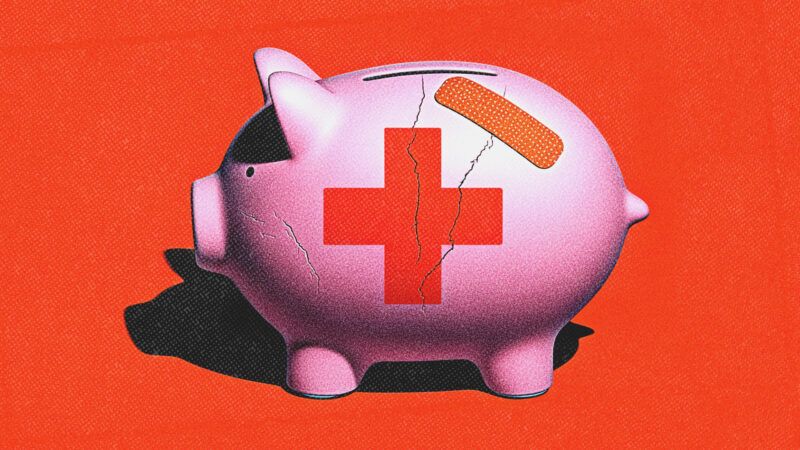
Billionaire progressive activist and California gubernatorial candidate Tom Steyer recently remarked: "Health care companies only care about one thing: profits. Single-payer now." This is the same Tom Steyer who opposed single-payer when he ran for president in 2020. "Bernie Sanders was right," he says. "Boy, was I wrong."
He still cannot explain how to pay for it. Can anyone?
Single-payer health care has been the progressive left's signature domestic demand for four decades. It has generated presidential campaigns, mass rallies, congressional cosponsors, and an inexhaustible supply of Twitter righteousness. What it has never generated once is a workable legislative proposal.
Brookings Institution economist Jessica Riedl has spent years waiting for one. Her challenge is simple: Show us a progressive bill that specifies (a) a provider payment system that actually saves money under America's existing, already expensive health infrastructure, and (b) a financing mechanism to replace the roughly $32 trillion in private premiums and out-of-pocket costs that would need to be covered by federal taxes over the next decade.
Despite hundreds of legislative proposals and multiple presidential campaigns built around the issue, no one has met the challenge.
It's not for lack of pretending. Sen. Bernie Sanders (I–Vt.) and Rep. Pramila Jayapal (D–Wash.) have bills that people trumpet as serious legislative vehicles. But as Riedl notes, the proposals are only aspirational. They enumerate generous new benefits with great enthusiasm and then instruct the secretary of Health and Human Services to figure out the rest. The phrase "The Secretary shall" appears 62 times in the Sanders bill alone.
OK, but what about Europe and Canada? Progressives inevitably say: They made it work! This is a rhetorical sleight of hand that collapses on contact with basic facts.
European countries built modest, government-controlled health infrastructures from the ground up over several decades. They contained costs—meaning, among other things, they rationed care—as they expanded access. America did the opposite.
We built the most expensive, technologically advanced, sprawling health system in human history, which consumes nearly 20 percent of gross domestic product (GDP), under mostly private incentives and market pricing. As Riedl puts it, "We cannot simply pay European prices for the more vast American health infrastructure that exists."
The central theory of single-payer savings has always been this: Slash payments to providers to offset the surge in the use of universal, no-cost-at-point-of-service coverage. The Congressional Budget Office (CBO) took a serious look at this fantasy. Its conclusion was that national health expenditures might actually rise, and demand for care would outrun supply. The final result would be European-style rationing, delays, and forgone services, all leading to worsening health care.
Then there's the inconvenient question of how to get the tax revenue needed for a single-payer system to replace private health care premiums, out-of-pocket expenses, and state health programs. Although neither Sanders nor Jayapal has an answer, the Committee for a Responsible Federal Budget does. Financing a Sanders-style system would require a new 32 percent payroll tax, a 25 percent income surtax, or a 42 percent value-added tax, more than doubling every individual and corporate income-tax rate.
The CBO found that such a system would reduce GDP by 6 percent to 10 percent by 2030. From a movement that claims to care about working Americans, that number deserves more than silence.
The state-level record confirms what the nasty arithmetic and voters' disgust tell us. Vermont passed single-payer legislation in 2011 and assigned an expert commission to make the numbers work. After three years of failure, Gov. Peter Shumlin abandoned the plan, admitting that the required 11.5 percent payroll tax per company plus the 9.5 percent income tax per Vermonter (with small businesses paying both) would be politically unsurvivable even in Sanders' home state. Colorado voters rejected their single-payer initiative in 2016 after analysis showed that even tripling taxes wouldn't cover the costs.
Back in California in 2022, the state's nonpartisan legislative analyst estimated that the proposed single-payer system created by the California Guaranteed Health Care for All Act would cost between $494 billion and $552 billion annually. Imagine the taxes needed to more than double that state's spending overnight.
After the bill died without a vote, Assemblymember Ash Kalra (D–San Jose) reintroduced it in February 2026, and it failed to advance again a few months later. California has now killed single-payer twice in four years.
The absence of a workable plan after 40 years tells you everything you need to know. This is Riedl's essential insight and the one that cuts deepest. It's unworkable. It's expensive. And it will kill the supply of health care. Steyer knew all this in 2020 when he ran for president. The only thing that's changed is politics.
COPYRIGHT 2026 CREATORS.COM