
Trump Taps Kevin Warsh To Lead Fed
Plus: Shutdown averted? Pixar's NIMBY robot beavers, Amazon goes big on AI, and Trump wants to prop up home prices.
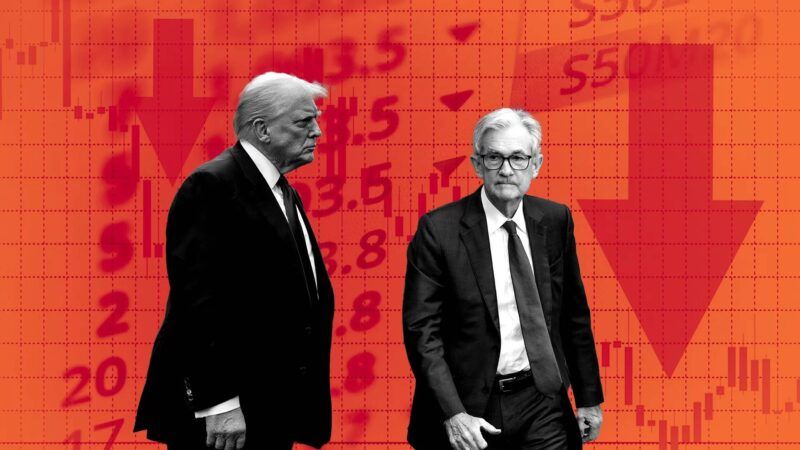
Kevin Warsh is President Donald Trump's pick to be the next Chairman of the Federal Reserve.
Trump has grumbled publicly about current Fed Chair Jerome Powell practically since the beginning of his second term. Now, the president has named a replacement. Not surprisingly, Warsh is a prominent critic of the Fed—and Powell.
Warsh was a Fed governor during the financial crisis, and like Trump, he favors lower interest rates in the short term. During the pandemic, Warsh also warned that ongoing expansions of the central bank's balance sheet could spark inflation. As The Wall Street Journal notes, he's usually been "more concerned about the risks of higher inflation than weaker growth."
But in recent years, he has devoted himself to something more like a structural critique of the central bank. In a lengthy speech published by Cato Journal in 2018, he talked about "the knowledge problem and fed policy"—yes, that's a Friedrich Hayek reference—and made the case for a more humble approach to central banking.
The Reason Roundup Newsletter by Liz Wolfe Liz and Reason help you make sense of the day's news every morning.
"We know far less than we purport about the price formation process," he wrote, and "still less about the economy's resilience to economic and financial shocks; and less still about the current constellation of loose monetary policy, stagnant wages, and elevated financial asset prices."
One of the big worries about Trump's search for a new Fed chief is that he'd end up choosing someone who simply answered to the president's whims, undermining the central bank's independence. This is an issue that libertarians have worried about too: On The Reason Roundtable recently, Reason Editor in Chief Katherine Mangu-Ward argued that even if you're a strong critic of the Fed, allowing it to become a fundamentally political body—an extension of politics and presidential moods—would be even worse. An independent Fed is preferable to one controlled by Trump or whoever ends up in the Oval Office next.
As it turns out, Warsh has strong opinions about Fed independence himself. In a 2010 speech, he made the case for a more nuanced view. "The Fed is not independent from government," he said. "It is independent within government." Warsh's main message was that the Fed can't hide behind independence or use it to shield officials from accountability. "Central bankers should not be pampered princes," Warsh has said. In his view, the Fed had grown too large and too unwieldy. Unchecked growth has made it worse at its core responsibilities: fighting inflation and providing liquidity. This overreach made the Fed less trustworthy, which was a problem, he said, because the "Fed's greatest asset is its institutional credibility."
Warsh's critique includes moments in which the Fed has rushed to prop up some failing part of the economy. "The Fed," he said, "as first-responder, must strongly resist the temptation to be the ultimate rescuer." The Fed shouldn't be asked to backstop every aspect of the economy or fix policy mistakes made by Congress. "The Federal Reserve," he once said, "is not a repair shop for broken fiscal, trade or regulatory policies."
Fundamentally, Trump has picked a long-time critic of a major governmental institution to run it. That's in character for the president, who has stacked his administration's top ranks with opinionated outsiders. But Warsh, unlike some of Trump's picks, is a serious person with insider experience and a thoughtful critique of the Fed's role and self-conception.
Will Warsh get the chance to put his stamp on the central bank? We may not find out for months. Powell's term ends in May, and Warsh must still be confirmed by the Senate, which could be a challenge.
Shutdown (kinda, sorta, maybe) averted? Senate Democrats and Trump have agreed on a deal intended to avert an extended government shutdown. But there will probably still be at least a brief shutdown this weekend anyway. And a shutdown that could stretch into next week.
As this newsletter noted yesterday, the funding deal that reopened the government after last year's 43-day shutdown is set to end on Saturday. (This is how Congress budgets now, in haphazard, two-month chunks.) The next set of extensions was expected to breeze through, avoiding a shutdown or drawn-out conflict.
But Department of Homeland Security (DHS) funding became a sticking point after Alex Pretti's killing last weekend. Senate Democrats said this week that they wouldn't renew funding for the agency unless changes are made to its immigration enforcement tactics. An initial test vote on DHS funding failed yesterday afternoon.
Late last night, however, a deal came together in the Senate that the president has said he supports. It's quite clear the president doesn't want another long shutdown; the last one was not a political winner for Republicans.
The new deal is essentially an exercise in kick-the-can, giving lawmakers more time to negotiate reforms to immigration enforcement while the rest of the government stays open.
The Senate still has to vote on the deal, however, and doesn't plan to do so until this afternoon. If passed, the deal then has to be passed by the House, which currently isn't scheduled to return to session until Monday. Even if the House acts quickly upon return, that means the government will partially shut down this weekend. The House could also decide to slow-walk its approval, demanding changes to the deal that keep the government in shutdown mode for days, or perhaps even longer.
As is often the case in Washington, it's the day before a government shutdown deadline, and everything is still up in the air.
However, Trump's seal of approval and stated desire to avert an extended shutdown might keep the House from holding up the process for long. On Thursday night, Speaker of the House Mike Johnson allowed that "We may inevitably be in a short shutdown situation." But, he said, "the House is going to do its job."
Congress? Doing its job? I'll believe it when I see it.
Scenes from Washington, D.C.: The temperature has been below freezing all week, and the White House Rose Garden is covered in snow and ice.
QUICK HITS
- In The Wall Street Journal, former Reasoner Emma Camp writes that Trump destroyed Millennial Optimism.
- Former CNN anchor Don Lemon was arrested in California and charged with "conspiracy to deprive rights." If that's a crime, Immigration and Customs Enforcement is in trouble.
- So much for affordability! Trump wants to prop up home prices. "People that own their homes," he said, "we're gonna keep them wealthy. We're gonna keep those prices up. We're not gonna destroy the value of their homes so that somebody who didn't work very hard can buy a home."
- Even when it has accidents, Waymo is safer than a human driver.
- Pixar's next movie is about NIMBY robobeavers. I am not kidding. The movie follows "a girl who transfers her mind into a robotic beaver to help the animals fight the local mayor's construction plans."
- If you don't like Pixar's latest, it looks increasingly like you'll just be able to make your own animated movie, or video game, or something else entirely, with new generative AI tools like Google DeepMind's Genie. Yes, it can play Doom!
- Speaking of outsider critics tapped to lead federal institutions: The New York Times' Ross Douthat interviews Doctor Jay Bhattacharya on restoring trust in science and public health after the failures of COVID-19.
- Amazon might invest $50 billion in OpenAI after announcing a wave of layoffs driven by AI efficiency gains. The 16,000 workers the company let go are, as they say, feeling the AGI.
- Construction on the $16 billion Hudson Gateway tunnel linking New York and New Jersey is set to pause after the Trump administration pulled funding.
- No ICE in Maine? Sen. Susan Collins (R–Maine) says that large-scale immigration crackdown operations have ceased in her state.
- The man who allegedly sprayed Minnesota Rep. Ilhan Omar (D–Minn.) with vinegar during an event in Minneapolis on Tuesday has been charged with one felony count of terroristic threats and one count of fifth-degree assault.
- Hasbro is being sued by its own shareholders for printing too many Magic cards and devaluing them in the process.
- Some celebrities are pushing for a strike intended to end ICE raids in Minnesota. And Bruce Springsteen put out a song protesting ICE, called "Streets of Minneapolis." It is…not a good song.
