
Bessent Says Construction Jobs Are Booming Under Trump's Tariffs. Government Data Show the Opposite.
Meanwhile, Trump is touting low gas prices, which are due in part to the lack of tariffs on oil and gasoline.
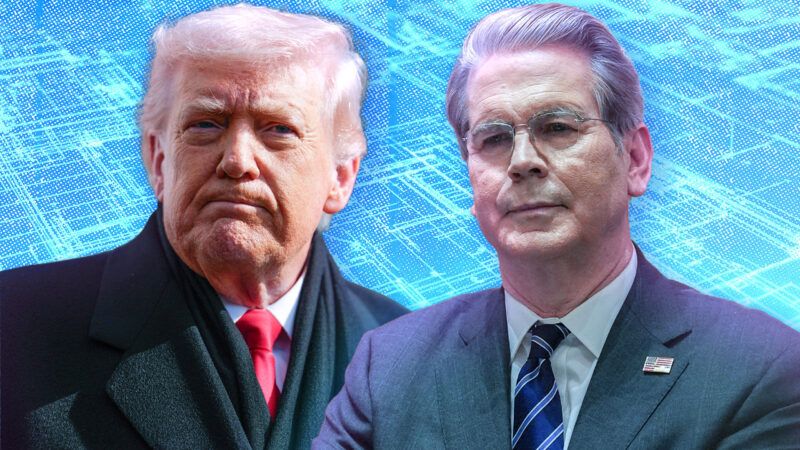
The Trump administration can't seem to tell the truth about the state of the economy—even in contexts when the news is politically beneficial.
Often, that seems to be happening because the White House still can't confront the obvious truth about President Donald Trump's tariffs.
Take two recent examples. The first occurred on Sunday, when ABC News' Jonathan Karl confronted Treasury Secretary Scott Bessent with some inconvenient facts. Karl pointed out that the number of manufacturing jobs in the U.S. has declined every single month since last April, when Trump announced his "Liberation Day" tariffs, which were supposedly going to benefit American manufacturers.
Bessent pivoted away to talk about a different sector of the economy. "What we're seeing is a burst in construction jobs, because we're seeing [a] record number of factories [under] construction," Bessent claimed, before offering some anecdotes about new factories being built in South Carolina.
But there are plenty of anecdotes that point in the other direction, too. Here's one: Earlier this week, Volkswagen Group said it was halting plans to build a new Audi factory in the U.S. in part because Trump's tariffs were cutting into the company's profits.
More importantly, the data aren't on Bessent's side here. The federal government's data do not show this "burst" in construction jobs. In fact, quite the opposite: Construction jobs declined by 11,000 in December, the most recent month for which Bureau of Labor Statistics data are available, and grew by just 0.2 percent during 2025 as a whole. Like most other blue-collar professions, jobs in the construction industry have been underwater since last April.
The president's tariffs aren't the only factor shaping that job market, but they surely aren't helping. The Associated Builders and Contractors (ABC) reports that overall construction input prices climbed 3.4 percent during 2025.
"Many tariff-affected materials, like derivative metal products and switchgear equipment, have experienced considerable price escalation in 2025," Anirban Basu, chief economist for the ABC, said in a statement earlier this month. He pointed out that the price of aluminum, which is subject to huge new tariffs imposed by Trump in early 2025, climbed by more than 25 percent last year.
Trump has also been delivering inaccurate economic information of late. During an appearance in Iowa on Tuesday, he bragged to Fox News about having "solved" inflation—a debatable claim, considering annual inflation is running at 2.7 percent.
But here's the more obviously wrong claim: "They were just saying in Iowa the fuel is $1.95 [per gallon]," Trump said, before turning to the audience. "Did you hear that? Somebody said it was $1.85, but it was $3.50, $4.50 just a year ago."
In reality, the average price for a gallon of gas in Iowa is about $2.55, according to AAA, which is a bit lower than the national average of $2.87. That's down from a national average of $3.10 last January when Trump returned to the White House.
So, yeah, that's politically good news for the president. Why exaggerate it?
But here's a better question: Why are gas prices falling when other products are getting more expensive?
For one, we are enjoying a period of low oil prices globally. That's a good thing, though it is also largely beyond the president's control.
It also seems important to note that gasoline and other oil products are exempt from the Trump administration's tariffs.
In other words, when a barrel of crude oil crosses the border from Canada, it doesn't suddenly have an extra 25 percent tax tacked onto it. But when a roll of aluminum or a pallet of lumber crosses the same border, it suddenly becomes significantly more expensive for Americans to buy. As a result, it has become more expensive to build things but gasoline has remained more affordable. This isn't rocket science.
Trump wants people to appreciate that he's lowered gas prices. Fine, but maybe that message would be easier to sell if he weren't deliberately making so many other things more expensive—and if his top deputies, like Bessent, weren't constantly misleading the public about the consequences of that key policy.
