

The Book That Explains the Heritage Foundation Meltdown
Staffers say they were told that if they couldn't agree with these ideas they should leave. Many have.
On a Thursday night in December, I got a breathless call from a Heritage Foundation senior scholar. John Malcolm and Jessica Reinsch, the director and a deputy director of the think tank's Meese Center for Legal and Judicial Studies, had just been summarily fired.
A Heritage spokesman would later accuse Reinsch and Malcolm of conduct inconsistent with the organization's mission and standards and breach of fiduciary duty. Sources close to the situation say they were actually dismissed after their superiors learned they were about to take jobs elsewhere—and realized that they may not be the only ones. A few days later, the bulk of the think tank's economic and legal/constitutional studies teams decamped en masse for Advancing American Freedom (AAF), a nonprofit founded by former Vice President Mike Pence.
More resignations would follow. But according to my source on that December night, Heritage President Kevin Roberts and his lieutenants had a message for those who stayed behind: "They've been going around the building telling everyone that our whole purpose now is to support and do everything Kevin Roberts wants."
While the proximate cause of the ongoing staff exodus is a video Roberts recorded in October defending Tucker Carlson's decision to amplify the white-nationalist influencer Nick Fuentes, the turmoil at Heritage has been brewing for far longer. In fact, Reason has learned, Heritage leadership has been directing employees to read Roberts' 2024 book, which agitates for a "Second American Revolution," and to leave if they can't agree with the positions therein.
Scores of board members, employees, and visiting fellows have opted to depart, variously citing antisemitism, misogyny, retaliation against employees who dare to speak up, and an institutional pivot away from free market principles. In conversations with more than a dozen current and former staffers, I repeatedly heard that Roberts' belief that he alone should get to determine all of the think tank's stances has provoked resentment among his own subject matter experts.
"The issue is you have the president of an organization committing everybody in it to his position unilaterally," one senior staff member told me in November. "Because Heritage has a one-voice policy, when the president goes out and says Heritage Foundation has this position"—be it support for tariffs or support for Tucker Carlson—"he implicates everybody down the chain, and he makes everybody stand for that."
* * *
A Heritage statement responding to last month's mass flight to AAF begins with "Our mission is unchanged." Likewise, in a January 1 letter printed in The Wall Street Journal, Heritage Vice President Roger Severino insisted that the think tank has changed tactics but not principles.
But multiple recently departed staff members confirm that they were told by superiors to look not to Heritage's official mission statement ("to formulate and promote conservative public policies based on the principles of free enterprise, limited government, individual freedom, traditional American values, and a strong national defense") but to Roberts' book in order to understand the think tank's de facto new direction. The perception was that if they couldn't get behind the ideas in the book, Heritage was not the place for them.
"Parts of the building were basically holding Bible studies with it," one former senior scholar quipped.
There's nothing controversial about the head of a think tank enumerating his or her views, and indeed, it's a timeworn tradition on the American right for would-be thought leaders to publish books that attempt to define and defend conservatism. But the situation in Roberts' case is complicated by two factors: the aforementioned one-voice policy at Heritage and the contents of this particular book.
Dawn's Early Light is a fairly explicit attempt to chart an alternative course for movement conservatism. "If you've read a lot of conservative books or think you have a good sense of the conservative movement," writes then–Sen. J.D. Vance (R–Ohio) in the foreword, "I suspect the pages that follow will be surprising—even jarring."
Those pages are replete with scornful references to "wax-museum conservatives" who "don't know what time it is," by which Roberts clearly means the kind of staid Reaganite wonks who care more about hewing to conservative principle than owning the libs—the kind of people, in other words, who have historically populated the institution he leads.
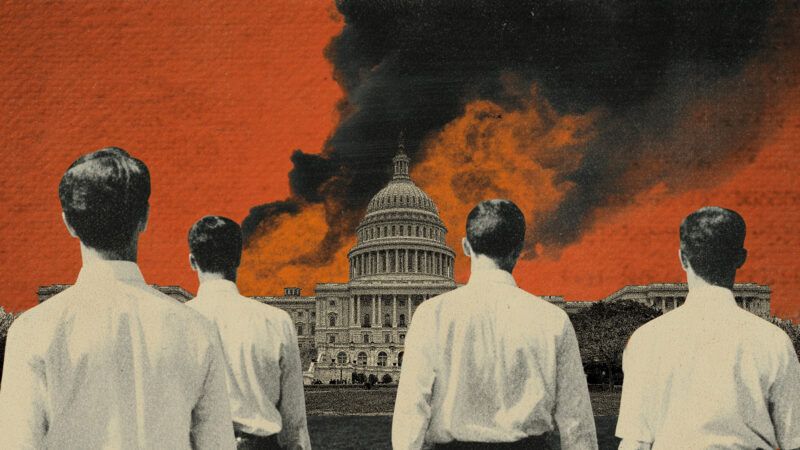
Fire and flames are a recurring motif in the book (the original subtitle of which was "Burning Down Washington To Save America" until the publisher apparently thought better of it). The first chapter features a long list of "decadent and rootless" American institutions that Roberts says need to be burned to the ground, including the FBI, The New York Times, the National Institute of Allergy and Infectious Diseases, BlackRock, the Loudoun County Public School System, and the Boy Scouts of America.
"We're going to (metaphorically) burn down the LA district attorneys office," he says at one point. "We need to (metaphorically) burn down the selective educational institutions that have such a grip on the formation of our elites," he says at another. "If an American institution is incompatible with or contemptuous of public prayer," he says in a third place, Roberts "would be hard pressed to believe that it should not simply be burned down for the common good."
This inflammatory (pun intended!) imagery is in keeping with Roberts' open embrace of populism and sympathy for the highly aggrieved "New Right." It's also an awkward fit for a conservative movement that has long counseled respect for inherited institutions and expounded the Chestertonian notion that civilizations are hard to build and easy to destroy. But this book was written to be a postliberal broadside in the culture war. It is polemic, not scholarship.
* * *
To be clear, not everything in Dawn's Early Light is a departure from the past. There's plenty of standard-fare conservatism (China hawkery, support for secure borders and making English the national language). From a civil libertarian perspective, Roberts' antipathy toward the federal bureaucracy and especially the surveillance state is even rather salutary. But there are also a number of record-scratch moments, particularly when it comes to his discussion of economics.
In theory, free enterprise and limited government are core Heritage principles, and the think tank was historically a staunch defender of free trade. Roberts' book, on the other hand, comes out swinging against globalization, in which "US firms sought to make profits all over the world by expanding into new markets, sending factories overseas, running money through international tax havens, developing global supply chains, and employing other new strategies," and calls for using "the immense powers of our federal and state governments" for protectionist ends. It also asserts more than once that President Donald Trump "won" the trade war during his first term.
Roberts is equally hostile to the modern financialized "sham economy," which he says is guilty of "funneling money to the parasitical enemies of the American way of life." In his view, the goal of the conservative movement should be to return to an economic system that would allow more men to support families on a single income, and he hopes to "restore the proper use of the government" to bring about his favored outcomes. He's comfortable with trade barriers, industrial policy, and the aggressive use of antitrust regulations "to rein in globalist corporatism," he writes. "Especially when it comes to Big Tech and big banks, we need to consider the nuclear option."
The book acknowledges that all of this would require "short-tem sacrifices, including higher prices for some consumer goods," but insists the pain will be worth it.
To reiterate, these positions are more closely aligned with the New Right than with old-school American conservatism. And that's not only the case with respect to economics. Roberts' foreign policy views are also seen by many former staffers as antithetical to the long-standing posture of the think tank he heads.
This is not the first time Roberts has seemed to commit his institution wholesale to a set of ideas that are more at odds than not with the traditional American right. In 2022, he gave a speech at the National Conservatism Conference in Miami in which he startled observers by declaring that he was there "not to invite national conservatives to join our conservative movement but to acknowledge the plain truth that Heritage is already part of yours."
Dismayed by the natcons' will-to-power political approach, a person of my acquaintance (who had been hired by Roberts) left a job at Heritage shortly after that speech. Many have followed in the years since, often for similar reasons.
* * *
All of this would arguably matter less if not for the think tank's practice of barring employees from publicly dissenting from the Heritage party line. "Speaking with one voice is a distinguishing piece of The Heritage Foundation's strategic advantage," its website proclaims. "While other organizations may have experts advocating contradictory points of view, Heritage employees are always rowing in the same direction."
The so-called one-voice policy, which dates back to Heritage co-founder Ed Feulner's time at the helm, "has always—for 49 years—been difficult to implement," Roberts told The Dispatch in 2022. "The difficulty is making sure that there is a conversation internally that gets us to a good spot."
Over and over again in my conversations with current and former staffers, I heard that intellectual collaboration under Roberts' predecessors has been supplanted by decrees handed down, literally, from the president's office on the eighth floor.
"When Ed Feulner was there, we debated these things, and that's how we came to a one-voice policy," a senior policy staffer (who has since resigned) told me in November. "Under Kevin Roberts, it's just whatever Kevin Roberts and his minions decide, without any consultation from the scholars."
"Kevin Roberts, in my opinion, has subverted the one-voice policy," another scholar who left last year told me in December. Ideally, "the one-voice policy at Heritage is that everybody gets together, all the substantive experts on an issue, and they hash it out. They come up with their own internal view, and then people agree that they won't, using a Heritage byline, go out and disagree with that position. What Kevin did differently was, basically, that he constrained the Heritage position to not be contrary to what the Trump administration wanted to hear."
Lending a certain plausibility to this claim is that Roberts himself announced in a 2024 interview with The New York Times that he sees "institutionalizing Trumpism" as the think tank's role. (A Heritage spokesperson did not respond to a request for comment for this story.)
"I can directly testify to being told that Dr. Roberts has special knowledge that no one else has," which should influence policy conclusions, a former research staffer told me in December. "That's cult-of-personality stuff. That's not what a think tank's supposed to be….There were instances where it was communicated to us in no uncertain terms, either fall in line or here's what happens to people that don't: They end up gone."
Faced with such an ultimatum, more and more Heritage staffers have chosen to go elsewhere. The wax-museum conservatives are calling Kevin Roberts' bluff.




