
Brett Kavanaugh Says Trump Threatens Federal Reserve Independence
Trump’s legal arguments “would weaken, if not shatter, the independence of the Federal Reserve,” the justice said.
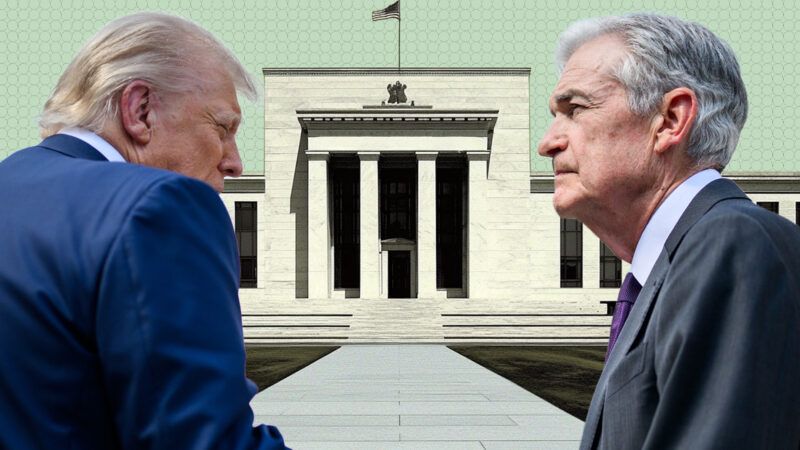
Greetings and welcome to the latest edition of the Injustice System newsletter. The U.S. Supreme Court heard oral arguments yesterday in Trump v. Cook, the closely watched case arising from President Donald Trump's efforts to fire Lisa Cook from her position as a member of the Federal Reserve's Board of Governors. Judging by the sharp objections to the president's position that were voiced by one of Trump's own SCOTUS appointees, Trump's chances of winning the case do not seem so good.
You’re reading Injustice System from Damon Root and Reason. Get more of Damon’s commentary on constitutional law and American history.
According to the terms of the Federal Reserve Act, the president may only remove a member of the Fed's Board of Governors "for cause." In this case, Trump claims that he has sufficient cause to fire Cook because of the mortgage fraud allegations that Trump leveled against her in a Truth Social post and in a letter purporting to fire her (no formal charges have been filed). Cook, however, disputes those allegations and says that she possesses evidence in her favor that the president never considered.
The Trump administration basically contends that the existence of any such evidence is irrelevant to the outcome of the case, because, in its view, the president alone gets to decide what counts as a sufficient "cause" for Cook's removal. What is more, the administration told the Supreme Court that the judiciary is effectively powerless in the face of Trump's decision to fire Cook. "When, as here, the President provides a cause," the administration argued in one of its briefs, "courts may not review his factual findings or his application of the for-cause standard to the facts, or otherwise second-guess his judgment that the removal is justified."
That assertion of unreviewable executive discretion was quickly challenged by Justice Brett Kavanaugh during yesterday's arguments. "Your position that there's no judicial review, no process required, no remedy available, a very low bar for cause that the president alone determines," Kavanaugh told Solicitor General John Sauer, "I mean, that would weaken, if not shatter, the independence of the Federal Reserve."
Sauer's blood pressure probably spiked to a dangerous level when he heard those unkind words coming from Kavanaugh, who has been all too kind to the executive branch in other recent cases. And it only got worse for Sauer from there.
"Let's talk about the real-world downstream effects of this because, if this were set as a precedent," Kavanaugh continued, "it seems to me, just thinking big picture, what goes around comes around." So "all of the current president's appointees would likely be removed for cause on January 20th, 2029, if there's a Democratic president, or January 20th, 2033," he observed, "and then we're really at at-will removal. So what are we doing here?"
Kavanaugh seemed to have made up his mind about what the Trump administration was doing here: Namely, it was pushing a surefire recipe for undermining or even destroying the independence of the Federal Reserve. And that independence, it should be noted, is something that the Supreme Court recently went out of its way to reaffirm amid Trump's firings of other independent agency officials.
Sauer undoubtedly expected to be grilled yesterday by the Supreme Court's three Democratic appointees, and so he was. But the fact that his most unforgiving interrogator turned out to be Kavanaugh, a Trump appointee, suggests that Cook is probably going to remain in her job at the Federal Reserve until her term officially runs out.
