
SCOTUS Seems Inclined To Reject Hawaii's Default Rule Against Guns on Private Property Open to the Public
The state requires carry permit holders to obtain advance permission before bringing firearms into businesses.
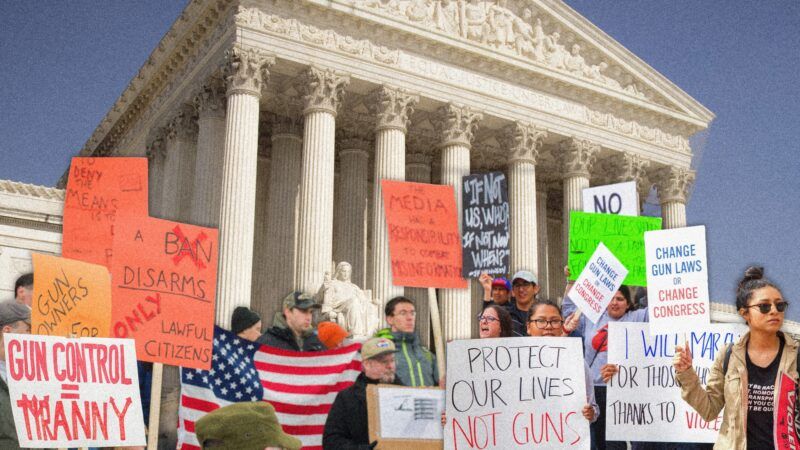
After the Supreme Court's 2022 ruling in New York State Rifle & Pistol Association v. Bruen, several states had to repeal laws requiring that residents demonstrate a "special need" before they were allowed to carry guns in public for self-defense. But even as they made carry permits easier to obtain, legislators made them much harder to use by restricting the locations where people could legally possess firearms. On Tuesday, the Supreme Court weighed the constitutionality of a variation on that theme: a Hawaii law that bans guns from private property open to the public unless the owner has explicitly allowed them.
Three justices—Sonia Sotomayor, Elena Kagan, and Ketanji Brown Jackson—were clearly inclined to uphold that law. But the rest of the Court seemed skeptical that it can pass muster under the Second Amendment.
Under Hawaii's law, carry permit holders who bring guns onto private property are committing a crime unless the owner has given his consent via "clear and conspicuous signage" or "unambiguous written or verbal authorization." That rule, the gun owners who challenged the law note, vastly complicates their ability to carry firearms for self-defense. In the absence of "clear and conspicuous signage," they must seek advance permission whenever they visit businesses such as grocery stores, gas stations, or restaurants.
That requirement, Alan Beck, the lawyer representing the plaintiffs in Wolford v. Lopez, told the justices, "defies a national tradition of allowing people to carry [guns] onto private property open to the public" unless "the owner objects." Principal Deputy Solicitor General Sarah Harris, who joined Beck in attacking Hawaii's law, likewise argued that the state was deviating from longstanding custom. When the Second Amendment was ratified, she noted, "people commonly carried arms" while traveling. "It would've been profoundly disturbing to the founding generation," she said, "to hear that in order to travel [and stop at] taverns or anywhere else," they would need "the affirmative consent of each [owner] and hope that they weren't trespassing if they were traveling and their carriage had to stop."
Under Bruen, Hawaii's law is constitutional only if the state can show it is "consistent with this Nation's historical tradition of firearm regulation." When it upheld Hawaii's law in 2024, the U.S. Court of Appeals for the 9th Circuit saw historical precedent for it in two sets of colonial or state laws enacted in the 18th and 19th centuries. It identified four laws that "prohibited the carry of firearms onto subsets of private land, such as plantations or enclosed lands." It also noted two laws, enacted by New Jersey in 1771 and Louisiana in 1865, that it read as prohibiting "the carrying of firearms onto any private property without the owner's consent."
Those laws are not "relevantly similar" to Hawaii's statute, Beck told the Supreme Court. He described the first set as "anti-poaching laws" that applied only to "enclosed lands" and included exceptions for guns carried in self-defense. And he objected to Hawaii's reliance on the 1865 Louisiana law, which he noted was an example of the "Black Codes" that sought to restrict the rights of newly emancipated slaves.
Even leaving aside the constitutional implications of that discriminatory purpose, Beck said, the Louisiana law was much more narrowly targeted than Hawaii's, which applies to gun owners in general rather than a disfavored subset. Harris likewise faulted the state for relying on the Black Codes, which she described as "outliers" that were "unconstitutional from the moment of their inception."
Justices Samuel Alito and Neil Gorsuch also thought it was odd to invoke Louisiana's law. Is it "not the height of irony to cite a law that was enacted for exactly the purpose of preventing someone from exercising the Second Amendment right…as an example of what the Second Amendment protects?" Alito asked Neal Katyal, the lawyer representing Hawaii. "You rely very heavily on an 1865 Black Code law in Louisiana," Gorsuch noted. "You say it's a dead ringer and a reason alone to affirm the [9th Circuit's] judgment." He described that as "quite an astonishing claim," expressing dismay that "a lot of people" who support gun control "like to cite the Black Codes," which ordinarily would be like "garlic in front of a vampire" to them.
Katyal emphasized that "the Radical Reconstruction Congress," when it readmitted Louisiana to the Union, did not object to the provision regarding guns on private property, which was "race neutral" on its face. He also argued that the "anti-poaching laws" were broader than that label implies, encompassing "improved lands" that included "seed stores and things like that."
In any case, Katyal suggested, Hawaii does not need to cite "relevantly similar" historical analogs because the Second Amendment does not guarantee a right to carry guns on other people's property without their consent. By requiring explicit consent, he said, Hawaii was simply enforcing the rights of property owners. And while other states might choose to do so in a different way, by assuming consent unless it is explicitly denied, that policy is not dictated by the Second Amendment.
"The Constitution protects the right to keep and bear arms," Katyal told the Court. "It doesn't create implied consent to bring those arms onto another's property."
While Jackson enthusiastically embraced Katyal's property rights framing, other justices pushed back. "There's been some suggestion [that] this is just redefining property rights and has nothing to do with the Second Amendment," Gorsuch noted. "And of course we don't allow governments to redefine property rights in other contexts that would infringe other constitutional rights." He mentioned the Fifth Amendment's restrictions on the taking of property.
Harris amplified that point. "In no other context could you say that there's an exemption to constitutional restrictions just because you're trying to redefine the laws of trespass," she said. She offered a First Amendment example: a federal law that the Supreme Court overturned in 1965, which required affirmative consent to receive "communist political propaganda" from abroad. According to Hawaii's logic, Harris said, that law was "just flipping the presumption" from "the default rule" that people "get the mail unless they say no." And in the Second Amendment context, she noted, that approach would "lead to a rule that it's fine to ban tenants from owning guns in self-defense" unless their leases explicitly allow them to do so.
The same reasoning, Chief Justice John Roberts suggested, could be used to override the First Amendment rights of political candidates who go door to door seeking people's votes. "What exactly is the basis for the distinction?" he wondered, noting the concern that courts should not treat armed self-defense as "a disfavored right." Alito was more direct: "You're just relegating the Second Amendment to second-class status," he told Katyal.
Justice Amy Coney Barrett wondered how Katyal's argument would apply to a general ban on "passing out pamphlets" because "people find it annoying," which likewise could be described as enforcing property rights. She also offered a 14th Amendment hypothetical: If there were no laws banning racial discrimination in public accommodations, she wondered, could a state "flip the default and say, unless the owner affirmatively consents, black people cannot enter" private property?
That "would violate the Equal Protection Clause because the government on its face is making a racial classification," Katyal replied. But that is "because there is state action in the way the government is adjusting its property defaults," Barrett said. Katyal initially agreed "absolutely," then retreated to his position that "there's no underlying right" to carry guns on other people's property.
Katyal repeatedly argued that the text of the Second Amendment "as informed by history" shows there is no such right. But under Bruen, a court first asks whether a law restricts conduct covered by the "plain text" of the Second Amendment. If it does, the government has the burden of showing the law is supported by historical tradition. Since "the text encompasses" the right to bear arms, Barrett wondered, "how can you avoid step two"?
Katyal's response boiled down to a complaint that step two is hard. "If you just jump to Bruen step two and say, oh, this law deals with guns, therefore the burden flips to the government," he said, "you're gonna have a really difficult time defending laws….You run into the problem that you've now flipped the burden for every firearms regulation. As long as it deals with guns, then the state has to come in or the federal government has to come in with an affirmative thing."
That's "exactly what the cases say" is supposed to happen, Justice Brett Kavanaugh noted. But that approach would "threaten gun regulation more generally in ways this Court has so far not reached," Katyal replied. "If every single time the state had to [meet] the burden [by identifying] historical analogs, that really does undo, I think, the much more limited nature of the inquiry."
During his rebuttal, Beck argued that laws like Hawaii's are aimed squarely at the right upheld in Bruen. "New York adopted that law first, and the governor of New York said the express reason they were doing that was to undermine the Bruen opinion," he said. California's governor likewise presented that state's new gun restrictions as a response to the Supreme Court's "very bad ruling." Given such statements, Beck said, "there's a clear body of evidence here that this was done to undermine Bruen and to undermine the Second Amendment right."
