
Europe's Biggest Advantage in the Showdown Over Greenland? America's Huge Pile of Debt.
America's large and growing national debt is not just a budgetary liability, but increasingly a geopolitical one too.
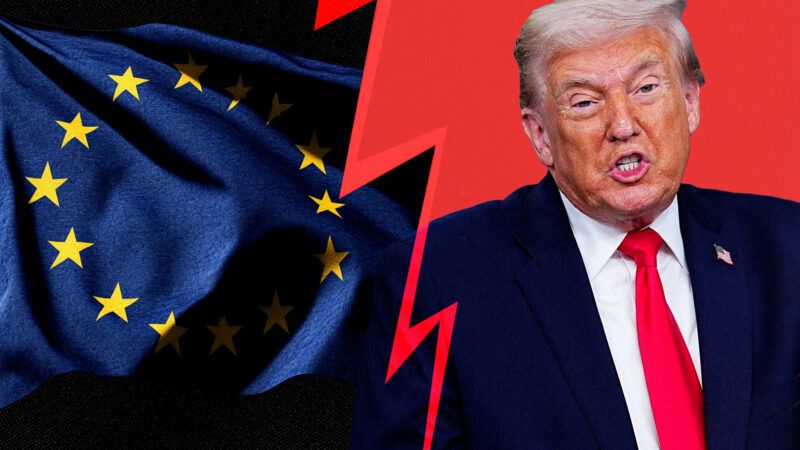
When he was running for office in 2016, Donald Trump said he would pay off America's national debt in just eight years.
That, obviously, did not happen. Instead, the national debt has exploded in the decade since Trump made that promise.
But history must have a sense of irony, because accomplishing that task—or at least making some progress toward it—would have put Trump in a stronger position today as he threatens to seize Greenland against the wishes of Greenlanders, the government of Denmark, and the European Union. Instead, America's large and growing national debt is not just a budgetary liability, but increasingly a geopolitical one too.
"Europe owns Greenland, it also owns a lot of Treasuries," George Saravelos, Deutsche Bank's head of currency research, reportedly wrote in a memo to the bank's clients.
In case that implication isn't clear enough, at least one Danish pension fund is already following through on the threat. AkademikerPension announced Tuesday that it will be selling all $100 million of its U.S. Treasury bond holdings. Anders Schelde, AkademikerPension's investing chief, told CNBC that the decision was driven by "poor [U.S.] government finances" and "not directly related to the ongoing rift between the [U.S.] and Europe."
"But of course that didn't make it more difficult to take the decision," Schelde added.
That seems to line up with what Saravelos is warning about. "In an environment where the geoeconomic stability of the western alliance is being disrupted existentially, it is not clear why Europeans would be as willing" to finance the U.S. government's borrowing, the Deutsche Bank analyst reportedly wrote this weekend.
To be sure, there is little that Denmark or the E.U. could do to prevent the U.S. from militarily seizing Greenland. But Europe is the world's largest market and the largest holder of U.S. bonds. Any direct conflict between the U.S. and Europe—or even an indirect one, marked by rising tariffs, decreasing trade, and deepening mistrust—would inevitably come with serious economic risks for America.
Those risks are already taking shape. The yield on U.S. Treasury bonds spiked on Tuesday as global markets responded to the latest round of threats over Greenland. As always, bond yields are a reflection of investors' opinions about the riskiness of an investment—higher yields mean investors are demanding a higher payout to compensate for more risk.
From the federal government's perspective, rising bond yields mean higher interest payments on newly issued bonds—and that's on top of the interest payments on existing debt, which are expected to top $1 trillion this year.
Exactly how much economic damage could the E.U. cause if its various national governments and private investors decided to sell large amounts of their U.S. Treasury bonds? Let's hope we don't have to find out. The peaceful buying and selling of goods (and government debt) has been a tremendously beneficial arrangement for both Europeans and Americans. The unnecessary conflict Trump is now openly courting could quickly become an economic mess on both sides of the Atlantic.
Still, this is a useful illustration of something that debt hawks have been warning about for quite some time: The federal government's growing debt pile is becoming a geopolitical risk that limits America's ability to project power around the globe. In this narrow case, the leverage created by the debt might help steer the U.S. away from starting a foolish, unnecessary conflict. In another context, however, the risk could be more serious.
