
Video Shows Feds Shooting ICE Protester With Nonlethal Round at Point-Blank Range, Blinding Him in One Eye
The incident raises more questions about federal agents' use-of-force policies and training.
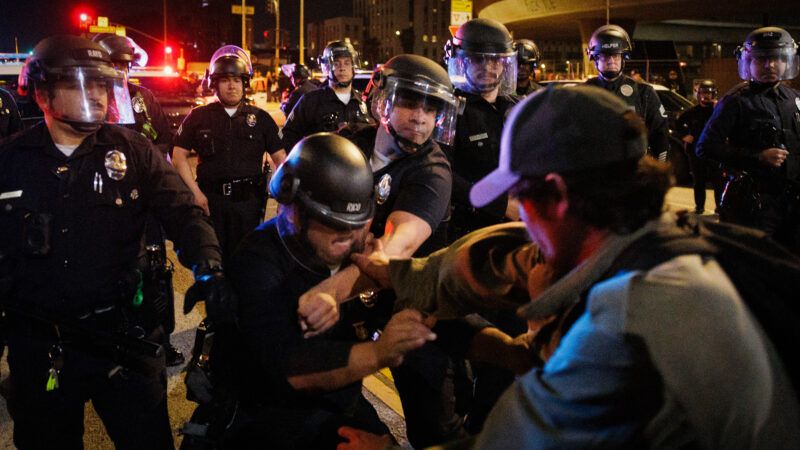
A 21-year-old has been left permanently blind in one eye after a Department of Homeland Security (DHS) officer shot a nonlethal round into the protester's face during a January 9 protest in Santa Ana, California, following the shooting and killing of Renee Good. This and other instances of federal agents using excessive force with crowd-control munitions raise alarming questions over the DHS officers' training on use-of-force policies.
A video published on X by Abigail Velez, a journalist for local affiliate ABC7, shows the moment when a federal officer struck Kaden Rummler, who was protesting outside of a federal building in a demonstration organized by Dare to Struggle, reports the Los Angeles Times. The video begins as an officer grabs a protester, identified by friends to the Times as Skye Jones, the leader of Dare to Struggle. As Jones resists officers, three other protesters, including Rummler, run up the steps and attempt to intervene. One woman is pushed back by an officer as a second officer fires a nonlethal shot into her leg. That same officer then fires at Rummler's face as he advances, carrying a megaphone.
The shot causes him to collapse to the ground until an agent grabs him by the collar and drags the bloodied Rummler toward the federal building.
Rummler lost vision in his left eye and suffered a fractured skull around his eye and nose, Jeri Rees, his aunt, told the Times. After six hours of surgery, where "doctors found shards of plastic, glass and metal embedded in his eyes and around his face," a 7 millimeter piece of shrapnel was left near Rummel's carotid artery for fear that removal could kill him, reports the Times.
Rees told the paper that Rummler said agents did not immediately call paramedics, and that "other officers were mocking him, saying 'You're going to lose your eye.'"
In a statement to the Times, Tricia McLaughlin, DHS assistant secretary of public affairs, said that two officers were injured after a "mob of 60 rioters threw rocks, bottles and fireworks at law enforcement officers outside of the federal building." She also claimed DHS officers took the "rioter to the hospital for a cut." A Santa Ana Police Department spokesperson told the paper that, in the Times' phrasing, "The only violence…that night were demonstrators tossing orange cones at the federal agents."
In an after-publication response to Reason's query about an incident in which immigration agents seemingly used unauthorized force to enter an individual's home in Minnesota, a DHS spokesperson shed light on the agency's training standards. The spokesperson said that officers are "subject to months of rigorous training" encompassing "deescalation tactics to firearms," including "multiple classes dedicated to the proper use of force."
But this is not the first time immigration agents' use of force has been questioned. In the past two weeks, investigations have opened into the fatal shooting of Renee Good and the January 14 shooting of a Venezuelan national in the leg during an attempted arrest in Minnesota. Last September, federal agents flooded the streets of Chicago, leading to a federal lawsuit against the Trump administration and federal agents for using "extreme brutality" against protesters and bystanders. In this case, one federal judge said the evidence of officers using excessive force "shocks the conscience." One such incident described in the lawsuit involved an agent, caught on video, shooting a pastor in the head with pepper balls during a protest.
Under DHS use-of-force guidelines, updated in February 2023, agents may be authorized to use and carry less-lethal devices, such as pepper balls and rubber bullets, and must complete training at least every two years. However, using a less-lethal device is considered deadly force when it "carries a substantial risk of causing death or serious bodily injury," such as "uses of impact weapons to strike the neck or head." The guidelines stipulate that DHS officers "may use deadly force only when…the [officer] has a reasonable belief that the subject of force poses an imminent threat of death or serious bodily injury to the [officer] or to another person."
Ed Obayashi, a sheriff's deputy and legal adviser of Modoc County in northern California, told the Times that officers are trained to avoid aiming at the face because less-lethal "projectiles can still cause serious injury [or] death." Obayashi also told the Times that he didn't see an imminent threat of death or serious bodily harm to the officers in the video of Rummler.
This is yet another example of federal agents using excessive force against protesters and bystanders with both nonlethal and lethal weapons. Perhaps the confusion over use-of-force standards is unsurprising given the Trump administration's rush to hire 10,000 new immigration enforcement officers last year, but the consequence is an unacceptable threat to Americans' rights and safety.
