
28 Years Later: The Bone Temple Delivers Anarchy in the U.K., Again
A zombie movie where mystical evil turns out to be a blonde guy named Jimmy.
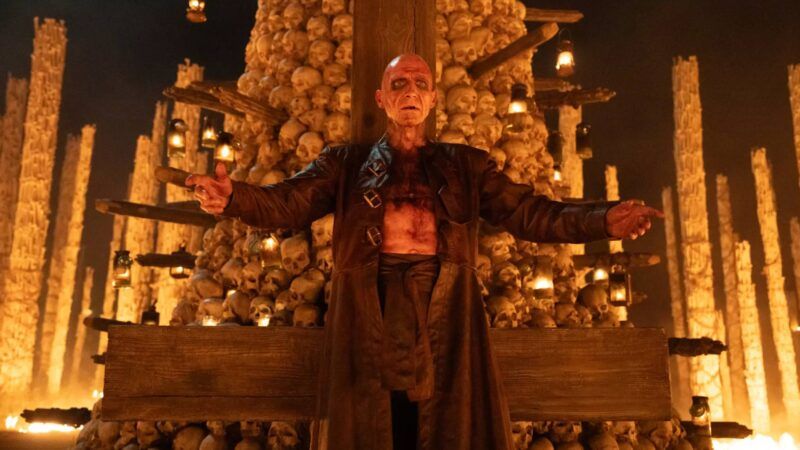
28 Years Later: The Bone Temple is a movie about the devil, who just happens to be a guy named Jimmy.
A direct follow-up to last year's 28 Years Later, this zombie sequel picks up where the last one left off, with a young boy named Spike having encountered a clan of blonde-haired track-suit-wearing psychos, all of whom go by the name of Jimmy. The Jimmys take their name from their leader, a scraggle-toothed Brit played by Jack O'Connell, who wears an upside down cross and claims to be the son of Satan.
In the movie's post-zombie-apocalypse timeline, the U.K. has been cordoned off by the world, left to deal with the infected undead all on their own. 28 Years Later used this as a sprawling quasi-metaphor for Brexit, immigration, and British independence, but The Bone Temple has other ideas on its mind. It's a movie about mystic evil and ordinary men, and how they are the same thing.
The Bone Temple was directed by Candyman's Nia DaCosta and feels more like a conventional horror film than its predecessor as a result. But like 28 Years Later, as well as the first film in the series, 28 Days Later, it was scripted by Alex Garland. Beyond the films in the series, Garland is the writer and director of movies like Civil War and Ex Machina. He first came to attention with The Beach, a novel about a supposed backpacker paradise off the coast of Thailand, a self-sustaining island society that looked like heaven but turned out to be a new kind of hell.
Garland's primary interest is in what happens after the veneer of society collapses and people are left to fend for themselves without social rules or governmental systems to rein them in. Do mutually beneficial moral frameworks assert themselves? Or do people devolve into something uglier and more brutish? He's a sort of philosopher of anarchy, and his answer to both of those questions is: yes, but it depends.
The Bone Temple is a case study in both scenarios. On the one hand, there are the Jimmys, who terrorize and torture what's left of the British population in the name of Old Nick, their Satanic inspiration, the devil-father that Jimmy claims to serve. On the other hand, there's Dr. Ian Kelson (Ralph Fiennes), last seen in 28 Years Later, waxing elegiacally about life, death, and the meaning of it all. He spends much of the movie in what feels strangely like a romcom scenario, except with the gigantic zombie alpha Samson. Fiennes' disarmingly gentle and weird performance was one of the highlights of last year's movies, and if nothing else, The Bone Temple succeeds simply by giving us more time to spend with him.
Kelson is damaged but still hanging on to his humanity. He's trying to treat the infected zombies with kindness and perhaps even some medical interventions, as a doctor and even a scientist who believes that humans can make the world better through a combination of objective science, artistry, and common decency. It's a belief he carries with him, and that also carries him, even through the zombie apocalypse; it's how he retains his dignity, in spite of everything.
Inevitably, these two worldviews come to a head in what amounts to a philosophical battle between the demonic and the secular, a contest of morality (or lack thereof) in a decimated world with no form or rules. As the film progresses, Jimmy's minions spot Kelson and believe he must be the manifestation of Old Nick. Jimmy engineers a sort of devil show in which Kelson, under threat, agrees to play the part.
The result is what is sure to be one of this young year's great scenes, a demonic farce in which Kelson plays the devil while blasting Iron Maiden in a temple of bones. It's a riot, audacious and bizarre and terrifying, but the message is clear enough: the devil isn't some mystical evil force from another plane. It's just people. The devil is just Jimmy, and everyone who believes themselves to be unbound by morality as a result of some mystical higher purpose. In Garland's brutal secular worldview, that sort of mysticism always cashes out as tortured bodies. There's no higher power, no mystical evil, just flesh and guts. The devil is real, but it's just Jimmy. It's just us.
