

No, ICE Agents Do Not Have 'Absolute Immunity' From State Prosecution
How J.D. Vance misstated the law.
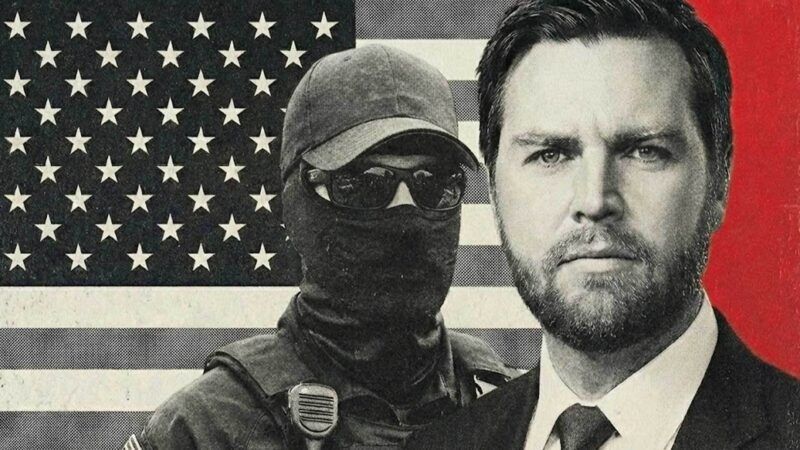
According to Vice President J.D. Vance, the Immigration and Customs Enforcement (ICE) officer who shot and killed Renee Nicole Good in Minneapolis cannot be prosecuted for it by Minnesota officials. "The precedent here is very simple," Vance declared. "You have a federal law enforcement official engaging in federal law enforcement action—that's a federal issue. That guy is protected by absolute immunity. He was doing his job."
But the precedent is not actually so simple. In an 1890 case known as In re Neagle, the U.S. Supreme Court held that a federal marshal named David Neagle was "not liable to answer in the Courts of California" after he fatally shot the would-be assassin of a Supreme Court justice named Stephen Field during an attack on Field that occurred on a train traveling through California (Neagle was present as Field's official bodyguard). "Under the circumstances," the Court said, Neagle "was acting under the authority of the law of the United States, and was justified in so doing." Therefore, "he is not liable to answer in the courts of California on account of his part in that transaction."
Vance may have been thinking of In re Neagle when he claimed that ICE agents possess "absolute immunity" from state prosecution. However, In re Neagle was not the Supreme Court's final word on the matter.
You’re reading Injustice System from Damon Root and Reason. Get more of Damon’s commentary on constitutional law and American history.
Sixteen years later, in Drury v. Lewis (1906), the Supreme Court allowed a state court to weigh murder charges filed by local officials against a U.S. soldier over the killing of a man suspected of stealing copper from a federal arsenal in Pennsylvania.
As part of the legal briefing in that case, Assistant Attorney General Milton Purdy cited In re Neagle in support of a Vance-like argument that called for shielding the soldier from any and all state prosecution. Here is how that argument is summarized in the U.S. Reports:
Even though [the soldier] used more force in attempting to make the arrest than he was warranted in using under the law, nevertheless since he was engaged in performing a duty imposed upon him by a law of the United States, the state courts are without jurisdiction to call him to account for the excessive use of force in performing a duty which the Federal laws commanded.
But the Supreme Court declined to adopt that sweeping argument in Drury v. Lewis. Instead, the Court held that the guilt or innocence of the soldier "was for the state court if it had jurisdiction, and this the state court had, even though it was [the soldier's] duty to pursue and arrest [the suspect] (assuming that he had stolen pieces of copper), if the question of [the suspect] being a fleeing felon was open to dispute on the evidence."
In other words, even if the soldier was doing his job by chasing down the suspect, the state court still had jurisdiction if the lawfulness of the soldier's use of force against the suspect "was open to dispute on the evidence."
And it was open to such dispute. According to some witnesses, the soldier did not shoot a "fleeing felon" at all; rather, those witnesses said the soldier only shot the man after he had surrendered. The Supreme Court thus left it up to a state court (and state jury) to untangle the thorny dispute over lawful versus unlawful use of force by the soldier. The state murder trial was free to proceed.
In short, Vance's blanket assertion that federal agents enjoy "absolute immunity" from state prosecution is contradicted by Drury v. Lewis and is therefore unsound as a statement of law.

Editor's Note: As of February 29, 2024, commenting privileges on reason.com posts are limited to Reason Plus subscribers. Past commenters are grandfathered in for a temporary period. Subscribe here to preserve your ability to comment. Your Reason Plus subscription also gives you an ad-free version of reason.com, along with full access to the digital edition and archives of Reason magazine. We request that comments be civil and on-topic. We do not moderate or assume any responsibility for comments, which are owned by the readers who post them. Comments do not represent the views of reason.com or Reason Foundation. We reserve the right to delete any comment and ban commenters for any reason at any time. Comments may only be edited within 5 minutes of posting. Report abuses.
Please to post comments
Absolute immunity? No. Functionally you are going to have trouble prosecuting a federal agent at the state level for legal actions taken in the course of duty.
Root has a small nugget of truth in his point, but he's still staking a position that defies the law and reality. Maybe he should honestly look at this whole situation from a legal perspective. If he did then he wouldn't be entertaining prosecution of Ross regardless of jurisdiction questions.
No, Root is entirely correct to point out that JD Vance's statement of the law was false. That's a separate matter from whether in practice any prosecution will flow.
Like Damon, shrike ignores the totality and context of a comment. He ignores actual precedence. Because shrike is retarded like Damon.
Damon Root once again takes a statement, ignores what was said and the contextit was said in, then tries to fact check what he imagines what was said.
In this case the officer was performing his legal federal duty. He fired legally while being hit with what even the state of minessota deems a weapon when used against an individual. He fired shots in self defense. Yes he has absolute immunity from the state in that situation. The state can not go after him. It would go to a federal court where they will dismiss based on precedence and case law.
Damon Root is a failed lawyer turned activist.
> The state can not go after him.
I wouldn't put it past the state to try, just for the political theatre of resisting the federal administration. Even if it goes nowhere, I could see "we tried" resonating with some voters.
The entire JD context for this quote was about the state trying to try the officer, which Damon ignores.
The state will definitely try (even though Minnesota law considers a car a weapon and justifies the shooting in its own legal system) which is where JD points out they cant.
Damon chooses to ignore this.
Of course. And when tossed people will be riled up because they think justice wasn't served just because it wasn't made to their liking.
We have "precedents" from 1890 and 1906, but Root did not mention Lon Horiuchi.
In 1997, Boundary County, Idaho Prosecutor Denise Woodbury, with the help of special prosecutor Stephen Yagman, charged Horiuchi in state court with involuntary manslaughter over his killing of Vicki Weaver. The U.S. Attorney filed a notice of removal of the case to federal court, which automatically took effect under the statute for removal jurisdiction[11] where the case was dismissed by U.S. District Judge Edward Lodge on May 14, 1998, who cited the supremacy clause of the Constitution which grants immunity to federal officers acting in the scope of their employment.[6]
You have to remember. Damon root is a failed lawyer turned activist.
If a fed agent qualified for state prosecution it was Horiuchi.
Idaho couldn't even prosecute for involuntary manslaughter after sniping a woman holding a baby.
Failed at being barely human scum and so, turned to activist journalism.
BIPOCs vs. AWFLs vs. Hamas Protestors is just the tip of the SJW hierarchy iceberg.
1. The agent defended himself.
2. Waltz specifically signed a bill in 2020 saying lethel force is usable if someone accelerates towards you
3. You are defending invaders and pedofiles. You are sub human
So, this isn't as bad as Root's other legal analysis articles but he still misses an important distinction here.
The soldier was dealing with a *state level* crime. The ICE agent fired to prevent a federal crime. Attacking a federal agent in the performance of their federal duties is a federal crime,
So it's not a simple 'haha the state gets jurisdiction' here and precedent is with the federal courts dealing with this UOF.
MN sues Trump in what will be one of the most laughable lawsuits ever.
""The complaint focuses on “Operation Metro Surge,” the name the Trump administration gave to its deployment of federal immigration enforcement agents from multiple DHS agencies to Minnesota, specifically to the cities of St. Paul and Minneapolis, an “unprecedented surge” that has involved “[t]housands of armed and masked DHS agents [who] have stormed the Twin Cities to conduct militarized raids and carry out dangerous, illegal, and unconstitutional stops and arrests in sensitive public places, including schools and hospitals—all under the guise of lawful immigration enforcement.”""
""The complaint argues that the federal immigration operations are unconstitutional and unlawful, as violations of the First and Tenth Amendments to the U.S. Constitution, the federal Administrative Procedure Act, Minnesota’s right to Equal Sovereignty, and violations of state and local laws.""
Are they that dumb?
""This “massive deployment of armed agents to Minnesota bears no connection” to the federal government’s claimed objective of fighting fraud, the complaint continues, “""
I guess they are. This is not about fighting the fraud. It's about immigration enforcement.
https://www.msn.com/en-us/news/us/just-in-minnesota-sues-trump-admin-for-federal-invasion-of-the-twin-cities/ar-AA1U56xV?ocid=msedgdhp&pc=DCTS&cvid=fcf4371c2c354e1dd86cb156860c0ce8&ei=12
This cop may not have absolute legal immunity but as a practical matter he is absolutely immune from prosecution by the state of Minnesota. This is all political theater.
^This
In a legal sense, Damon Root is completely justified in putting himself in front of the ICE vehicle and demanding they get out.
In a practical sense, even if he has the popular support to effectively stop this specific ICE officer from taking any further action, it is unwise for him to force the situation in such a manner.
But, if retards suddenly developed 110+ IQs when the situation demanded it, we wouldn't be where we are.


