
Elon Musk Said Rand Paul Is the One Person in Washington Who 'Gets It'
In an interview with Reason, CNN's Scott Jennings recounts the conversation he had with the tech entrepreneur about his distaste for exorbitant government spending.
That there are fractures within the conservative movement is not going to come as a shock to those who follow politics closely, particularly over the last few months. The response to Republican activist Charlie Kirk's September murder and a much-condemned October video by the Heritage Foundation's Kevin Roberts both shoved a question to the fore: What, exactly, does it mean to be a conservative?
In isolation, the debate concerns whether to exclude people on the far fringes: Holocaust deniers and conspiracists. That same question, though, has lingered over the conservative movement in a much broader way for the last decade as it tries to decide what it is under President Donald Trump, and what it will be when he is gone.
Which is, in some sense, why I wanted to interview CNN's Scott Jennings. The Republican pundit's profile ballooned during the 2024 presidential election, known for his viral exchanges with liberal-leaning panels in which he says he tries to give the average MAGA believer a fair shake. He has, to many, become a face and voice of the movement. But Jennings began in a very different place: a political operative in George W. Bush's presidential administration who cites Sen. Mitch McConnell (R–Ky.) as one of his most influential mentors. He's a good example of the old guard meeting the new guard, wrapped up in one person.
His recent book, A Revolution of Common Sense: How Donald Trump Stormed Washington and Fought for Western Civilization, is a full-throated endorsement of the Trump administration, as the title would suggest. Yet it still puts on display some of the consequential fissures within the GOP. Can the movement reconcile those and have it both ways? The answer in Jennings' book seems to be "yes." In our interview, it was more complicated.
There was the alliance gone wrong between Trump and Elon Musk, who pledged to attack government spending and waste. Things turned sour between the two, at least for a time, after the introduction of Trump's "One Big Beautiful Bill," the first major legislative package of his second term, because it came with an enormous price tag. "I think a bill can be big or it could be beautiful," Musk said last year. "But I don't know if it could be both."
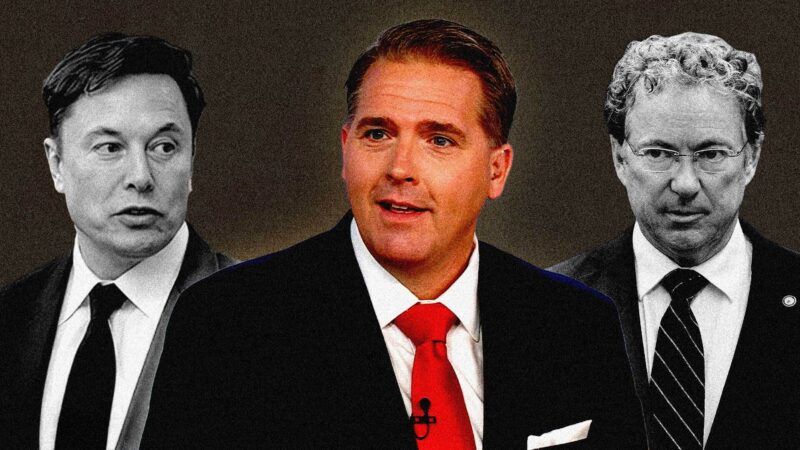
The spat laid bare a tension that has long persisted: whether the Republican Party means what it says when it comes to spending responsibly and reducing our gargantuan national debt. "When I asked Elon, for the book, 'Did you meet anyone in Washington that you actually think gets it?' he only gave me one name," Jennings tells me, "and it was [Sen.] Rand Paul [R–Ky.]."
The One Big Beautiful Bill Act got a positive review in Jennings' book. In our interview, however, he was (refreshingly) willing to acknowledge something that many politicians are not: "Ultimately, if you really wanted to tackle this, it's going to require some pretty massive structural changes in entitlements and other things that are effectively just on autopilot right now," he says, though he acknowledges Trump "made a long-term campaign promise: 'I will not cut Social Security and Medicare.'"
The president has instead offered that he will raise significant government revenue via tariffs—a subject Jennings said was the biggest departure from old-school conservative thought. Although the policy was supposed to reinvigorate manufacturing, the sector has lost jobs for seven months in a row. Is that common sense? "For me and a lot of Republicans, reconciling this has been interesting," Jennings says. "Because on the one hand, it's not traditional conservative economic theory. On the other hand, a lot of our constituents actually believe somebody's got to do something about the hollowing out of middle America."
One of Trump's defenses has been to say that children will maybe "have two dolls instead of 30 dolls"—a tacit admission that his policy may force people to go with less. "If I were advising him," Jennings says, "I would tell him I don't think that's the correct communications vector on this."
At the outset of his book, Jennings writes that the major thread connecting Trump to Jennings' mentors and former bosses—and the more traditional wing of the Republican Party generally—is the president's support for free speech. The Biden administration, after all, sought to pressure social media platforms to censor content the government found objectionable. But what about Trump suing media companies for coverage he doesn't like; or the administration seeking to deport someone whose only offense appears to be writing an op-ed; or the government issuing veiled threats against a network for airing speech it took issue with?
"I think you could pick out any individual moment and say, 'Oh, what about this? What about that?'" Jennings responds. "Generally, my argument is: Trump is friendlier to speech and friendlier to the First Amendment and friendlier to the press than virtually any other president in my lifetime."
The theme, to some degree, is that Jennings is wary of narrowing the tent. He is a Republican through and through, and he wants Republicans to win, even when what exactly is winning sometimes remains unclear. But he is willing to draw certain lines.
"If somebody walked in the door and said, 'Let's raise all the tax rates to 100 percent,' we'd beat them up and throw them out," he says. "But if somebody oozes into the door and says, 'Hey, I have a great idea, let's deny the Holocaust and praise Stalin and worship Hitler or whatever'—we don't have to absorb that either."
