
Hegseth Won't Let Us See a Video That Might Undermine Support for Trump's Bloodthirsty Anti-Drug Strategy
The defense secretary claims the video, which shows a second strike that killed two floundering survivors, would compromise "sources and methods."
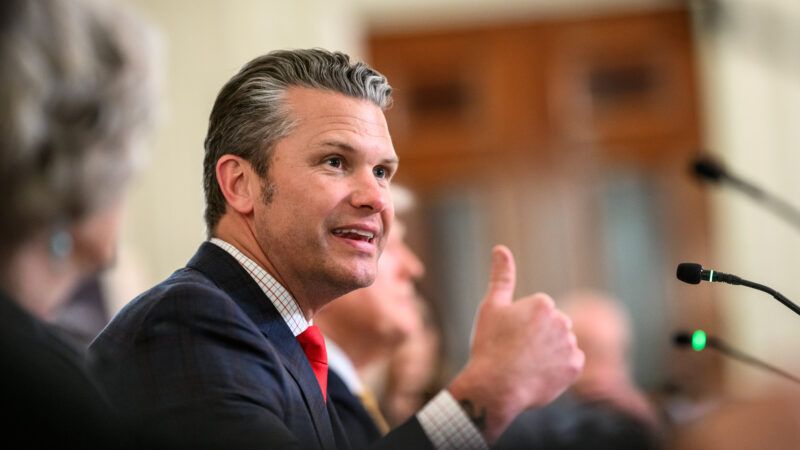
Two weeks ago, President Donald Trump said he saw "no problem" with releasing the full video of the newly controversial September 2 operation that inaugurated his deadly military campaign against alleged drug boats in the Caribbean and the eastern Pacific. But on Tuesday, Defense Secretary Pete Hegseth said no one aside from a select group of lawmakers would be allowed to see the video, which shows a second missile strike that blew apart two survivors of the initial attack as they clung to the smoldering wreckage.
"In keeping with long-standing…Department of Defense policy, of course, we're not going to release a top secret, full, unedited video of that to the general public," Hegseth said after he and Secretary of State Marco Rubio briefed senators on the boat attacks, which so far have killed 95 people in 25 operations. But the fact that the video currently is deemed "top secret" should not be decisive, since Hegseth has the power to declassify it. He is using vague national security concerns as an excuse to conceal footage that might undermine public support for Trump's murderous anti-drug strategy by vividly showing what it looks like in practice.
"Will you release video of that strike so that the American people can see for themselves?" ABC's Selina Wang asked Trump on December 3. "I don't know what they have," Trump replied, "but whatever they have, we'd certainly release, no problem."
Hegseth contradicted that commitment three days later. "President Trump said he would have no problem if the full video of the strike is released," Fox News reporter Lucas Tomlinson noted during a Q&A session on December 6. "When can we see that video? When will you release it?"
Hegseth implied that Tomlinson was mistaken in taking the president at his word. "We're reviewing it right now to make sure sources [and] methods" are not compromised, Hegseth said. "I mean, it's an ongoing operation….We've got operators out there doing this right now. So whatever we were to decide to release, we'd have to be very responsible about it. We're reviewing that right now."
Two days later, Trump himself retreated from his promise of transparency. "Mr. President, you said you would have no problem with releasing the full video of that strike on September 2nd off the coast of Venezuela," ABC's Rachel Scott reminded him. Trump denied that he had said what he said: "I didn't say that. You said that. I didn't say that. This is ABC fake news." Then he announced a new position: "Whatever Hegseth wants to do is OK with me."
When Scott pressed Trump on whether he would order Hegseth to release the video, he unloaded on her: "You're the most obnoxious reporter in the whole place. Let me just tell you, you are an obnoxious—a terrible, actually, a terrible reporter. And it's always the same thing with you. I told you, whatever Pete Hegseth wants to do is OK with me."
Given that green light, Hegseth evidently decided he did not need to offer any specific rationale for refusing to release the video. Like Trump's promise that "we'd certainly release" it, Hegseth's talk of "reviewing" the footage with an eye toward redacting clues about "sources [and] methods" has gone down the memory hole.
Sen. Markwayne Mullin (R–Okla.), a member of the Senate Armed Services Committee and an enthusiastic supporter of summarily executing suspected cocaine couriers, told reporters on Tuesday the issue with the video is "the sensitivity" of "the assets used" in the boat strike. "It is a classification issue," said Mullin, who had not seen the video. "I don't make the classification….If you don't like the classification, talk to the White House about it."
Rep. Adam Smith (D–Wash.), who as the ranking Democrat on the House Armed Services Committee was allowed to see the video during a closed-door briefing on December 4, thinks the claim that releasing it would compromise "sources and methods" is "ridiculous." The Pentagon could easily "make sure that nothing in that video…shows anything [sensitive]," Smith said during a December 7 interview on ABC's This Week. "If they showed…just the portion that we saw, those two on the boat, it's no different [from] any of the dozen-plus videos they've already released."
While the military rationale for concealing the video is dubious, the political rationale is pretty clear. "They don't want to release this video because they don't want people to see it," Smith said. "If they release the video, then everything that the Republicans are saying will clearly be [seen] to be completely false."
Like the Trump administration's position on releasing the video, its justification for the second strike is a moving target. Rep. Jim Himes (D–Conn.), the ranking Democrat on the House Intelligence Committee, has noted the Pentagon's "shifting explanations."
Immediately after the attack, Himes recalled during a December 7 interview on the CBS show Face the Nation, members of Congress were told U.S. forces "needed to clear the wreckage so that there wasn't a danger to navigation." Then "right before we watched the video," Himes said, the explanation was that the unarmed survivors "might have had a radio," "might have been radioing a boat," and "might have been trying to recover the cocaine." But "when you actually watch the video," he noted, "you realize they don't have a radio" and are "barely hanging on" to what remains of the boat. Then the claim became that they were "trying to right the boat," even though "the conflagration" from the first missile strike "probably destroyed everything in that boat."
The latest explanation illustrates the alarming implications of conflating drug smuggling with violent aggression. Adm. Frank Frank M. Bradley, who commanded the operation, reportedly told lawmakers he ordered the second strike because he worried that the two floundering survivors could have salvaged whatever cocaine might have remained in the capsized bow of the boat, which was all that was left after the first strike.
Trump, who last month said he "wouldn't have wanted" a second strike, alluded to Bradley's rationale for it during his vituperative December 8 exchange with Scott, the ABC reporter. "I saw the video," he said. "They were trying to turn the boat back to where it could float. And we didn't want to see that, because that boat was loaded up with drugs."
Trump was echoing Sen. Tom Cotton (R–Ark.), chairman of the Senate Intelligence Committee, who after watching the video on December 4 claimed the helpless survivors were "trying to flip the boat" so they "could stay in the fight"—a "fight" that did not actually exist, since neither those two men nor the nine others killed in the attack were engaged in combat with U.S. forces. Cotton later qualified his claim on NBC's Meet the Press, saying "they looked at one point like they were trying to flip the boat back over, presumably to rescue its cargo and continue their mission." It is at least as plausible, of course, that "they were trying to flip the boat back over" in an effort to avoid drowning.
In any event, Cotton said, "it doesn't really matter what they were trying to do." Since part of the boat was still afloat, he averred, "that boat, its cargo, and those drug traffickers remained valid targets….It was entirely appropriate to strike the boat again to make sure that its cargo was destroyed. It is in no way a violation of the law of war."
Himes disagrees. "Any American who sees the video that I saw will see the United States military attacking shipwrecked sailors," he told reporters. According to the Defense Department's Law of War Manual, "orders to fire upon the shipwrecked would be clearly illegal." The manual says individuals are deemed "shipwrecked" when they are "in distress at sea," "helpless," and "in need of care and assistance," provided they "refrain from any hostile act."
Beyond the issue of whether Bradley violated that rule, Cotton's claim that the two survivors "remained valid targets" raises the question of whether they were ever valid targets. The answer depends on whether you accept Trump's preposterous premise that supplying Americans with cocaine amounts to "an armed attack on the United States." If you don't, you will see a problem not only with this particular attack but with Trump's general policy of treating criminal suspects as "combatants" in a nonexistent "armed conflict," which he thinks justifies killing them from a distance without legal authorization or any semblance of due process.
The video that Hegseth refuses to release would dramatically illustrate the consequences of that logic. Cotton, who told reporters he did not see "anything disturbing" in the video and said "I personally don't have any problem with" releasing it, is confident that Americans will share his morally and legally bankrupt take on the cold-blooded murder of defenseless people. Hegseth seems less sure.
