

SCOTUS Sounds Ready To Let Trump Fire FTC Commissioner Rebecca Slaughter
Plus: It's the final day of Reason's webathon.
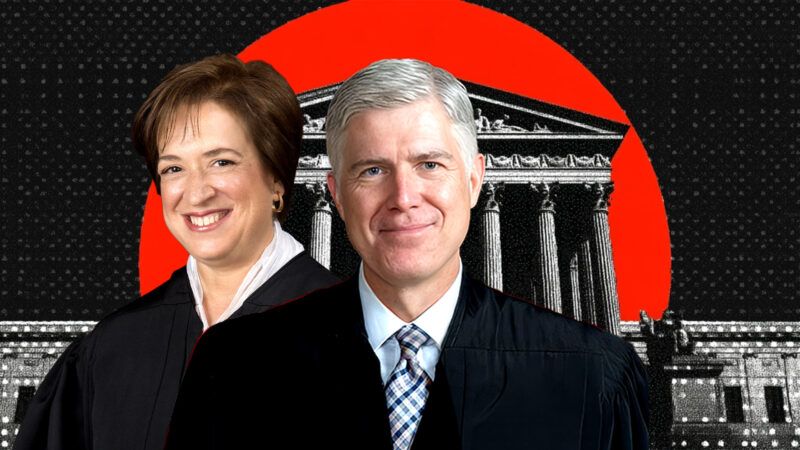
The U.S. Supreme Court heard oral arguments yesterday in a case with huge implications for both presidential power and the future of independent federal agencies. Yet the big question on the mind of the justices was seemingly not whether President Donald Trump should win—since they all seemed to accept that he was going to win, whether they individually liked it or not—but rather, the big question seemed to be just how broad or narrow Trump's legal victory was going to be.
You’re reading Injustice System from Damon Root and Reason. Get more of Damon’s commentary on constitutional law and American history.
The case is Trump v. Slaughter. At issue is Trump's purported firing of Rebecca Slaughter for purely political reasons from her position as a commissioner of the Federal Trade Commission (FTC). Standing in the way of Trump's actions is a 1935 Supreme Court precedent called Humphrey's Executor v. United States, in which the Court unanimously held that President Franklin Roosevelt exceeded his lawful authority when he tried to fire an FTC commissioner for purely political reasons.
"Humphrey's Executor should be overruled," declared Solicitor General John Sauer, who argued that independent federal agencies such as the FTC are actually a "headless fourth branch" of government that ought to be placed under the control of a unitary executive.
The Supreme Court's six Republican-appointed justices all signaled varying degrees of support for Trump's ability to fire an FTC commissioner at will. Based on what I heard yesterday, Trump is very likely to succeed in his quest to oust Slaughter.
But several of those same six justices also seemed to stop short of endorsing the administration's broader call for overruling Humphrey's Executor. Justice Brett Kavanaugh, for example, brought up the worry that if Trump is able to fire an FTC commissioner at will, he will also be able to fire a top Federal Reserve official at will. "I share those concerns," Kavanaugh said. He seemed to be looking for a way to distinguish the FTC from the Federal Reserve in a manner that would let Trump control the former but not control the latter.
Justice Amy Coney Barrett, meanwhile, explored ways in which the government might win by further narrowing Humphrey's Executor, rather than by overturning it.
Trump's position in this case rests on the idea that because the FTC exercises executive power, the agency must be brought entirely within the confines of the executive branch.
But Justice Elena Kagan challenged that idea by pointing out that the FTC and other such independent federal agencies also exercise significant legislative power, such as when an agency makes federal rules. Which means that if Trump wins and the FTC falls under complete executive control, the president stands to gain all of that legislative power, too.
"Isn't it problematic," Kagan told Sauer, "given what we know about the founders' vision, that what this is going to amount to at the end of the day is putting not only all executive power in the President but an incredible amount of legislative/rulemaking power and judging in the President's hands?"
Justice Neil Gorsuch spoke up a few minutes later to share Kagan's worries. "The one thing our Framers knew is that every political actor seeks to enhance its own power," he told Sauer. "We all know that to be true from our own experiences. And this Court, as part of this bargain, has allowed these agencies to exercise both executive and legislative." However, Gorsuch added, "if they're now going to be controlled by the President, it seems to me all the more imperative to do something about it."
For me, this was one of the most fascinating aspects of the day's arguments. Kagan, the liberal jurist, was in a sort of harmony with Gorsuch, the conservative textualist, about the fact that Congress has relinquished many lawmaking powers to federal agencies.
Yet only Gorsuch seemed interested in taking Congress to task for its role in creating the problem. It was Gorsuch, not Kagan, who pointed out that Congress was guilty of abdicating the lawmaking authority that Congress itself should have been jealously guarding. And it was Gorsuch, not Kagan, who also pointed an accusing finger at the Supreme Court's own permissive brand of judicial review in past delegation cases. "Is the answer," Gorsuch asked, for the Court to "recognize that Congress cannot delegate its legislative authority?"
That is almost certainly not going to be the Supreme Court's answer in this case, although I do look forward to reading a possible Gorsuch concurrence that argues for limiting the power of the executive through the use of the non-delegation doctrine.
Before You Go
Reason's annual webathon is coming to a close today, and I wanted to encourage you one last time to consider making a donation to help support my work and the work of my colleagues. Your generous support makes our endeavors possible. Thank you!

Editor's Note: As of February 29, 2024, commenting privileges on reason.com posts are limited to Reason Plus subscribers. Past commenters are grandfathered in for a temporary period. Subscribe here to preserve your ability to comment. Your Reason Plus subscription also gives you an ad-free version of reason.com, along with full access to the digital edition and archives of Reason magazine. We request that comments be civil and on-topic. We do not moderate or assume any responsibility for comments, which are owned by the readers who post them. Comments do not represent the views of reason.com or Reason Foundation. We reserve the right to delete any comment and ban commenters for any reason at any time. Comments may only be edited within 5 minutes of posting. Report abuses.
Please to post comments
"And it was Gorsuch, not Kagan, who also pointed an accusing finger at the Supreme Court's own permissive brand of judicial review in past delegation cases."
Perhaps because the progressive Left are against Trump specifically exercising this delegated authority, not that Congress should not delegate this authority to the Executive on principle?
It’s ok because Democrats did it first, and will do it again.
— Poor stupid sarcbot
The president does not have the power to fire any EB person he wants.
What, like, out of a cannon?
That would be cool.
Every Friday afternoon, we get to see selected EB employees shot from a cannon on the White House lawn.
How many bureaucrats do you think it will take before they're able to properly aim the cannon such that it hits the intake funnel on the woodchipper?
Then the President is not the chief executive, and either Section II of the Constitution is nonsense or Congress has put in unconstitutional restrictions on the Chief Executive's authority.
Or...The presidency is of enumerated powers, then all the (made up) inconsistencies go away.
Stfu commie scum.
Its true, you have made up all of the inconsistencies.
Certainly ity is implausible that Congress can make the rest of the executive branch an independent agency.
Wrongo. "Independent" agencies like the FTC are increasingly using executive branch powers to levy fines for example which clearly fall under the executive branch and guess what? The executive branch is run by the President. It's, like, in the Constitution and everything.
Levying fines is a judicial power.
To what branch does the FTC belong, Dr. Retard? Who is head of that branch?
I like to again point out that making regulations is not the same as making laws. Regulations are made inside the purview of the law to effectively administer the law. Congress seems unable to do the work it is assigned in the Constitution and it seems unlikely it could do the detailed work of developing regulations. Having independent agencies making these regulation provides some separation from politics and offers some continuity in that the members terms overlap Presidential terms. I don't see allowing the President to remove agency members without cause as a good thing.
The problem, in Slaughter's case, is that there is cause.
There is also the constitutional problem of Congress creating an alternate executive branch, not under the purview of the duly elected Chief Executive.
The independent agencies are under the purvey of the president, he just can't fire the commissioners at will. There is nothing in the constitution that says otherwise, and the constitution does discuss lower officials.
Wrong again. All persons in the Executive Branch fall under the Chief Executive who has absolute authority. The fact Congress and the Courts have tried to bypass that inconvenient Constitutional thingy and create an unaccountable deep state doesn't mean it should be allowed to exist. If we are lucky SCOTUS will rule that there are no unaccountable employees, no 4th branch of government and no "experts" or "professional bureaucrats" that rule from the shadows with impunity beholden to no one.
All employees are accountable to someone.
At most, if exceptions exist, they must be deeply rooted in our nation's history and tradition, or rooted in the text of the Constitution itself.
There is no express text allowing Congress to create an independent agency with FTC-like powers, nor do any such agencies have been shown to exist during the Reconstruction period, let alone the Founding.
This may be how you think it should be, but it is not how the Constitution is written.
Congress has power over the president, not the other way around.
Walz +5
They are balanced powers with different functions. One is not inherently over the other.
Congress writes the laws, confirms appointees, ratifies treaties, and can impeach. The President can veto, but that can be over ridden.
Congress clearly is the more powerful branch. They have power over the president in all cases, and the president has zero over them.
Do you intentionally go out of your way to break my Walz Retardometer?
It’s at Walz +11 with your comments consistently.
Stop making up bullshit, commie scum, and get in the helicopter.
That's like saying a brown bear is not the same as a grizzly.
Both are mechanisms for defining what is "legal" in this country and what is "illegal". The fact that regulations are ostensibly regulated by some legislative code while the laws are ostensibly regulated by the constitution is not a significant difference.
I do believe that there is a place for regulations, and I also acknowledge that the scope of regulations has gone far too far.
"Establish levels of Chemical Foo that are harmful in order to protect the environment"
"Establish rules on which chemicals shall be allowed to be produced in order to protect the environment"
Both of these are regulations. The latter is far broader in Scope than the former. Regardless of your distinctions without a difference, the question is the extent to which the Legislative branch should be allowed to delegate to unelected bureaucrats.
"Having independent agencies making these regulation provides some separation from politics and offers some continuity in that the members terms overlap Presidential terms."
This is, of course, complete horseshit. As we have seen constantly, these regulators are constantly acting in a political manner. They have merely been engaged in the kinds of politics M4E prefers. Once these boards have been staffed with political lackies, their independence actually insulates the politicians from the consequences of their laws, which is of course what they want.
I was going to reply but you already said everything I would have and probably better. Thank you.
Yes, "politics" is the word we use for how government decides things. To say that an agency is separated from politics is a non-sequitur, the politics is just hidden and insulated from control by the officials elected to exercise the people's sovereign will. It is advocating bureaucratic rule, unhindered by representative democracy.
+1, Overt.
Right. Laws routinely delegate regulation-making to the Department Secretary. And then there's some provision for congress to overturn regulations it doesn't like.
Why is FTC different from EPA?
independent federal agencies
No such thing.
Yeah I just don't get this. We're not children, why do we continue to pretend that outfits like the FTC and the Federal Reserve are not politically aligned organizations? Forget about whatever your own politics are, no one can actually believe such a thing.
The Federal Reserve is not politically aligned. That is the whole point. Same with the NRC and FTC, and many others.
They are all designed not to be politically aligned.
They are still unConstitutional.
"To make all Laws which shall be necessary and proper for carrying into Execution the foregoing Powers, and all other Powers vested by this Constitution in the Government of the United States, or in any Department or Officer thereof."
+4 on the walz scale
Careful, she’s likely to make the Walz Retardometers overheat and possibly explode.
1. Why didn’t you include what Justice Jackson had to say on the topic Damon? (I know why)
2. The solution to Congress abdicating its responsibility to the Executive isn’t to let unelected bureaucrats run the Executive. (See #1 as to why)
3. A libertarian article on the topic would question why the Federal government is engaged in so much of our lives that it needs to have millions of bureaucrats making “rules” in the first place.
This is what Justice Jackson said:
https://x.com/cspan/status/1998128420396372094
Yeah a full throated endorsement of rule by unelected technocrats.
This is why you can’t have chicks in charge.
Especially retarded ones like her.
Because Action Jackson, while entertaining at times with her DEI rants, is a severely retarded person that knows nothing of the Constitution.
Jackson manages to make Molly Godiva look somewhat less retarded, and that’s no small feat.
*"Isn't it problematic," Kagan told Sauer, "given what we know about the founders' vision, that what this is going to amount to at the end of the day is putting not only all executive power in the President but an incredible amount of legislative/rulemaking power and judging in the President's hands?"*
On the substance, there is no universe where Kagan and the other libs don't want an enormous amount of power in the President's hands. They just don't want it in THIS President's tiny hands. That's the problem with having an ends-based judicial philosophy. Everyone sees you moving the target from ruling to ruling, and your arguments stop carrying any weight.
On the style, nobody who uses the word "problematic" should be in a position of power. Ever.
"*"Isn't it problematic," Kagan told Sauer, "given what we know about the founders' vision, that what this is going to amount to at the end of the day is putting not only all executive power in the President"
The Constitution Article 2, Section 1 "The executive Power shall be vested in a President of the United States of America."
So, yeah because that is where it belongs.
When the FTC was created in the Constitution, the framers stated that...
...wait um. Yeah not actually seeing that in there anywhere. So the only constitutional issue I see is why the hell it exists in the first place. I mean I know the answer: Woodrow Wilson. If I ever get elected to Congress I will introduce the "Woodrow Wilson Fucked Everything Up Act. The WWFEUA will immediately undo everything Wilson did in his entire administration.
Congress has an enumerated power to write the laws that the government follows. The president is required to follow federal law. Nowhere in the constitution does it give the president the ability to fire anyone he wants.
This should be an esay case. But thr Republicans have disregarded the Constitution for so long that they think that what they made up is actually in the text.
Herein Molly stands up for the Independent Agencies Article IX powers as enumerated and further strengthened in the 37th Amendment
Walz +9
Nope. Boy, your on a roll today. Congress can not write a law that binds the hands of the Chief Executive in exercising his Constitutional power. That's just not a thing.
True. But absolute control over the executive branch is not an enumerated power.
MAGAs claim the Constitution says stuff it does not.
"To make all Laws which shall be necessary and proper for carrying into Execution the foregoing Powers, and all other Powers vested by this Constitution in the Government of the United States, or in any Department or Officer thereof."
That is pretty damn clear to me.
And what do you know of the Constitution, CCP commietard?
It’s a stupid commie and will say whatever it’s told to say by its masters, no matter how dumb.
"The executive Power shall be vested in a President of the United States of America."
Show me where it says "and any independent agencies the Congress shall choose to create"
"To make all Laws which shall be necessary and proper for carrying into Execution the foregoing Powers, and all other Powers vested by this Constitution in the Government of the United States, or in any Department or Officer thereof."
That’s not it, Dr. Retard.
Being governed by unelected panels of bureaucrats is not in the constitution.
Congress shouldn’t delegate its authority to the executive branch and it certainly doesn’t have the authority to make rules for the executive branch - that would violate the separation of powers. Unless specifically defined in the constitution; spending originates in the House, for example, but is spent by the executive branch.
You only vote for four people in federal government. Congress is accountable to you, and the rest of the government is accountable to Congress. That is how it works. It is beyond stupid to imply that anyone not elected is "unaccountable".
STFU tard
You just made our point for us.
There is no accountability to the voter if our elected representative can’t fire them
Walz +11. I have to turn my Walz Retardometer off for a bit. It’s hot enough to fry an egg.
Jesus, dumbass. Your doubling down on stupid today. The agencies created by Congress are exercising executive powers and as such are acting in the sphere of the Executive Branch which means they fall under The Presidents control.
Being governed by unelected panels of bureaucrats is not in the constitution.
Yes it is. A1S9 last item.
Really now? Please cite it, commietard.
A1S9 is a citation.
You must have a different "double secret probation" copy of The Constitution of The United States of America than I do.
Article 1 Section 9 Clause 8 (the last item) in my copy reads:
"No Title of Nobility shall be granted by the United States: And no Person holding any Office of Profit or Trust under them, shall, without the Consent of the Congress, accept of any present, Emolument, Office or Title, of any kind whatever, from any King, Price, or foreign State."
"The Fed" & SCOTUS
President Woodrow Wilson did not favor the Constitution. President Calvin Coolidge did. Ironically, Wilson widely is revered; Coolidge largely ignored.
Wilson believed in a technocracy in the form of "independent" agencies like the Interstate Commerce Commission (ICC) established in 1887 staffed by "experts" to govern the country. In 1914, he created his first such "independent" agency, the Federal Trade Commission (FTC)to oversee American businesses and to protect consumers.
Previously established by Congress in 1913, the Federal Reserve Board with its Federal Reserve Banks (FRB) to regulate the economy, also is supposed to be "independent". Investors particularly watch the floundering machinations of the FRB. A current case is before the U. S. Supreme Court to determine how "independent" is "independent" and independent of what.
The real issue? Should the FRB exist, at all? Its record over the decades has been miserable. Its main accomplishment? Debasing the dollar by 96%.
Yes, a free and independent market replacing the Fed would harbor most of the problems that it had before the Fed; nevertheless, such a market governed by the Scientific Method as described in the novel, Retribution Fever, would be preferable to the incompetent gang of "experts" plaguing us now.
Recall that it was a group of "experts" from four central banks who, in 1928, created the context for the Great Depression. There really is a better way.
https://www.nationonfire.com/frb/ .
Debasing the dollar by 96% is a product of going off the gold standard.
Walz -8. First non-retarded thing you’ve said here.
Let the Fed have all the legal independence it wants. Just repeal the legislation that makes its "dollar" legal tender.
There's a law review article out there that makes a pretty good case against reading a nondelegation doctrine into the Constitution, that the Founders understood possession of a power to implicitly include the right to delegate it (subject to explicit restrictions on delegation).
Along the way, it points out that under the definitions of "legislative" and "executive" used by the Founders and their contemporaries, any exercise of delegated legislative power is an executive function.
Assuming that the review article got its history correct, then then fact that an agency exercises delegated legislative power would constitute proof that it is an executive agency, and therefore has to be under the close supervision of the President, who is by the Constitution solely vested with the executive power.
How, then, to prevent delegations of legislative power from creating an imperial presidency? Why, restore the single-house veto, improperly prohibited by the Supreme Court in INS v. Chada. The combination of the unitary executive and the single-house veto ensures that a regulation cannot be adopted except with the (implicit) consent of the President and each house of Congress -- which is to say, the very same entities whose approval is necessary to make legislation.
interesting.
dust removed from Article II ...
MAGAs are the dumbest shits in the world. They claim things are in the Constitution when they are not, and ignore what is in the actual Constitutions.
Fucking fascists all of them.
Walz +11
I feel like you're kinda retarded
Very retarded.
You have misrepresented the constitution throughout this entire comment thread. When anyone makes a point you copy and pasted a quote that had nothing to with that commentor said. You've failed miserably at any point, AS ALWAYS!
Justice Jackson wasn't considering whether "Humphrey's Executor" should be overturned or whether the President should have the power to fire Slaughter. Her concern was that Donald J. Trump would have that power should they overturn "Humphrey's Executor". The Democratic party appointed justices can't separate the office of the Presidency from Trump. TDS at 10.
This will hopefully have the beneficial effect of less unaccountable executive agencies being created by Congress that have the sole purpose of creating authoritarian regulations to rule citizens' lives.
A win-win. I'm not sure how any "libertarian" could disagree with this.
And SCOTUS should. The FTC is either Legislative, Justice or Executive. That is it. There are no others. Clearly NOT Justice. Clearly NOT Legislative. Therefore, the FTC is the Executive, and the Chief Executive can fire them.
The most Libertarian justice by a MILE, Gorsuch, said as much. Reason should line up behind Neil, every time.
No story here at all.
At most, if exceptions exist, they must be deeply rooted in our nation's history and tradition, or rooted in the text of the Constitution itself.
There is no express text allowing Congress to create an independent agency with FTC-like powers, nor do any such agencies have been shown to exist during the Reconstruction period, let alone the Founding.


