

Reason.com - Free Minds and Free Markets
Reason logo Reason logo
  • Latest
  • Magazine
    • Current Issue
    • Archives
    • Subscribe
    • Crossword
  • Video
    • Reason TV
    • The Reason Roundtable
    • Just Asking Questions
    • Free Media
    • The Reason Interview
  • Podcasts
    • All Shows
    • The Reason Roundtable
    • The Reason Interview With Nick Gillespie
    • The Soho Forum Debates
    • Just Asking Questions
  • Volokh
  • Newsletters
  • Donate
    • Donate Online
    • Donate Crypto
    • Ways To Give To Reason Foundation
    • Torchbearer Society
    • Planned Giving
  • Subscribe
    • Reason Plus Subscription
    • Gift Subscriptions
    • Print Subscription
    • Subscriber Support

Login Form

Create new account
Forgot password

Supreme Court

After Repeatedly Losing in Lower Court, Trump Asks SCOTUS To Review His Birthright Citizenship Order

Plus: Justice Anthony Kennedy wrote a book.
Damon Root | 9.30.2025 7:00 AM

Share on FacebookShare on XShare on RedditShare by emailPrint friendly versionCopy page URL Add Reason to Google
Media Contact & Reprint Requests
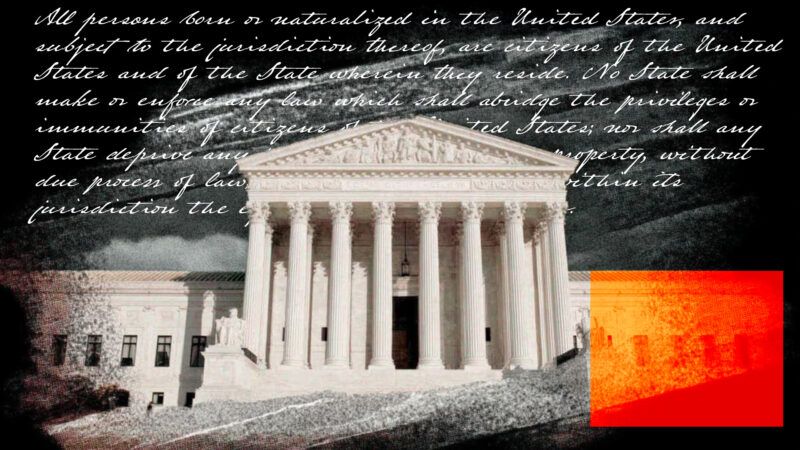
the Supreme Court | Illustration: Eddie Marshall | Midjourney
(Illustration: Eddie Marshall | Midjourney)

The U.S. Supreme Court's 2025–2026 term, which officially kicks off next week, was already on track to be a notable one thanks to the impending SCOTUS showdown over the scope of President Donald Trump's power to fire top officials from "independent" agencies such as the Federal Trade Commission and Federal Reserve.

But now the coming term is set to become even bigger. That's because after repeatedly losing in the lower courts, Trump has finally asked the Supreme Court to review the constitutionality of his executive order purporting to deny birthright citizenship to millions of U.S.-born children.

You’re reading Injustice System from Damon Root and Reason. Get more of Damon’s commentary on constitutional law and American history.

This field is for validation purposes and should be left unchanged.

As you may recall, the Supreme Court already sort of danced around the edges of birthright citizenship last spring when it heard Trump v. CASA, a case that arose from the birthright citizenship controversy yet ultimately focused on the separate issue of the propriety of nationwide injunctions issued by federal district court judges. Coming out of that case, it was an open question as to when the administration might seek the Supreme Court's review of the underlying executive order.

We now have our answer to that question. Late last week, the Trump administration asked the Supreme Court to fully weigh in, urging the justices to find that Trump's order is consistent with the Citizenship Clause of the Fourteenth Amendment, which says, "All persons born or naturalized in the United States, and subject to the jurisdiction thereof, are citizens of the United States and of the State wherein they reside."

In fact, Trump's order runs counter to the text, history, and original public meaning of the Fourteenth Amendment, which guarantees U.S. citizenship to all but an extremely narrow subset of U.S.-born children, such as those whose parents are foreign diplomats and who are therefore not "subject to the jurisdiction" of the United States. If the Supreme Court's "originalist" majority practices what it preaches, Trump's executive order will lose 9–0 on the merits, and deservedly so.

I don't expect the Supreme Court to wait too long before agreeing to take this case up. The justices must be aware that the reckoning over Trump's unlawful birthright citizenship order is already long overdue.


In Other Legal News: Justice Anthony Kennedy Wrote a Book

We seem to be living in boom times for Supreme Court books. And I don't just mean books written about the Supreme Court. I also mean books written by members of the Supreme Court.

Last year brought us Over Ruled by Justice Neil Gorsuch. Last month brought us Listening to the Law by Justice Amy Coney Barrett. And now, next month will bring us Life, Law & Liberty, the new memoir from retired Justice Anthony Kennedy.

My hopes are not exactly sky-high for this Kennedy book, but I do confess to feeling a slight hint of cautious optimism. After all, his legal career is certainly fascinating if you care about the Supreme Court's doings. For many years, Kennedy was the "swing" vote on a closely divided Court, which meant that he left his mark on the law, for better and worse, in ways that most justices can only dream about.

Kennedy also enjoyed the rare distinction, as I remarked when he retired in 2018, of having been "denounced by every major faction in American politics." For example, conservatives attacked Kennedy for his votes in favor of abortion rights and gay marriage; liberals attacked him for writing the Citizens United opinion; and libertarians attacked him for signing off on eminent domain abuse.

Such legal battles, even if narrated in an entirely vindictive and one-sided fashion by Kennedy, could still make for intriguing memoir fodder. Or at least that's my hope. We'll see.

Start your day with Reason. Get a daily brief of the most important stories and trends every weekday morning when you subscribe to Reason Roundup.

This field is for validation purposes and should be left unchanged.

NEXT: Archives: October 2025

Damon Root is a senior editor at Reason and the author of A Glorious Liberty: Frederick Douglass and the Fight for an Antislavery Constitution (Potomac Books). His next book, Emancipation War: The Fall of Slavery and the Coming of the Thirteenth Amendment (Potomac Books), will be published in June 2026.

Supreme CourtDonald TrumpTrump Administration14th AmendmentConstitutionLaw & Government
Share on FacebookShare on XShare on RedditShare by emailPrint friendly versionCopy page URL Add Reason to Google
Media Contact & Reprint Requests

Hide Comments (101)

Editor's Note: As of February 29, 2024, commenting privileges on reason.com posts are limited to Reason Plus subscribers. Past commenters are grandfathered in for a temporary period. Subscribe here to preserve your ability to comment. Your Reason Plus subscription also gives you an ad-free version of reason.com, along with full access to the digital edition and archives of Reason magazine. We request that comments be civil and on-topic. We do not moderate or assume any responsibility for comments, which are owned by the readers who post them. Comments do not represent the views of reason.com or Reason Foundation. We reserve the right to delete any comment and ban commenters for any reason at any time. Comments may only be edited within 5 minutes of posting. Report abuses.

  1. Chumby   2 months ago

    Activist lower court judges >>> scotus

    - Damon

    1. mad.casual   2 months ago

      DR, DR;

    2. Ersatz   2 months ago

      A sane country would understand the open ended interpretation of this issue is idiocy.

  2. GOD OF PENGUIN ISLAND   2 months ago

    And how will we know if he wins at scotus? If Reason doesn’t cover it, he won.

    1. Spiritus Mundi   2 months ago

      21 articles they have yet, and never will, write.

      https://www.whitehouse.gov/articles/2025/09/president-trump-stacks-up-21-victories-in-the-supreme-court-so-far/

      1. GOD OF PENGUIN ISLAND   2 months ago

        Apparently this topic is prohibited.

        1. windycityattorney   2 months ago

          Shadow docket wins are not really wins. Its not a ruling on the merits and are not strictly speaking "supreme court victories." And no, a press release from the White House touting these premature victory celebrations doesn't deserve much discussion at all.

          When Trump loses the birthright citizenship clause case on the merits, for example, then we can have a discussion. When the tariff cases get to a decision on the merits, we can have a discussion, etc...etc...

          1. Moo Cow   2 months ago

            They won't get to a decision on the merits until they need to. For example, on the off chance a Democrat gets elected to the presidency on 2028.

          2. JesseAz (RIP CK)   2 months ago

            You crowd about e very win in the inferior courts lol.

            Shadow docket is the new msnbc approved word for morons.

      2. SCOTUS gave JeffSarc a big sad   2 months ago

        That doesn’t fit with the Koch mandate to always attack Trump.

  3. SQRLSY   2 months ago

    I find it absurd that the SCROTUS even bothers to hear cases like birthright citizenshit! The 9 Nazguls should simply look at shit like this, and summarily (QUICKLY! Near instantly!) announce, "Hey, look, Doofuss, the absolutely clear language of the USA Cunts-Tits-Tuition clearly says twat shit says! Now back OFF, Jack, with trying to countermand the USA Cunts-Tits-Tuition!!!"

    Twat's next, months and months of hearing EACH AND EVER SINGLE LINE of said USA Cunts-Tits-Tuition, for EVERY provision thereof? Two Senators per state, is Dear Orange Dicktator gonna challenge THAT with an Executive Odor, and then we'll have "Odor in the Court" over THAT one, and EVERY OTHER THING in said USA Cunts-Tits-Tuition?

    WHY does shit take 9 over-paid Nagging NAZI Nazguls to READ plain English words and cuntcepts here in the USA Cunts-Tits-Tuition?!?!?!?!? And WHY do we have an ASSpiring DickTator who, on a regular basis, tries to countermand these simple English words?

  4. TJJ2000   2 months ago

    LOL... So.... The 14A says, "guarantees U.S. citizenship to all but an extremely narrow subset of U.S.-born children, such as those whose parents are foreign diplomats"????

    Funny. I thought it said "subject to the jurisdiction thereof".

    Course an "originalist" practice must be to *add* all that BS ad-lib in there?
    IGNORE the CRA1866 "That all persons born in the United States and not subject to any foreign power" from which the 14A was based?
    IGNORE the very AUTHOR of the 14A?

    1. Steve Bird   2 months ago

      That argument always makes me scratch my head. The 14th Amendment's Citizenship Clause needs to be interpreted consistently with a statute written two years earlier that...uses different language? The drafters of the 14th Amendment could have tracked the language of the statute, but they apparently chose not to. The 14th Amendment's Citizenship Clause is broader than the 1866 statute. Maybe that was a mistake. Maybe you've got a solid policy argument that they should have been a little more restrictive. But policy arguments don't control our analysis of the Constitution.

      Conservative legal thinkers fought for several decades to advance the crazy notion that the proper way to interpret the Constitution (and statutes) starts--and ideally ends--with reading the damn words on the page. They've had a large degree of success! More recently, MAGA folks have been screaming for a reversal of that trend, demanding that the Constitution (and law generally) be construed consistent with the Trump Administration's preferences. (I'm waiting for someone in the MAGA camp to argue that the Constitution is a "living document" that should be understood in light of modern "needs.") Any judge who rules an Administration's act or policy unconstitutional or otherwise illegal is a "liberal activist." If that judge was a Trump appointee, he's a "traitor." I've seen this movie, it doesn't end well.

      1. M L   2 months ago

        "That argument always makes me scratch my head. . . ."

        It's quite simple. Just read what the authors said about it.

        They said repeatedly, in no uncertain terms, that "subject to jurisdiction" excluded those subject to any foreign power.

        The reason they used different language than the CRA is explained in detail. In addition to those "subject to any foreign power" the CRA also excluded "Indians not taxed." This latter language presented issues, for example: it was intended to cover a class of Indians that are subject to taxation and jurisdiction, yet the language could be read to exclude Indians within that class who did not pay any tax in point of fact because they were poor.

        "Subject to jurisdiction" was considered to capture the objectives of both "not subject to any foreign power" as well as "Indians not taxed" in a single phrase with better and more precise language.

        Trumbull summed it up: "Therefore I think it better to avoid these words and that the language proposed in this constitutional amendment is better than the language in the civil rights bill. The object to be arrived at is the same."

        Trumbull, Howard and others repeatedly explained that jurisdiction here was exclusive, and excluded anyone subject to or having allegiance to a foreign power. There was not even a whiff of disagreement or debate on this. The only debate was whether that principle extended to excluding those subject to the "quasi foreign" powers of Indian tribes, and the prevailing view was that it did.

        1. Zeb   2 months ago

          The question remains, what does it mean to be subject to or having allegiance to a foreign power? Seems to me it is not an unreasonable interpretation to say that a person who is here and intends to stay is not that. Foreign countries have no jurisdiction inside the US. Only US governments do. If they go back to their home country, they are subject to its jurisdiction, but so is a US citizen who travels to another country.
          And what about Americans with dual citizenship? Maybe that shouldn't be a thing, but it is now. Don't they have "allegiance" to a foreign power in some sense? Or permanent legal residents. I don't think there is much controversy around their children being citizens.
          I do think that the sensible policy would be that children of temporary visitors, or illegal immigrants shouldn't be citizens automatically. But I remain unconvinced that the 14th allows that policy. Maybe it's time for an amendment to clarify how that works. Seems like there is a lot of reasonable disagreement on the subject.

          1. M L   2 months ago

            "Seems to me it is not an unreasonable interpretation to say that a person who is here and intends to stay is not that. "

            I agree, with the qualification that in the modern context they are also here legally.

            Fundamentally, the U.S. retained the choice whether to bring foreigners into its exclusive jurisdiction and recognize their departure from prior allegiances, or not. In no way did the U.S. abrogate its ability to make that choice. And this pervades the historical discussions, even though laws restricting immigration were unnecessary back then for obvious reasons.

            "I do think that the sensible policy would be that children of temporary visitors, or illegal immigrants shouldn't be citizens automatically. But I remain unconvinced that the 14th allows that policy."

            You just said someone is not a foreigner with foreign allegiance if they "intend to stay." Doesn't that exclude temporary visitors? Seems like you've contradicted yourself here on that point.

            1. Zeb   2 months ago

              No contradiction. I meant that most people at least agree that those who intend to stay (legally) get birthright citizenship for children born here. It was not a statement that it is necessarily limited to such people. I'm still not sure about that.

              1. TJJ2000   2 months ago

                OR... Stated correctly. The U.S. Constitution doesn't have a 'right' to birthright citizenship for foreigners or Indians who's jurisdiction is within tribes. That was left for congress/USC to grant.

          2. sarcasmic   2 months ago

            "Subject to jurisdiction" basically means "can be arrested."

            Diplomats have diplomatic immunity, meaning they're subject to the laws of their home country. They can't be arrested by the police.

            Foreign soldiers are subject to the laws of war, not those of the government. They can't be arrested by the police.

            Everyone else can. Having allegiance to foreign power doesn't mean they can't be arrested. Being subjects or citizens of a foreign power doesn't mean they can't be arrested. So they're under the jurisdiction of the United States.

            So the amendment grants citizenship to the children of people who can be arrested. That's how it is. If Trump doesn't like it then he needs to change it, not behave like a progressive and creatively reinterpret the meaning.

            1. M L   2 months ago

              It's cute that you want to take a "I watched quite few episodes of law and order" level of understanding and then apply that to constitutional interpretation.

              Meanwhile if you want to know the reality, "subject to the jurisdiction thereof" meant something different, in the context of the citizenship clause. You can read about it here, starting on page 2890: https://babel.hathitrust.org/cgi/pt?id=coo.31924069588592&seq=122

              1. sarcasmic   2 months ago

                The Constitution was not written for lawyers. It was written to be understood by laymen. When someone starts making lawyerly arguments and making petty personal attacks, my bullshit detector goes off and I tend to ignore whatever they say. Because I know they are obfuscating with an agenda and otherwise arguing in bad faith.

                1. M L   2 months ago

                  Laymen understanding by law and order watchers in 2025 isn't the same thing as laymen understanding hundreds of years ago. Usage changes over time.

                  Don't take my word for anything. Just read the congressional record for yourself, it's only 7 pages.Then you can arrive at an informed opinion on the subject and perhaps you'll be able to share a worthwhile comment.

                  1. SCOTUS gave JeffSarc a big sad   2 months ago

                    Sarc will never give up the con.

                2. TJJ2000   2 months ago

                  Amazing how well you just described exactly what most-others do every-time they see your comments. You've got to be the shiniest mirror in the room.

            2. Azathoth!!   2 months ago

              "Subject to jurisdiction" basically means "can be arrested."

              No. It doesn't.

              Diplomats as well as foreign national embassy employees can be arrested. This is done in conjunction with their government

              Likewise soldiers.

              Illegals are literally avoiding the jurisdiction of the US --otherwise they would not BE illegal.

              This means that if they have children here those children are not citizens.

              Simple.

            3. JesseAz (RIP CK)   2 months ago

              This is retardedly false as usual sarc.

              People on a non diplomatic visa can be arrested dummy.

          3. JesseAz (RIP CK)   2 months ago

            Difficulty. They call their home country embassies when arrested. When they return home they do not pay US taxes. They do not register for civil service. Majority dont even try to gain legal residency.

        2. Steve Bird   2 months ago

          Thank you for the thoughtful response; it was a welcome change from the kind of reactions we often see on this site.

          I haven't had a chance to do much research on the history surrounding the Citizenship Clause (and my preliminary Googling has mostly led to very biased and incomplete sources), but I'm comfortable disagreeing with you on one point: "There was not even a whiff of disagreement or debate on this." From what I'm reading, there was in fact some concern about the words chosen. There was some hand-wringing about the proposed clause's broad language conferring automatic citizenship on the children of *Chinese* people. I don't pretend to be an expert on the deliberations that went into the 14th Amendment (I understand the written record is a little sparse), but it looks clear to me that there was at least some "disagreement or debate" about the Citizenship Clause's implications.

          Regardless of what Jacob M. Howard (or Trumbull, or anyone else who spoke from the podium) had to say, I don't give a whole lot of weight to their purported *intent*. I'm with Justice Scalia on this point: "What I look for in the Constitution is precisely what I look for in a statute: the original meaning of the text, not what the original draftsmen intended." To convince me that "subject to the jurisdiction thereof" means "not subject to any foreign power," you'd need to convince me that this was the commonly understood meaning of the phrase in 1868. I don't think we should give much deference to the explanations offered by a clause's proponents--the clarifications offered by an advocate can be made with varying degrees of good faith. (As a lawyer, I say this with some confidence.) Was "jurisdiction" generally presumed, in 1868, to be exclusive? That's an honest question--I'll reevaluate my position if you can convince me that it was.

          1. M L   2 months ago

            The original source to read is the Congressional Globe, it's only 7 pages, Kurt Lash linked it here: https://reason.com/volokh/2025/08/26/prof-kurt-lash-responds-to-keith-whittington-on-birthright-citizenship/

            You will find that record shows the following:

            1. There was no disagreement that "subject to jurisdiction" excluded those subject a foreign power or having foreign allegiances. Instead, the debate focused on whether this principle extended to Indian tribes which were only "quasi foreign."

            2. The hand-wringing you refer to was that of Edgar Cowan, Senator from Pennsylvania. If you read those exchanges, you will find that it was an irrelevant tangent, and probably a deliberate attempt to derail the discussion with irrelevant racially inflammatory remarks. Those that responded to Cowan said they failed to see how anything he said was relevant or related at all to the citizenship clause. Cowan objected to the idea of Chinese and Gypsies becoming citizens, but he had no objection to Germans becoming citizens. So he was arguing for a racial distinction. (In the Cong Globe discussion on the CRA too, Cowan said but Chinese aren't Germans that's a fallacy, or something to that effect). But existing law already made no racial distinctions, they were all the same in terms of citizenship, and the clause would change nothing in this regard. Bottom line, the discussions with Cowan simply do not inform the meaning of "subject to the jurisdiction" and never attempted to do so.

            3. Generally agree with your second paragraph. However, I would say that the contemporaneous debates and discussions of the drafters and ratifiers are always going to be the starting point for original meaning, and generally are far and away the most important and pertinent body of evidence as to original meaning. Furthermore, if you find that spirited discussions of the drafters and ratifiers were remarkably unified on a particular point, this will be virtually dispositive of that particular issue.

      2. Stupid Government Tricks   2 months ago

        It's confusing now because "illegal immigration" was not a thing in 1866. Passports weren't invented or in common use until 1920. Government IDs didn't exist until drivers licenses, far as I know. It was impossible for pregnant women to fly in, give birth, and fly out; anchor babies were just not possible. Only the rich could have sent a pregnant woman across the ocean, waited a month or two to give birth, then waited to recover, and finally return home, and the rich had no reason to even think of such a thing.

        So the courts have just been fishing around and making stuff up.

        1. Zeb   2 months ago

          That's a good point. The 14th wasn't really intended to deal with the sorts of problems we have with immigration today.

          1. Stupid Government Tricks   2 months ago

            One fix is to update the 14th Amendment, but that's a long slow and uncertain process, and no one wants to take a chance of it coming out the wrong way and taking another 150 years to fix.

            I'd say that makes it ripe for legislation, because all the various interpretations are policy matters. But legislation is too easy to change.

            So everyone's yelling at the courts to fix it. Again, I'd say almost any court interpretation would be valid, because the 14th Amendment didn't address the future.

            It's a mess.

            1. TJJ2000   2 months ago

              The Supreme Law was made 'hard to change' precisely because it resides *above* congress.

              The only 'mess' is in the endless deception, curbing, word-games, twisting and manipulation dishonorable people make-it a mess trying to distort it to their favor.

              1. Zeb   2 months ago

                I think this is one case where reasonable people disagree on the correct interpretation. I, for one, think that a better policy would be for illegals and tourists not to get birthright citizenship. But I don't think that's what the 14th allows. There are plenty of smart people who know more about law than I who agree. Sometimes disagreements aren't based on one side being stupid or dishonest.

                1. TJJ2000   2 months ago

                  The "and subject to the jurisdiction thereof" allows it.
                  If it wasn't allowed by the 14A that phrase wouldn't be there.
                  Nor would an entire documented record leading to the 14A like the CRA of 1866.

  5. Idaho-Bob   2 months ago

    That's because after repeatedly losing in the lower courts, Trump has finally asked the Supreme Court to review the constitutionality of his executive order purporting to deny birthright citizenship to millions of U.S.-born children.

    The left is going to lose their minds when SCOTUS agrees that anchor babies aren't Americans. The Justices may want to consider some real security because the murderous leftists will be at their homes BEFORE the decision is made.

    1. SRG2   2 months ago

      when SCOTUS agrees that anchor babies aren't Americans

      What is the legal basis of your argument?

      1. Idaho-Bob   2 months ago

        I've read the 14th and I have a hard time reconciling how a baby is a citizen but the parents remain illegal. Ambiguous at best in a modern reading.

        1) We deport the parents and put the infant American citizen up for adoption.
        2) Deport all off them and keep the family intact
        3) Let all of them stay because the infant is a citizen.

        The only option the leftists support is #3, incentivizing all of the border jumpers to crank out welfare supported baby/citizens. Future democrat voters is the end game.

        The right supports #2 because it is less cruel than #1 and only costs the taxpayer bus fare to San Diego, Nogales, El Paso, etc.

        This is why SCOTUS needs to make a decision.

        1. mad.casual   2 months ago

          Ambiguous at best in a modern reading.

          And, no offense, this is in the broad and shallow sense. This is part and parcel to Root's stupidity.

          By Root's low-IQ evaluation, if Russian hackers cross the border illegally and have a kid on US soil, they're free to interfere with elections as they see fit.

          Per your argument about options, there is no "one best" way to deal with the situation and to pretend their is or that the rulings from a time when immigrating from Russia took months and risked death from exposure to the modern day where it's as simple as hopping a plane, booking a vrbo online, and packing for a day trip is stupid (stupid 'conservatism' no less!).

          Once again, Congress won't perform their Constitutionally-required duty, so POTUS and SCOTUS have to take action.

        2. SRG2   2 months ago

          Ambiguous at best in a modern reading.

          So you adhere to a kind of living constitution argument that is antithetical to the right, particularly on the SC. Or is originalism to be applied only when convenient? I note you didn't actually answer my question. You can certainly make a policy case for amending the constitution, but it seems you prefer to reinterpret it to fit your wishes.

          1. damikesc   2 months ago

            Why do you keep ignoring that those mothers are not subject to the laws of the US? They ain't Americans. If their home country allows them to use heroin, it means dick here.

            1. SRG2   2 months ago

              Why do you keep ignoring that those mothers are not subject to the laws of the US? They ain't Americans.

              Any illegal within the US is subject to US jurisdiction - else the US could not charge them for any crimes and could only deport them. Duh. Can you cite a single instance of an illegal immigrant arrested for a crime successfully arguing for release on the grounds that the US has no jurisdiction over him?

              You appear to be advancing a kind of illegal immigrant version of the SovCit bullshit.

              1. JesseAz (RIP CK)   2 months ago

                Just as dumb as when sarc said it.

                Is your argument that of youre from NY and get caught speeding in Pennsylvania youre now a resident of Pennsylvania?

                What a dumb conjecture.

          2. Idaho-Bob   2 months ago

            Two retorts -

            1) I answered your question -
            This is why SCOTUS needs to make a decision.
            My opinion is a baby born on American is a citizen, but the parents are not. Now what? I gave three options.

            2) I am an originalist, but the 14A as a stand-alone does not address the criminal trespassing parents. I vote we keep the baby and deport the criminal parents. This is consistent with the 14A with no other context.

            Happy now?

            1. SRG2   2 months ago

              You didn't answer my question, preferring instead to say that thr SC should decide.

              You're not addressing all the many instances of people who were born here long ago, not merely weeks.

              But I was reasonably happy beforehand, and my level of happiness has not altered, though thank you for your concern 🙂

              1. Idaho-Bob   2 months ago

                It's a SC decision, not mine.

                Regarding the anchor people who have been here for years -

                If the SC says they are citizens because they were born on this side of a line in the dirt, they can stay. Are the parents still here? Deport them, and the kids can go or stay. Their choice.

                The democrats have incentivized pregnant women to border hop, squeeze out a pup and viola! everyone gets free everything. Fuck that.

                No other country deals with this nonsense.

              2. TJJ2000   2 months ago

                Naturalization (making the decision about 'non-subjects of US jurisdiction' / foreigners) *is* a congress delegated authority by the US Constitution.

                Article I, Section 8, Clause 4 of the Constitution provides Congress with the "power . . . To establish an uniform Rule of Naturalization . . .throughout the United States."

                The only SCOTUS ruling being made is whether the Supreme Law usurps that congress authority and grants trespassers a ?inherent? (!contradiction!) 'right' to the USA. Ya know; kind of like how CA granted break-into your house bums a right to live there.

                1. SRG2   2 months ago

                  Naturalization (making the decision about 'non-subjects of US jurisdiction' / foreigners) *is* a congress delegated authority by the US Constitution.

                  Yes, but birthright citizenship isn't. Still, at least you accept that the Executive does not have the authority.

                  FWIW someone born in the US isn't a trespasser.

                  1. TJJ2000   2 months ago

                    There is no 'birthright citizenship' phrase in the 14A.

                    And you are right; The Executive has no grounds to violate USC within the bounds of Constitutional. As Obama surely did (DACA) and Biden (Trying to Force Open-Borders in Texas) and most other Democrats probably did in some form or another.

                    Just because you're born in someone else's house doesn't entitle (give you) a right to that house. It really doesn't matter how 'self-entitled' you feel about it. Your 'claim' resides at the discretion of an invitation from the actual home-owners (i.e. representative democracy / congress).

                    1. SRG2   2 months ago

                      There is indeed no "birthright citizenship" phrase - however it is the appropriate term to sum up the status of people born here per 14A. You don't have to have everything spelled out. After all, you probably approve of the separation of powers, yet the phrase isn't to be found in the Constitution - it's simply a summary of the principles and delegations found in it.

                    2. TJJ2000   2 months ago

                      It's not appropriate because there is an 'or' and an 'and' condition to it. "All persons born or naturalized in the United States, and subject to the jurisdiction thereof, are citizens". Cherry-Picking conditions and phrases to suit one's agenda isn't how anyone honorably reads any law. It's how they make-up their own law.

      2. JesseAz (RIP CK)   2 months ago

        It has been posted here dozens of times shrike. Including liberal law professors from UPenn. Sorry you're an idiot.

        Just actual historical congressional discussion.

        The Indian citizenship act.

        Definition of total jurisdiction (illegals do not register for jury, to vote, or pay us taxes working outside the US, cant get passports, cant petition us embassies, subject to native jurisdiction agreements, etc)

        Sorry youre retarded.

        1. SCOTUS gave JeffSarc a big sad   2 months ago

          I’m just sorry that Shrike continues to draw breath.

      3. M L   2 months ago

        "What is the legal basis of your argument?"

        The legal basis is that the authors of the citizenship clause, and all those who ratified it, held this view.

        For example:

        "What do we mean by "subject to the jurisdiction of the United States?" Not owing allegiance to anybody else. That is what it means." - Trumbull

        1. Zeb   2 months ago

          I don't owe allegiance to anyone. That has to be earned.

          1. M L   2 months ago

            Well, your view is different than that of the English common law (Blackstone):

            "Natural allegiance is such as is due from all men born within the king's dominions immediately upon their birth. For, immediately upon their birth, they are under the king's protection; at a time too, when (during their infancy) they are incapable of protecting themselves. Natural allegiance is therefore a debt of gratitude; which cannot be forfeited, cancelled, or altered, by any change of time, place, or circumstance, nor by any thing but the united concurrence of the legislature. An Englishman who removes to France, or to China, owes the same allegiance to the king of England there as at home, and twenty years hence as well as now. For it is a principle of universal law, that the natural-born subject of one prince cannot by any act of his own, no, not by swearing allegiance to another, put off or discharge his natural allegiance to the former: for this natural allegiance was intrinsic, and primitive, and antecedent to the other; and cannot be devested without the concurrent act of that prince to whom it was first due. Indeed the natural-born subject of one prince, to whom he owes allegiance, may be entangled by subjecting himself absolutely to another; but it is his own act that brings him into these straits and difficulties, of owing service to two masters; and it is unreasonable that, by such voluntary act of his own, he should be able at pleasure to unloose those bands, by which he is connected to his natural prince."

            Crucially, though, the American founding rejected some elements of this. Namely it recognized a natural inalienable right to renounce allegiances. But it still recognized them as something automatically owed.

            1. sarcasmic   2 months ago

              "Patriotism is supporting your country all the time, and your government when it deserves it."

              -Mark Twain

              1. SCOTUS gave JeffSarc a big sad   2 months ago

                Yet you only support big government, and have unswerving obedience to the extreme far left democrat party.

            2. Zeb   2 months ago

              We're free citizens, not subjects of a king (or whatever replaces the king). In my view that's one of the most important things we lost from English law.

        2. SRG2   2 months ago

          Unfortunately Trumbull neglected to get his definition into 14A and that is not what the term was understood to mean at the time or in the later history and tradition of the US.

          "Under the jurisdiction" has, and had, a straightforward legal definition which means, among other things, that the US can prosecute people here illegally, which they would not be able to do if they lacked jurisdiction.

          1. M L   2 months ago

            No, the phrase "subject to the jurisdiction" is right there in the citizenship clause. And I'm explaining to you what it was understood to mean at the time - by the authors and all those who ratified it. There was no disagreement on this point.

            You are trying to impose your own ahistorical definition of the words, presumably because you prefer open borders policies.

            1. sarcasmic   2 months ago

              You are trying to impose your own ahistorical definition of the words, presumably because you prefer open borders policies.

              You are trying to creatively reinterpret the plain text of the Amendment (like a progressive), presumably because you have a deep hatred for immigrants.

              1. M L   2 months ago

                No, I'm telling you what the original meaning of the citizenship clause is, according to the historical record.

                1. sarcasmic   2 months ago

                  I've seen enough cherry picked historical records to know that anyone can twist records to say the meaning is whatever they want it to be. Some go so far as to claim the true meaning is the opposite of what the words say. So I'm going with the plain text, not deliberately misinterpreted quotes taken out of context with the intent to deceive and obfuscate.

                  1. M L   2 months ago

                    I see, so you wear your anti-intellectual ignorance on your sleeve like badge of honor. Good for you.

                    1. sarcasmic   2 months ago

                      I know bullshit when I smell it. And the air reeks whenever lawyers or wannabe lawyers are anywhere close by.

                    2. JesseAz (RIP CK)   2 months ago

                      Only one side has presented an intellectual and historical argument here sarc. Hint. They dont watch Maddow like you.

              2. JesseAz (RIP CK)   2 months ago

                Do you have zero reading comprehension sarc?

            2. SCOTUS gave JeffSarc a big sad   2 months ago

              He wants open borders. Period.

            3. SRG2   2 months ago

              What Trumbull said about the meaning of the phrase is not law, then or now, particularly when "jurisdiction" is a well-understood term. Further, it Trumbull were right, then, as I said, US courts would be powerless to try illegal immigrants, for want of jurisdiction. This is obvious.

              1. JesseAz (RIP CK)   2 months ago

                It is well understood. Just not by the retarded left.

                Citizens fall under multiple jurisdictions. City, state, feds. The terms here are relative to full jurisdiction. Youre just too dumb to understand this concept. Same idiocy your side shows regarding the meaning of due process.

    2. Gaear Grimsrud   2 months ago

      Generally speaking a party has to lose in the lower courts before SCOTUS will hear a case. Really stupid headline. The court could simply let appellate rulings stand so if they hear it it's not really the slam dunk Damon fantasies. It could be 9-0 but I doubt it will be at this point. In any case the court really doesn't have any options except to rule on it.

    3. MollyGodiva   2 months ago

      Yes. Overturning 150 years of law to satisfy the xenophobia of a bigot president is very much worth going apeshit over.

      1. JesseAz (RIP CK)   2 months ago

        What laws?

  6. M L   2 months ago

    "In fact, Trump's order runs counter to the text, history, and original public meaning of the Fourteenth Amendment"

    So confident, yet so wrong.

    In fact, Trump's order is entirely consistent with the 14A. Some discussion here: https://reason.com/volokh/2025/08/26/prof-kurt-lash-responds-to-keith-whittington-on-birthright-citizenship/

    "deny birthright citizenship to millions of U.S.-born children."

    Have there been millions of births to illegal immigrants just since February 20?! No.

    1. MollyGodiva   2 months ago

      Only in MAGA land would an EO that goes counter to the actual text is “consistent” with it.

      1. M L   2 months ago

        Tell me you don't understand what "subject to the jurisdiction thereof" means without telling me.

        1. MollyGodiva   2 months ago

          That line covers diplomats and members of foreign militaries.

          1. JesseAz (RIP CK)   2 months ago

            Wrong ad usual Tony.

  7. MollyGodiva   2 months ago

    The argument for birthright citizenship is very easy. It is undisputed that after 1868 the children of all immigrants were automatically citizens, and have been ever since. Since it was true then, it must be true now. Congress can not pass a law to take away a constitutional right from a population.

    1. damikesc   2 months ago

      Plessy v Ferguson was settled precedent as well, Tony.

      1. MollyGodiva   2 months ago

        Plessy v Ferguson being overturned gave people rights. That is completely opposite of what Trump wants.

    2. IceTrey   2 months ago

      But women fly here and have their babies amd leave immediately. They aren't immigrants so the babies shouldn't have citizenship.

  8. sarcasmic   2 months ago

    The 14A is very clear. If you can be arrested then your kids are automatically citizens. If you're a diplomat or an invading soldier employed by a foreign government, then you're under different jurisdiction and can't be arrested by the po po.

    Whether or not this is a good thing in this day and age is a separate debate. One thing I'm really tired of is Trump and his defenders behaving like progressives by trying to creatively reinterpret the Constitution, and attacking anyone who believes that it says what it says of having bad intent. It would be nice if they could stop acting in bad faith just like the leftists they hate so much, and behave like civilized human beings.

    *cue the tu quoque brigade*

    1. M L   2 months ago

      It's OK to be ignorant about this issue. Many people are. But why pretend to know what you're talking about and confidently spout wrong information? Oh, I see. You said it right there, you have some political axe to grind.

      Here's one reference point:
      "The phrase, "subject to its jurisdiction" was intended to exclude from its operation children of ministers, consuls, and citizens or subjects of foreign States born within the United States." https://supreme.justia.com/cases/federal/us/83/36/#tab-opinion-1967657

      1. sarcasmic   2 months ago

        I just said that these are two separate questions. One is the clear meaning of the plain text, and the other is if it needs to be changed.

        I think the meaning is clear. Most people, with the exception of Trumpians with political axes to grind against people they hate, agree that the words mean what they say. Dreaming up new definitions of "subject to the jurisdiction" is an attempt to take a page from the Progressive playbook and creatively reinterpret the plain text to mean something else. Those arguments are politically motivated and in bad faith, just like when Progressives make them. The Trumpians making them do not want any honest discussion because it would show them to be liars. They want to change the Constitution without changing the Constitution, by reinterpreting parts of it to mean what they want it to mean not what it says. You know, like Progressives.

        In short, Trumpians are using the same dishonest tactics that they decry when used by the Progressives they hate.

        1. M L   2 months ago

          Again . . . nobody is dreaming up new definitions, except for "progressives" of course who do that all the time with the constitution, often by their own admission. And you are buying into that and doing it yourself. Just look at the plain meaning of the text, back when it was passed. It doesn't apply to temporary visitors, sojourners, tourists, etc..

        2. JesseAz (RIP CK)   2 months ago

          It is clear, but you refuse to acknowledge the meaning. Just like the term due process.

      2. sarcasmic   2 months ago

        I skimmed through that. There were five discussions of that clause. Only one went so far as to claim what it meant. The others said it was so painfully obvious that it didn't need to be explained. When four say it means what it says, and one says "this is what it really means", I'm going with the four. Looks to me like you're desperately defending one cherry-picked quote while willfully ignoring anything that contradicts it. Very lawyerly. Very Progressive. Totally in bad faith.

        1. M L   2 months ago

          I could just quote the entire Congressional record. It all supports the same thing. No cherry picking. Feel free to cite a single piece of contemporaneous evidence for your own position, if you can.

        2. JesseAz (RIP CK)   2 months ago

          How about mouthing the words, asking an adult to help you understand it?

    2. JesseAz (RIP CK)   2 months ago

      This remains a retarded understanding of constitutional construction no matter how many times you repeat it.

      They are not under full jurisdiction.

      Jury duty
      Selective service
      Voting
      Passports

      And on and on. Stop being retarded.

  9. IceTrey   2 months ago

    Jurisdiction in the 14th does NOT mean territorial jurisdiction which is the government's authority to enforce the laws of the country. It means personal jurisdiction which is the authority the government has over its citizens anywhere in the world. Americans working in foreign countries have to pay US taxes because the government has personal jurisdiction over them. A green card is the minimum attachment a person has to have to the US for their kids to be citizens at birth.

    1. Zeb   2 months ago

      Maybe they should have stated that explicitly when they wrote it. I mean in the actual text, not in debates and discussions surrounding it. In general I like the brevity of the US constitution, but goddamn, sometimes they could have spelled things out just a little more.

      1. StevenF   2 months ago

        They DID use language that EVERYONE understood at the time to mean what IceTrey states. The fact YOU are not aware of that only proves YOU have not looked at ANYTHING written at the time regarding the issue.

      2. JesseAz (RIP CK)   2 months ago

        It was explicit as understood at the time, per congressional records. Youre arguing a living constitution interpretation zeb.

        1. Zeb   2 months ago

          No, I'm saying that people at the time were capable of understanding that language evolves over time and that defining your terms would help to prevent situations like this in the future.

          And I still don't see how anyone in the US, with the usual exceptions, is not subject to the jurisdiction of the US, even if also subject to a foreign country as well.

  10. StevenF   2 months ago

    The headline is 100% FALSE. President Trump HAS NOT lost ONCE in lower courts, much less repeatedly. Several courts have issued orders claiming the President's order is illegal, but NOT ONE has so much as scheduled a preliminary hearing on the actual case.

  11. AT   2 months ago

    I defy anyone here to argue that Global Birth Tourism is what was intended by a righteous society, justice system, and Constitution that was trying to keep former slaves from being politically disenfranchised in the wake of a long-needed major social overhaul.

    And I'm willing to bet that six (maybe even seven - Kagan can be reasonable) Justices will not simply roll over for the Democrat's effort to continue raping the efforts the Republicans put so much work into, trying to remedy the travesty of slavery.

    Democrats want two things: slaves, and replacements for Americans. Birthright citizenship forbade the former and, as a result, they're desperate for it to get the latter.

    I don't see SCOTUS green lighting either.

  12. Uomo Del Ghiaccio   2 months ago

    In a practical sense, birthright citizenship is a unsustainable idiotic notion if you adhere to the most steadfast proponents. It is not logical to interpret birthright citizenship in the black and white boolean fashion that these proponents pitch.

    There has always been exceptions baked into the law that add some nuance to who is eligible. The logical interpretation is that if either biological parent is in the country legally, whether a citizen or not, that the child would be granted birthright citizenship as long as other exceptions are in play.

    If neither biological parent is in the country legally, then birthright citizenship would not be granted to the child.

    If a child is granted birthright citizenship, this does not change the status of the biological parents, for example in the case where one of the biological parents is illegally in the country, this person would still be eligible for deportation. In the case of biological parents who are legal, but not citizens, the would not become citizens simply because their biological child was granted birthright citizenship.

    We have a legal process to come to the country and although like all government function is ripe with dysfunction and sorely in need of improvement, the concept of birthright citizenship needs to be based upon the legal status of the biological parents being legal.

    If you extrapolate out to the absurd, the argument of an invasion is valid even if it is improbable. Still it's not impossible and the probability is not so farfetched to not consider it.

    If either biological parent is in the country legally, whether a citizen or not, that the child would be granted birthright citizenship as long as other exceptions are in play.

    1. Zeb   2 months ago

      I agree that is a problem and an absurdity. Even more absurd is the automatic citizenship of children born to citizens abroad. Which makes it possible to have generations of citizens in foreign countries who have never even visited the US.

Please log in to post comments

Mute this user?

  • Mute User
  • Cancel

Ban this user?

  • Ban User
  • Cancel

Un-ban this user?

  • Un-ban User
  • Cancel

Nuke this user?

  • Nuke User
  • Cancel

Un-nuke this user?

  • Un-nuke User
  • Cancel

Flag this comment?

  • Flag Comment
  • Cancel

Un-flag this comment?

  • Un-flag Comment
  • Cancel

Latest

They Built a Hemp Business in Good Faith but Washington Is About To Crush It

Brittany E. Hunter | 11.30.2025 6:30 AM

Knitters Need Free Trade: Trump's Tariffs Are Making Crafting Supplies Harder To Get

Fiona Harrigan | From the December 2025 issue

America's Politicized Holiday Dinner

C. Jarrett Dieterle | 11.29.2025 7:00 AM

Trump Slammed Biden's $52 Billion CHIPS Act. Then He Used It To Buy a Federal Stake in Intel.

Peter Suderman | From the December 2025 issue

Trump's $1.1 Billion Tax Hike on Toys and Games

Eric Boehm | 11.28.2025 7:45 AM

Recommended

  • About
  • Browse Topics
  • Events
  • Staff
  • Jobs
  • Donate
  • Advertise
  • Subscribe
  • Contact
  • Media
  • Shop
  • Amazon
Reason Facebook@reason on XReason InstagramReason TikTokReason YoutubeApple PodcastsReason on FlipboardReason RSS Add Reason to Google

© 2025 Reason Foundation | Accessibility | Privacy Policy | Terms Of Use

This site is protected by reCAPTCHA and the Google Privacy Policy and Terms of Service apply.

Take Reason's short survey for a chance to win $300


