

How Tariffs Could Cause Shortages in American Stores
A sharp decline in ocean freight from China during April is a sign of the supply chain issues that will begin hitting in May.
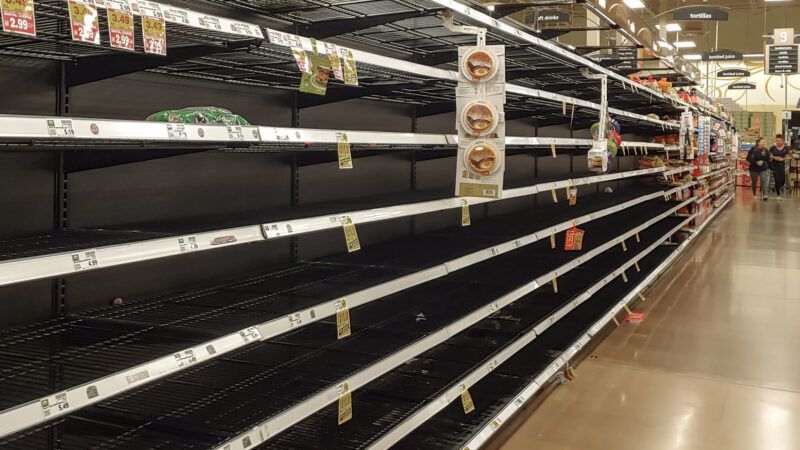
Tariffs make it more expensive to bring goods into the United States, and one of the primary consequences of artificially inflating the cost of imports is that you get less of them.
Possibly a lot less.
American retailers are bracing for supply chain disruptions that could lead to price hikes and shortages as soon as next month—and might continue for a while, even if the Trump administration backs down from its trade war with China.
Cargo volumes to American ports are expected to "significantly decline because of canceled or delayed orders due to the tariffs," says Jonathan Gold, vice president of supply chain and customs policy for the National Retail Federation (NRF).
That's particularly true for any business that depends on imports from China. Although the administration has issued exemptions for several items—consumer electronics, computer chips, pharmaceuticals—other Chinese imports are now subject to tariffs as high as 145 percent. In other words: For every $100 of clothes, toys, luggage, sporting goods, or household items that arrive on a container ship, an American company must pay $145 to bring those goods into the country.
When the imports continue, those costs will be passed along to the consumer. But in many cases, the imports might not happen at all, because the tariffs are simply too high.
"While the impacts of lower import levels on retailers and consumers are currently unknown, it will ultimately depend on individual retailers and their specific mitigation strategies," says Gold. "Potential impacts could include less inventory and fewer choices for consumers as well as increased prices, especially at small retailers."
The telltale sign of those coming disruptions is the sharp decline in ocean freight heading for the United States. The Port of Los Angeles, for example, currently expects to receive just 14 foreign vessels in the week of May 4 through May 10. That would be a 36 percent drop from last year. A bigger drop looms: Ocean freight bookings from China to the U.S. are down 60 percent since the tariffs took effect, according to Flexport, a global logistics firm.
Why is that dropoff happening now, when the tariffs have been in place since President Donald Trump's "Liberation Day" announcement on April 2? Because of shipping times from China. It takes about 30 days for a container ship from China to reach the West Coast, and the higher tariffs imposed by Trump did not apply to ships that departed China by April 9. Those ships will continue arriving on the West Coast through early May.
"That means that there are no economic effects of what was done on April 10th until about May 10th," wrote Molson Hart—founder and CEO of Viahart, a toy company that imports products from China—in a post on X. He also points out that a sharp drop in freight shipping will have consequences beyond supply chain disruptions: "Warehouses will start doing layoffs because no labor is needed to unload containers and some products will be out of stock, reducing the need for shipping labor."
It takes longer for ships from China to reach other ports—45 days to Houston, nearly two months to New York—which means longer lags before the impact of the tariffs is fully felt.
But it will be felt. The NRF estimates that overall imports to the U.S. will fall by 20 percent in the second half of this year if tariffs are maintained near current levels. Some big retailers, such as Target, have reportedly halted all orders from China.
In response to the huge new tariffs on goods from China, some American businesses might seek new suppliers in other countries. But those changes will take time to establish—and Trump's so-called "reciprocal tariffs" have injected a lot of uncertainty into the economy, even though they have been paused for 90 days. It doesn't make much sense for an American business to reconfigure its supply chains when the tariff playing field might shift again by mid-summer.
"Global supply chains can't change on a dime, or even with a 90-day 'pause,'" says Dan Anthony, president of the Trade Partnership. "Significant price hikes to cover tariff costs, or shortages for certain goods because no other suppliers can fill the gaps quickly, seem likely if the tariffs remain in place."
Once they hit, those problems will continue for a while. That's because of the same lag effect that slowed the impact of the tariffs. As Hart's post explains, even if the Trump administration lifts tariffs as soon as supply chain issues and shortages become impossible to ignore, there will be an inevitable delay as orders must be made, ships loaded, and the month-long journey taken across the Pacific.
"Starting in a couple of weeks, we are just going to start running out of stuff," Sean Stein, president of the U.S.-China Business Council, told NBC, "and if the administration waits to resolve the problem until we have shortages and hoarding, that is just too late."
The Trump administration last week signaled a willingness to reduce some tariffs on imports from China, claiming that negotiations with the Chinese government were underway. China has denied that claim. Also last week, White House press secretary Karoline Leavitt said there would be no unilateral lowering of tariffs by the United States.
Every day and each mixed signal from the Trump administration pushes the economy into a longer period of disruption and uncertainty. Once the consequences fully arrive, consumers might recognize some similarities to the early days of the COVID-19 pandemic, when essential items suddenly became scarce.
"The whole situation is a bit like lockdowns," Hart wrote on X. "Once you shut down, it takes a long time to get economic activity back to where it was, if you ever can."




