Dobbs Recentered Women in the Abortion Debate
Two years after the Dobbs decision, Americans are increasingly concerned with how abortion bans affect women with wanted pregnancies.
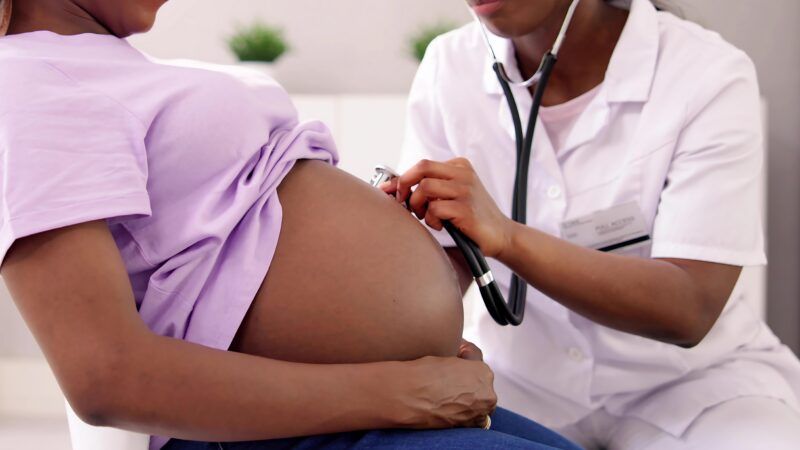
Today marks two years since the U.S. Supreme Court issued a decision in Dobbs v. Jackson Women's Health Organization, overturning Roe v. Wade and the legal standards that had governed American abortions for decades. A lot can be said about the impacts of this decision, from direct changes to state abortion laws to its effect on politics, failure to actually reduce the number of abortions, or opening up new avenues in the drug war. But today I want to focus on one change that is on some level obvious but often goes unremarked upon: the way Dobbs shifted the focus of the abortion debate back to women's lives, not just the lives of any potential offspring that they're carrying.
Two years after the Dobbs decision, Americans seem increasingly concerned with how abortion bans affect the physical health of women—including women with wanted pregnancies.
You are reading Sex & Tech, from Elizabeth Nolan Brown. Get more of Elizabeth's sex, tech, bodily autonomy, law, and online culture coverage.
Pre-Dobbs Discourse
For as long as I can remember, abortion discourse in the U.S. was focused on fetuses and zygotes. When did they attain personhood? When could they feel things? How early did their hearts beat? At what point were they viable outside the womb?
The most common slogans of the pro-life movement focused on the fetus, telling us that "abortion is murder" and "abortion stops a beating heart." To the extent that women factored into this debate on the pro-life side, it was generally as victims and dupes—tricked by evil "abortionists" and Planned Parenthood staffers into going against their own moral intuition or best interests. We saw a lot of focus on regulations like pre-abortion ultrasounds and waiting periods, pushed under the premise that women who got abortions didn't understand what they were doing, or hadn't taken the time to think it through.
On the pro-choice side (and, yes, I realize these binary labels are quite imperfect), we heard a lot about women's need for choices—to decide when and if they would become mothers, to control their own reproductive fate. We heard about the many substantial reasons why women choose abortion, and the need to destigmatize this choice.
The potential for risk to women's health and lives if abortion was illegal was certainly part of this discussion, but arguably not the central focus of discourse about why abortion should be legal. And when the focus was on danger to women's lives, it was more often framed as a matter of women put at risk by illegal abortion attempts.
Dobbs shifted all this.
Centering Risks to Pregnant Women
In a Dobbs world, the physical dangers of pregnancy and the need for abortion to counter these dangers have become perhaps the most central theme in advocacy against abortion bans.
We've been hearing more and more about women with serious and sometimes life-threatening pregnancy complications who have been denied abortions, forced to wait until their condition worsened before a doctor felt comfortable declaring an abortion OK, or required to go through a complicated court process in order to be granted permission to get an abortion.
Abortion as treatment for emergency complications during pregnancy is at the center of a Supreme Court case that should have a decision coming very soon.
Countless articles have detailed the way abortion bans have negatively impacted pregnancy care—sometimes bringing women "to the brink of death" (as one ABC News article put it)—and care for women who have miscarried.
I've recently been interviewing people who describe themselves as pro-life or personally opposed to abortion but against abortion bans. The things that come up again and again are the fears that these bans risk the health and lives of women for whom abortion is a medical necessity, and interfere with decisions that should be between women and their doctors. The people I've talked to (whose stories I'll tell in a future article) believe that work to decrease the number of elective abortions must come through means other than abortion bans, as the bans present too much risk to pregnant women—and sometimes very much wanted babies, too.
Even though bans tend to contain exceptions for emergency situations, hospitals and doctors can be anxious and overly cautious when interpreting what is and isn't an emergency, leaving pregnant women with complications in perilous situations.
A Paradigm Shifted
Reproductive freedom advocates have long warned that things like this would happen, but hypotheticals don't tend to make headlines or grip people's consciousness. The fact that there are now documented stories of things like this happening seems to have tipped the scales mightily.
A new CBS News poll found that the message that abortion bans put pregnancy care at risk is resonating with a majority of Americans. Some 67 percent said they are concerned that abortion bans will mean that pregnant women may be more at risk, and 61 percent were concerned that reproductive care may be more difficult to access.
Bans putting pregnant women at risk was a concern for 91 percent of Democrats, 65 percent of independents, and 41 percent of Republicans. Bans making reproductive care difficult to access was a concern for 88 percent of Democrats, 59 percent of independents, and 33 percent of Republicans.
Americans are faced with the reality of who will be punished or put in danger by abortion bans, and it's not just the worst caricatures of callous and irresponsible women. It's not even just those who choose an abortion under broadly sympathetic circumstances. It's anyone who becomes pregnant. It's women with wanted pregnancies. It's women already dealing with the grief of a miscarriage or a fetus with fatal problems. Those who have done everything normatively right and still wind up facing a choice between their own life and continuing a pregnancy that may not even be viable.
Circumstances like those don't account for anywhere near the majority of people seeking abortions, to be sure. But the last couple years have shown us that they're not incredibly rare, either. And the more Americans hear about women in these situations being forced to jump through hoops to get an abortion, or being brought to death's door before they're allowed care that could save their lives, the more the reality of what abortion bans actually mean sinks in—and it seems to be making people rethink what these bans actually mean.
More Sex & Tech News
• New legislation would repeal parts of the Comstock Act, a Victorian-era law that criminalizes mailing anything that could be used to induce an abortion or anything "obscene, lewd, lascivious, indecent, filthy or vile." But while the bill's text has not yet been released, its sponsors say it would only repeal the parts of the law that apply to abortion.
• To provide new AI-enabled services, companies like Apple, Microsoft, and Google "need more persistent, intimate access to our data than before," notes New York Times columnist Brian X. Chen. Will people feel comfortable handing that over?
• Engadget explores the people taking Meta to small claims court over the deletion of their Facebook and Instagram accounts.
Today's Image